

Sold as:

from £6.99
Sold as:
from £19.99
 5 Star Service Rating




 Secure, One-Tap Checkout
 5 Star Feefo Rating
 Hand Picked, Delivered to Your Door!
 1 Year Bareroot Guarantee
 Platinum Trusted Service Award 2026
 Mail Order Plant Experts - Est. 1949
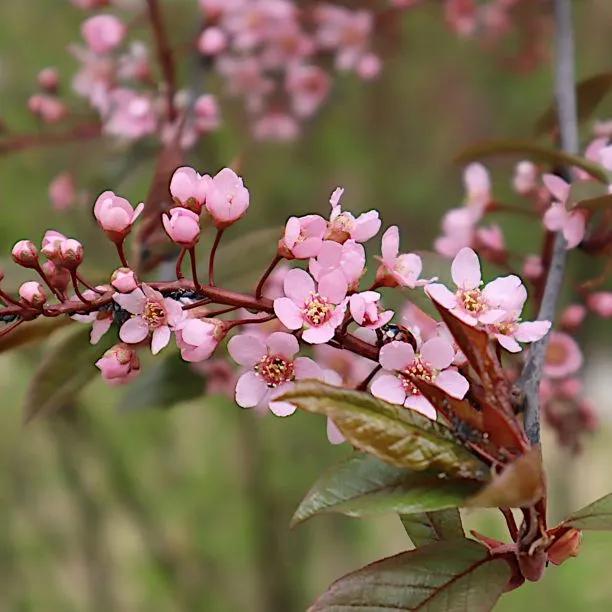




The Purple Leaf Bird Cherry is a pink flowering variety of the native Bird Cherry tree. It's a striking specimen, with excellent contrasts and changes of colour across the year.
The leaf buds and new stems begin as a deep purple, bronzing into a coppery tone as the leaves unfurl, becoming deep green in summer and then red in Autumn. The flowers appear in May, while the leaves are still fresh, on long flowering strands called racemes. Each delicate flower has pale pink petals around a rose-hip coloured centre. These face out in every direction from their central stalk, appearing all the more vivid because of the rich foliage. The small, bitter black fruit are popular with birds.
With its narrow, upright canopy it's suitable for most gardens, and reaches a height of about 10 metres.
Browse our variety of cherry blossom trees or our full range of garden trees.
Delivery season: Cherry blossom trees are delivered bareroot during late autumn and winter, approximately November-March inclusive.
Choosing a size: Small trees are cheaper, easier to handle and more forgiving of less than ideal aftercare, so they're best for a big planting project. If instant impact is your priority, or if you are only buying a few plants for use in a place where it's convenient to water them well in their first year, then you may as well use bigger ones. All our bareroot trees are measured by their height in centimetres above the ground (the roots aren't measured).
This is a tough, hardy tree that will grow in most well drained sites, and tolerates compacted urban soils and air pollution. It really needs close full sun to flower well; given that it's such an ornamental tree, it's not worth planting in partial shade in our opinion.
This unusual pink bird cherry was discovered by chance in Sweden in the 1950's and all existing trees are clones of the original, as it doesn't come true from seed. The RHS loves this tree and has given it 3 awards since 1974, two for its cuttings on display and the Award of Garden Merit for being easy to grow and good-looking.
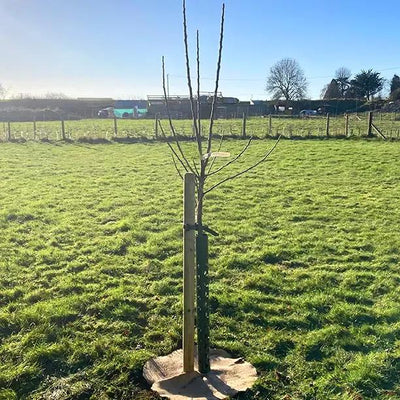
Standard trees are measured by their girth in centimetres 1 metre above ground level: their trunk's waist measurement. Unlike sapling trees and hedge plants, standards aren't measured by their height, which will vary quite a bit both between and within species.
So, a 6/8cm standard tree has a trunk with a circumference of 6-8cm and an 8/10 standard has a trunk 8-10cm around. This measurement makes no difference to the tree's final height.
On average, standard trees are 2-3.5 metres tall when they arrive, but we cannot tell you precisely how tall your trees will be before we deliver them.






 Sign In
 Saved items