Sold as:

from £6.99



Sold as:
from £19.99
 5 Star Service Rating




 Secure, One-Tap Checkout
 5 Star Feefo Rating
 Hand Picked, Delivered to Your Door!
 1 Year Bareroot Guarantee
 Platinum Trusted Service Award 2026
 Mail Order Plant Experts - Est. 1949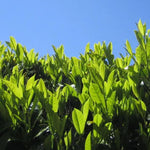
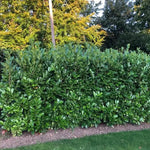





The common or cherry laurel is a vigorous garden superhero that relishes inhospitable conditions and will make a stunning, shiny green hedge all year round. Its seriously glossy, greeny-yellow leaves, which can be up to 15 cm long, are so verdant and lush that they look almost tropical. Naturally bushy, it blocks out light very well, and helps to dissipate strong, prevailing winds.
In summer, it's festooned with tall, white, flowers that are richly scented and pull in bees and butterflies.
Autumn brings large, shiny, black, inedible "cherries" that are hugely popular with birds.
It's almost infinitely forgiving of mistakes, so it's hard not to produce a good Laurel hedge!
View the rest of our laurel hedging or our range of hedging plants.
A similar but less vigorous option is Portuguese laurel, Prunus lusitanica. For restrained evergreen hedging with smaller, matt leaves, Privet hedging has the same propensity to thrive where no other plant dare go.
Delivery season: Bareroot plants are delivered during late autumn and winter, approximately November-April inclusive.
It'll grow in any soil apart from waterlogged. It's very shade tolerant, and is a go-to choice for shady sites with poor, dry soil.
It's low maintenance and can be hard pruned at anytime if necessary, although it'll bounce back better if you do this in winter.
Spacing a Cherry Laurel hedge: Like most formal hedging, plant at 3 per metre, 33cm apart in a single row.
Its vigour is second to none, its rounded, shiny leaves play with light to brighten a dark corner of the garden, and it can be shaped into individual balls or lollipops that look fantastic.
Plant a laurel hedge next to a low, stone wall, and you can 'extend' your wall by several metres by trimming the laurel flush to the wall's face. It'll provide a perfect screen to block the line of sight from nearby buildings, and is an ideal windbreak to provide shelter in a garden so that you can grow more tender ornamental trees and plants.
Lead and stone statuary or planters look especially good against its vibrant green and are indicative of how laurel can be used in a more formal setting where you use laurel to provide structure in the garden as opposed to the more commonly used but slower growing box or yew.
Another use is as ground cover for game and wildlife, although it's probably best not to grow it next to a field containing livestock because it's poisonous to them.
Some formative pruning will make it as dense as possible. Do not clip Laurel Hedging straight after planting, but wait until new leaves appear, showing that the roots have established.
A mature hedge is best pruned with secateurs and loppers when practical, which won't leave ragged foliage.
The best time to use a hedge trimmer is the middle of Spring, when the vigorous new growth will cover the ragged foliage.
Trim your hedge into a sort of "A" shape, with a flat top. A slight taper to a hedge - wider at the bottom than at the top - allows light and air to get to the lower branches, keeping them healthy and covered in leaf.
Hard Pruning Old Laurel: Laurel cut to the ground will grow back. Mid-winter is the best time for surgery.
What we refer to as cherry or common laurel is not a true laurel like the bay leaf laurel (Laurus nobilis): it belongs to the cherry family, the genus Prunus. It has a long tradition of use in gardens here since it was first introduced from the Ottoman Empire in the 1500s.
The long-lasting foliage is a standard element for floristry.
Before Laurel, the main evergreen broadleaf available in Britain was Holly (boxwood is too slow for tall barrier hedges around a garden), and it's mostly a case of "everything Holly can do, Laurel can do better".
Cherry laurel has heavier, bigger leaves than Holly that are better at excluding light and traffic noise. They also stop effectively weeds from getting started in their dense shade.
And it grows quickly to considerable heights, whereas Holly has medium-to-low vigour and so isn't ideal for really tall hedges.
There is a splendid laurel hedge outside Bristol providing shelter from the M5 that is around 20 feet, 7 metres, tall; you can't achieve that with Holly in a reasonable time frame.


 Sign In
 Saved items