Buying Elm Trees Online:
Order Potted Elm Trees Now For October Delivery
Pre-Order Bareroot Elm Trees For 2025/26 Winter Planting Season
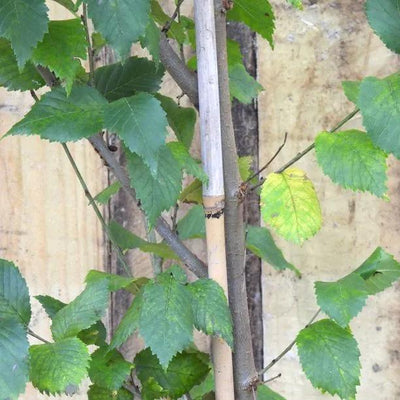
Native Elms, once a quintessential feature of the British landscape, have become quite rare in the UK since the arrival of Dutch Elm Disease in the 20th century, so Wych Elm (which is less attractive to the beetles that spread the disease) and the hybrid Wingham Elm are the best choices for recreating the Elm forests of the past.
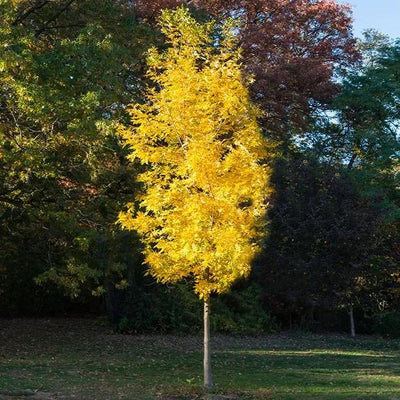
We also grow the Japanese Sapporo Autumn Gold Elm.
What size Elm trees should I buy?
- If you are not in a hurry to get a full sized Elm tree, we recommend starting with the smaller 6/8cm girth size.
- If you are in a hurry and need instant impact, then go for the 8/10cm girth size.
Standard trees are measured by their girth 1 metre above the ground, and young saplings are measured by height.
So, a 6/8cm Standard Elm tree is much bigger than an 60/80cm sapling Elm tree. If a tree is available in both sizes, it will be noted in the product description.
Browse our full range of garden trees.
- When your order is ready: your mail order trees are delivered by next working day courier (not the next working day after ordering!)
- Friendly support: if there is anything wrong with your plants when you inspect them, Contact Us within 5 working days
All bareroot plants are covered by our Refund Guarantee, so you can give them a whirl with complete confidence.
Elms are dear to the hearts of those of us well aged enough to remember them in their heyday, but back when they were everywhere, some people had a less rosy view of them: underneath an English Elm was a bad place to put your garden shed!
"Elm, she hates mankind, and waits till every gust be laid,
To drop a limb on the head of him that anyway trusts her shade"
~ Rudyard Kipling, Oak, Ash, and Thorn (Best sung by The Bromleys)
The Wych Elm, Ulmus glabra, is also susceptible but less appealing to the beetles, and geographic isolation protects many more of them; they are also a good hedge plant, which again keeps them safe.
The quest to breed a thoroughly Dutch Elm Disease resistant variety has been achieved, at least for now, in the form of the Wingham Elm, a complex hybrid of four species.
It may well be the closest we will ever get to resurrecting the Elm landscapes of the past, and caterpillars of the endangered, Elm specific White-letter Hairstreak butterfly seem perfectly at home eating it!
Before Wingham, the most widely available disease resistant variety was Sapporo Autumn Gold, a Japanese x Siberian Elm hybrid that doesn't really resemble our native Elms, but is a lovely tree in its own right and still appealing to butterflies hungry for Elm leaves to lay eggs on.
Does Elm Make Good Firewood?
According to the poem by Lady Celia Congreve "Elm wood burns like churchyard mould, E'en the very flames are cold."
But that is complete poetic licence - cold flames, honestly, Celia - elm wood burns well when it's dry.
Due to the high water content when it's alive, it's on the slow side to season: a good size Elm log probably needs to spend an extra year on the pile.
But as with any wood, you simply chop it smaller if you need it to dry faster.
Dutch Elm Disease
Prior to the 1970's*, huge English Elms, Ulmus procera, and Smooth Leaved Elms, U. minor, were common in the British landscape and frequently feature in old songs, stories, place names and paintings.
Nowadays, they are reduced to a few small, windy pockets where the beetles that carry Dutch Elm Disease cannot reach them, or maintained as low hedges that are less attractive to the beetles.
*The first wave of Dutch Elm Disease in the UK was in the 1920's, but was less devastating than the later wave that arrived in the late 1960's.


 Sign In
 Saved items


 5 Star Service Rating




 Secure, One-Tap Checkout
 5 Star Feefo Rating
 Hand Picked, Delivered to Your Door!
 1 Year Bareroot Guarantee
 Platinum Trusted Service Award 2026
 Mail Order Plant Experts - Est. 1949