


Sold as:

from £6.99

Sold as:
from £19.99
 5 Star Service Rating




 Secure, One-Tap Checkout
 5 Star Feefo Rating
 Hand Picked, Delivered to Your Door!
 1 Year Bareroot Guarantee
 Platinum Trusted Service Award 2026
 Mail Order Plant Experts - Est. 1949
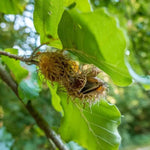

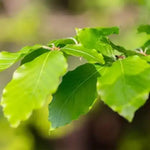






Common Green Beech is a large, semi-native tree that makes an excellent park or woodland specimen. If it's grown out in the open, it'll develop a broad, rounded canopy and the tree's trunk will usually divide into thick, smooth branches quite low down. In a forest, it'll maintain a single straight trunk and the canopy will be much narrower.
Beech is often called majestic and it well deserves the title. It's a big, spreading, muscular tree with well-formed branches and smooth grey bark that is rippled in places. Mature trees will cast quite dense shade underneath them during summer. The wind pollinated flowers aren't really visible, and are a good pollen source for bees. The nuts that ripen in autumn are eaten by pigs and many small animals, although horse owners shouldn't allow their horses to eat them. Beech looks beautiful in autumn, when the grey bark highlights the russet brown leaves.
Fagus sylvatica should reach a height of about 35 metres.
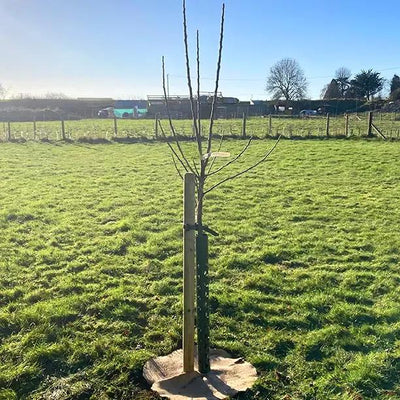
Standard trees are the largest size that we deliver; you can also buy younger Green Beech saplings here.
Browse our range of beech trees or all our garden trees.
It's suitable for any soil type as long as the drainage is good, and it tolerates some shade while young, as long as it can grow up into full sun. If your soil is damp or waterlogged in winter, Hornbeam looks similar and is a better choice.
In the past, beech trees were prized by pig farmers, who would fatten their herds up for winter on the fallen beech nuts, known as mast. Humans can also eat the nuts, although they are pretty bitter. The oil of mast can be used for frying and for lamp oil. Beech wood is great for burning and while the timber isn't tough enough for outdoor or structural uses, it makes good quality indoor furniture.
Beech is a European tree that is probably not a true native in Britain; modern evidence suggests that it was not growing here before the formation of the Channel, and Stone Age humans might have introduced it from the mainland. Whatever the case, it is widely naturalised in Southern Britain and over 80,000 hectares of woodland are classified as being predominantly made up of beech.
The Whomping Willow in the Harry Potter films was, with added computer graphics, based on a 400-year-old beech tree known as the Queen Beech in the woods of Frithsden Beeches, Hertfordshire. This striking old tree was coppiced for firewood centuries ago and for the last 200 years it has been left alone, so it has a massively thick trunk and an imperious head of branches, several of which are as big as a mature tree.
Beech trees were perhaps best employed by Capability Brown, who used their vast and elegant form to punctuate parkland and to form great silvery-grey columns when grown in more confined woods.
Standard trees are measured by their girth in centimetres 1 metre above ground level: their trunk's waist measurement. Unlike sapling trees and hedge plants, standards aren't measured by their height, which will vary quite a bit both between and within species.
So, a 6/8cm standard tree has a trunk with a circumference of 6-8cm and an 8/10 standard has a trunk 8-10cm around. This measurement makes no difference to the tree's final height.
On average, standard trees are 2-3.5 metres tall when they arrive, but we cannot tell you precisely how tall your trees will be before we deliver them.






 Sign In
 Saved items