

Sold as:

from £6.99

Sold as:
from £19.99
 5 Star Service Rating




 Secure, One-Tap Checkout
 5 Star Feefo Rating
 Hand Picked, Delivered to Your Door!
 1 Year Bareroot Guarantee
 Platinum Trusted Service Award 2026
 Mail Order Plant Experts - Est. 1949





Gleditsia triacanthos Sunburst is a Golden variety of Honey Locust, withglorious golden-yellow new leaf fronds, made up of fern-like rows of little leaflets that seem to sniff the breeze as they sway about. They mature to green, and go yellow again in Autumn. This cultivar is thornless, unlike the wild species. The tiny flowers aren't really visible, but they have a good sweet scent that carries well. In a hot, sunny summer, especially in the South and West, you should get some seeds, which are lovely long bean pods.
It's a great garden tree, with a canopy spread of only 4-5 metres and it'll grow well in the middle of a lawn with grass growing right up to its trunk. They reach a height of about 12 metres.
Browse our large garden trees, or all of our trees.
Delivery season: Honey Locust trees are delivered bareroot during late autumn and winter, approximately November-March inclusive.
Choosing a size: Small trees are cheaper, easier to handle and more forgiving of less than ideal aftercare, so they're best for a big planting project. If instant impact is your priority, or if you are only buying a few plants for use in a place where it's convenient to water them well in their first year, then you may as well use bigger ones. All our bareroot trees are measured by their height in centimetres above the ground (the roots aren't measured).
It's suitable for most gardens and will grow on pretty much any soil in a sunny place. Responds well to pruning.
Gleditsia are native to America and parts of Asia, and have been widely planted in Britain since the start of the 1700's. This Sunburst variety, also listed as "Inermis Aurea" was bred in the 1950's.
The pulp and seeds inside the ripe seed-pods are sweet and can be eaten, usually cooked.
It is in the pea family, so it is a cousin of Robinia, the Common or Black Locust. It's one of the nitrogen fixing trees used in "multicultural" orchards, where fruit species are planted in a repeating sequence along a row like Apple, Cherry, Pear, then a Nitrogen Fixer, which can be harvested for wood; cutting the tree releases nitrogen from the roots. This permaculture principle reduces the pressure from pests and diseases, which cannot swarm from similar tree to tree, and nourishes the terrain to an extent.
Standard trees are measured by their girth in centimetres 1 metre above ground level: their trunk's waist measurement. Unlike sapling trees and hedge plants, standards aren't measured by their height, which will vary quite a bit both between and within species.
So, a 6/8cm standard tree has a trunk with a circumference of 6-8cm and an 8/10 standard has a trunk 8-10cm around. This measurement makes no difference to the tree's final height.
On average, standard trees are 2-3.5 metres tall when they arrive, but we cannot tell you precisely how tall your trees will be before we deliver them.
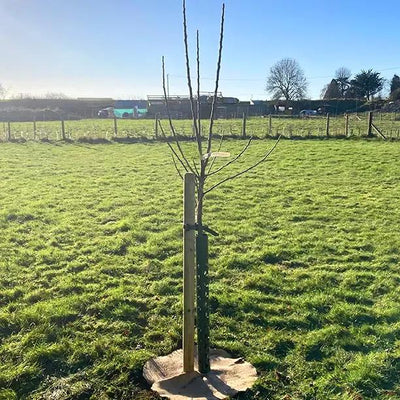
This tree transplants badly when it gets large, so these plants are slightly too small to be graded as standardss and are delivered when they are about 2m tall.






 Sign In
 Saved items