Home > Hedging Plants > Native Hedging > Hornbeam - Carpinus betulus

Hornbeam Hedging / Sapling Trees | Carpinus betulus

Key Data

Autumn Colour Best Plants for Hedges Hornbeam Hedging & Trees Native Hedging Screening

Hedging Native Acidic Soil Chalky Soil

Wet Soil Exposed Windy Areas Full Shade Partial Shade

Wildlife Value


3 Quantity
Unit Price £0.00
TOTAL £0.00 inc. £0.00 VAT
You get a 5% discount on catalogue prices when you checkout.
Our minimum order value is £25.


Availability

  jan feb mar apr may jun jul aug sep oct nov dec
Bareroot                        
Potted                        

Bareroot and potted - what' s the difference?

We deliver on a weekly basis, you can specify delivery dates after adding the item to your basket.

Most deliveries are charged at £9.49+VAT with a few exceptions

DescriptionPlanting InstructionsAfter CareDelivery & GuaranteeReviews(3)

Hornbeam Hedge Plants - Delivered by Mail Order from the Nursery with a 1 Year Guarantee

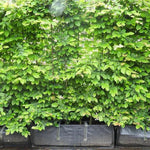
Hornbeam, Carpinus betulus, is a medium-large sized native tree that is a classic choice for a non-evergreen formal hedge. It is very hardy and tolerates damp, shady conditions. Hornbeam will grow in both chalky and acidic soils, but we don't recommend it for poor, dry soil.
Like beech hedging, a Hornbeam hedge will hold onto its autumn leaves for part of the winter.
Hornbeam is good for tall hedges: it will reach 20 metres if it grows freely as a tree.
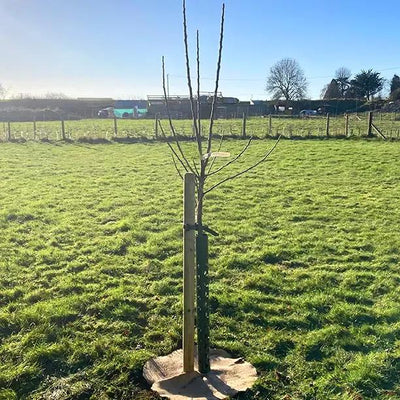
The plants on this page are young saplings. You can also buy larger Hornbeam trees and Fastigiate Hornbeam.

Hornbeam hedge plants are delivered bareroot during winter (Nov-March) and pot-grown year round. Pot-grown Hornbeam saplings are more expensive.

Choosing a size: When you are ordering Hornbeam plants for a hedge, we suggest that you buy smaller plants if you are not in a rush. They are cheaper and easier to handle than large plants. They will also give you a bushy hedge with little effort. All our hedge plants are measured by their height in centimetres above the ground (the roots aren't measured).
If you are ordering the larger sizes of bareroot Hornbeam, you could save money when you buy it in packs of 50 plants.

Spacing a Hornbeam hedge:
Plant Hornbeam hedging at 3 plants per metre, 33cms apart.
You can also plant Hornbeam at 5 plants per metre in a staggered double row, with 33 cms between each plant and 40cms between the rows.

General description of Hornbeam plants:
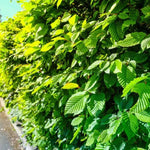
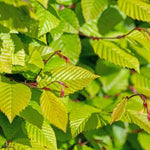
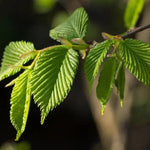
The glossy green, slightly crinkled leaves turn golden yellow in autumn and then brown in winter.
When it is grown as a normal tree, Hornbeam makes a beautiful parkland specimen, with a rounded, spreading canopy that casts deep shade underneath it. It is a very popular tree for pleaching on wires into a flat screen and for pollarding.

History & uses of Carpinus betulus
Hornbeam was extensively grown as a coppice tree and numerous old plantations are still in use today. The hard, dense wood burns very nicely and it is good for making heavy duty items like floorboards and the handles of tools.

Hornbeam VS Beech:
Grown as a hedge, Beech and Hornbeam look very similar, but beech is considered to be the better choice because it holds onto its autumn leaves for longer during winter. However, Hornbeam is a much tougher plant than Beech. If your site is damp, shady or in an exposed Northern location, hornbeam is the best choice; it is also a bit cheaper.