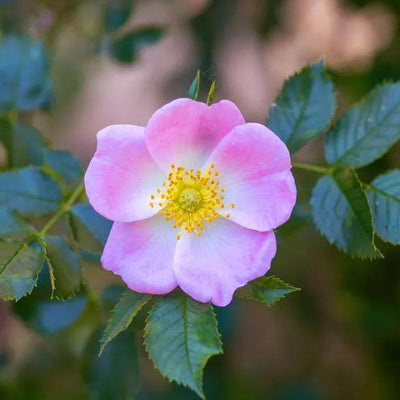
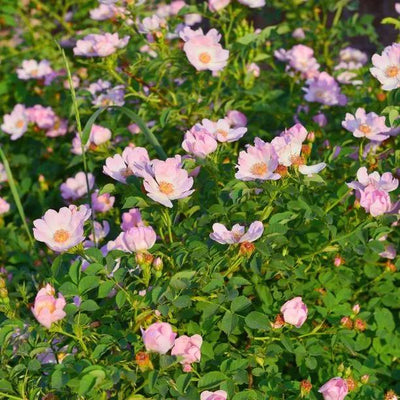
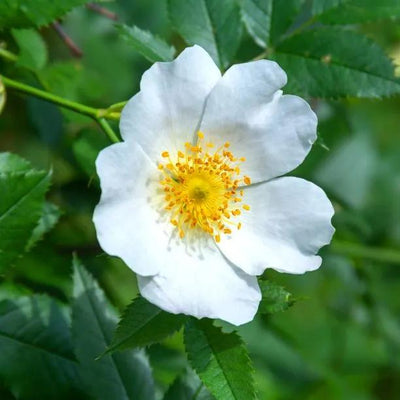
Pre-Order Bareroot Wild Roses For 2025/26 Winter Planting Season
Wild roses are enormously tough, thorny and disease resistant, excellent in mixed hedges or as wildlife friendly shrubs, popular with small nesting birds.
They are ideal for planting in areas where they will get little attention after they establish in their first year. They will all grow in damp, shady places and dry, exposed sites with poor soil.
Rugosa varieties* are the best for dry soil in shade, useful for protecting a gloomy edge of a sandy garden from people and animals; we recommend Roseraie de l'Hay for its superior ornamental value.
To give a rose hedge a better upright structure, interplant it with Hawthorn.
Browse our other rose varieties.
- When your order is ready: your mail order rose bushes are delivered by next working day courier (not the next working day after ordering!)
- Friendly support: if there is anything wrong with your plants when you inspect them, Contact Us within 5 working days
All bareroot plants are covered by our Refund Guarantee, so you can give them a whirl with complete confidence.
*Rugosa roses are not native and are a Schedule 9 plant: only for garden use. It's illegal to plant them out in the wild, like a country hedge, or cause them to grow in the wild by planting them along a boundary onto land where they can easily spread. This is not a concern in urban areas, nor in most suburbs.
Can Roses Make a Hedge?
Yes, wild roses are very suitable for secure hedging (they are an essential component in our native hedge mix), but to maintain a really neat shape they need plants like Hawthorn, Hazel, or Blackthorn to add rigidity that supports the roses' sprawling nature.
Although not native, the Ramanas roses (white and red) with their upright habit are great for hedges, and Roseraie De L'Hay is especially beautiful.
They can be clipped like any ordinary hedge, and it's wise to wear a helmet with face protection when cutting mature, overgrown ones that are as tall as you!
For ornamental garden rose hedges, you can use most tall shrub roses and larger varieties of hybrid tea - the thorny ones will be reasonably secure as well.
Some of the best garden roses for hedges are Rosa de Resht, Buff Beauty, Felicia, and Ferdinand Pichard.
Where Can I Grow a Rose Hedge?
Wild Rose Hedges
You can grow a wild rose hedge anywhere with at least some sun: they are as hardy and undemanding as the other plants in our native hedge collection.
Garden Rose Hedges
A garden rose hedge typically needs full sun, as the plants are jammed in close together, and good garden soil (or heavy clay) to support them.
How can you encourage roses to grow into a hedge?
To encourage roses into a compact hedge shape, they should be paired with sturdier plants. Rigid hedge options like hawthorn and hazel make perfect companions for rose hedges. Our native hedge mix is an excellent option for a fast growing, full sun loving natural hedge.
What is the best way to prune hedge roses?
You can prune roses in a hedge along with the rest of the mix with the standard hand shears or electric trimmer. Take some off the top once per year, and trim the sides at least twice per year, in spring and autumn. Some extra caution might be necessary once your roses grow up near eye level. Thorns can go flying out of an automatic hedge trimmer, so your sturdy gloves might need to be paired with eye protection and long sleeves.
What planting conditions are best for roses?
After your wild roses establish themselves in the first year, they don’t really need much attention. They will do best in a spot where you won’t be tempted to give them too much extra care – they are happiest when left alone. Local wildlife will also adore you for providing a safe haven for nesting birds and small creatures hiding under the thorny branches. Rose hedges across the UK thrive in a variety of conditions. If you have a particularly dry and shady spot, the rosa rugosa varieties will be right at home in conditions that other plants might not thrive in.


 Sign In
 Saved items


 5 Star Service Rating




 Secure, One-Tap Checkout
 5 Star Feefo Rating
 Hand Picked, Delivered to Your Door!
 1 Year Bareroot Guarantee
 Platinum Trusted Service Award 2026
 Mail Order Plant Experts - Est. 1949