

Sold as:

from £6.99

Sold as:
from £19.99
 5 Star Service Rating




 Secure, One-Tap Checkout
 5 Star Feefo Rating
 Hand Picked, Delivered to Your Door!
 1 Year Bareroot Guarantee
 Platinum Trusted Service Award 2026
 Mail Order Plant Experts - Est. 1949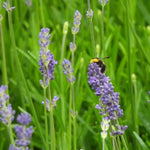
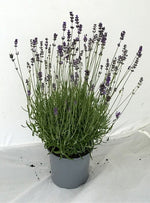
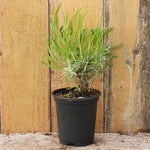



Munstead is the plant that most English lavenders ought to be. Of course, Hidcote gets the headlines — deeper colour, bigger flower spikes, the one everyone asks for by name — but Munstead quietly gets on with being a better-behaved plant. It flowers about two weeks earlier, holds a neater, more mounded shape with less of a tendency to splay open after a few seasons, and it has the sweeter scent that makes it a better choice for cooking and for cutting for the house and lavender bags. The flowers are a soft lavender-blue rather than Hidcote's more intense purple, and they sit above the grey-green foliage in dense little spikes that hum with bees from the moment they open until late summer.
This is also one of the hardiest lavenders you can plant in the UK, perfectly comfortable outdoors all year round in any part of the country. By the way, in our experience, Hidcote is just as tough. Munstead makes a superb low hedge at around 45cm, compact enough to line a path without swallowing it, and it clips into a tight, rounded mound that looks good even in winter. If you only have room for one lavender — in a pot on the terrace, in a gap at the front of a border, along the edge of a raised bed — then Munstead is probably the one to choose.
Munstead Wood, near Godalming in Surrey, was the garden that Gertrude Jekyll created over a period of fifty years from the 1880s onwards — the place where she experimented with the colours, forms and planting combinations that changed the way the English gardens looked. She was an artist first and a gardener second, trained at the Royal College of Art, and she designed over 400 gardens, many in collaboration with the architect Edwin Lutyens. She ran a nursery from Munstead Wood, selling what her catalogue called "Sweet Herbs and Old Plants of English Gardens" — lavender being prominent among them. The variety that bears the garden's name was introduced by the nursery firm Barr in 1916, and it is thought to be one of Jekyll's own selections. The National Trust bought Munstead Wood in 2023, and - at the time of writing - the garden is being carefully restored.
Dr Jekyll in Stevenson's Strange Case, incidentally, was named after Gertrude Jekyll's brother. The family pronounced it "Jee-kull."
Munstead's soft blue pairs naturally with other plants that like the same conditions: poor soil, full sun, good drainage. Rosea (pale pink English lavender) planted alternately along a path gives you a classic colour combination without any mismatch in habit or timing. For a mixed lavender hedge with real contrast, use Hidcote — the deep purple against Munstead's paler blue is striking when they flower together. Beyond lavender, it sits well with santolina, catmint, rosemary, thyme and hardy geraniums. For a contemporary gravel garden, try it with Edelweiss white lavender and Stipa tenuissima — all the movement and none of the watering.
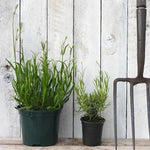
Your lavender plants are grown here in the UK. We only dispatch when conditions are right for planting, and you will have them delivered by next-day courier. Every plant comes with our guarantee and human support from the team in Somerset if you need advice. Browse our full English lavender range or see all our lavender plants. Oh yes, and we are a Which? Best Buy...
Both are English lavenders (Lavandula angustifolia) and both have the RHS AGM, but Munstead is more compact, flowers about two weeks earlier, and has a softer, more rounded habit. Its flowers are paler — lavender-blue rather than deep purple. The scent is slightly sweeter, which is why it is generally preferred for cooking. Hidcote has the stronger colour contrast and the bigger flower spikes. Both make excellent hedges. If you can't decide, plant both — Munstead at the front, Hidcote behind.
Certainly. It's one of the best lavenders for containers. The compact, mounded habit is perfect for pots. Use one that is at least 30cm across with drainage holes. Full advice in our lavender growing guide.
Three plants per metre (33cm apart) for a proper, solid hedge. At that spacing, they will join up by the end of the first summer if you plant 2L pots, or by the second summer with P9s. For a looser row of individual mounds that touch when in flower, 40–45cm works well. Always plant into warm soil. May is ideal for most of the UK.
The best. English lavenders have a sweeter, less camphorous scent than Dutch or French types, and Munstead is the variety most often recommended for culinary use. Pick the flowers just as they start to open — that's when the essential oil is strongest. Use sparingly in shortbread, scones, sugar, honey and ice cream. A little goes a long way: one level teaspoon of fresh flowers is usually enough for an Aga sized (quite large) tray of biscuits.
Give it a light trim in early spring (late February to March) — just a shave, not a hard cut. Then, prune properly after flowering in late August or September. More detail in our lavender pruning guide.


 Sign In
 Saved items