

Sold as:

from £6.99

Sold as:
from £19.99
 5 Star Service Rating




 Secure, One-Tap Checkout
 5 Star Feefo Rating
 Hand Picked, Delivered to Your Door!
 1 Year Bareroot Guarantee
 Platinum Trusted Service Award 2026
 Mail Order Plant Experts - Est. 1949




The White Poplar tree, is the only poplar we grow that will do well on chalky soil. Its great feature is its two-tone leaves, which are glossy green on top and felted with fuzzy white 'hairs' on the underside. When the wind is rippling through them, they remind one of a shoal of fish, catching the sun and going dark as they turn one way and the next.
The mostly white bark is easy to identify, with its darker diamond shaped markings, although the old trees lose the white layer and become deeply ridged, providing shelter for various insects. Older trees sucker freely, making even more homes for small animals.
Male trees have red catkins, and females have pale green catkins.
This isn't a tree for a small garden: it's medium-sized, but its roots are real bullies and will make life hard for plants near them. It's a fantastic shelter belt tree.
They reach a height of about 20 metres in the UK; in warmer countries, some trees are closer to 40 metres.
Browse our large garden trees, or all of our trees.
Delivery season: Poplar trees are delivered bareroot during late autumn and winter, approximately November-March inclusive.
Choosing a size: Small trees are cheaper, easier to handle and more forgiving of less than ideal aftercare, so they're best for a big planting project. If instant impact is your priority, or if you are only buying a few plants for use in a place where it's convenient to water them well in their first year, then you may as well use bigger ones. All our bareroot trees are measured by their height in centimetres above the ground (the roots aren't measured).
Hardy, wind resistant, and suitable for the coast, the only thing it needs is plenty of sun. It loves a moist to wet soil beside water, but it'll grow almost anywhere.
If you prune your trees, they'll respond by suckering
Please note: The roots attack old drains and foundations (new build concrete is in no danger), so we advise a safe planting distance of 20 metres from vulnerable structures.
Naturalised across Britain for centuries, though its true native range is from warmer parts of Europe to Central Asia. They were created by Hades from the remains of the nymph Leuce.
Other common names: Abbey, abele, Dutch beech, white asp / aspen.
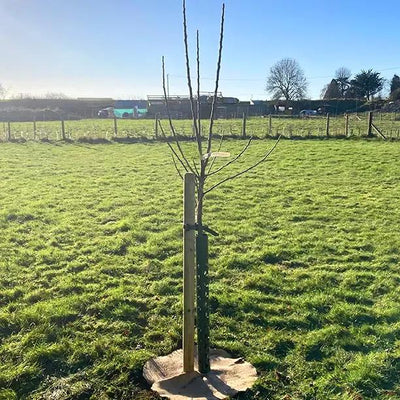
Standard trees are measured by their girth in centimetres 1 metre above ground level: their trunk's waist measurement. Unlike sapling trees and hedge plants, standards aren't measured by their height, which will vary quite a bit both between and within species.
So, a 6/8cm standard tree has a trunk with a circumference of 6-8cm and an 8/10 standard has a trunk 8-10cm around. This measurement makes no difference to the tree's final height.
On average, standard trees are 2-3.5 metres tall when they arrive, but we cannot tell you precisely how tall your trees will be before we deliver them.






 Sign In
 Saved items