


Sold as:

from £6.99

Sold as:
from £19.99
 5 Star Service Rating




 Secure, One-Tap Checkout
 5 Star Feefo Rating
 Hand Picked, Delivered to Your Door!
 1 Year Bareroot Guarantee
 Platinum Trusted Service Award 2026
 Mail Order Plant Experts - Est. 1949








The common Whitebeam, Sorbus aria, is a fairly compact, native tree that keeps a nice rounded, upright shape without any attention, spreading a little (as we all do) when they get older. In early spring the new leaves that burst from the buds have a fuzzy white tomentose covering, giving the tree the appearance of being in flower from a distance. These fine hairs remain on the bottom surface of the leaves, hence the name and this is a characteristic of the Whitebeam varieties in our range. The foliage is well structured and quite rigid, pointing upwards slightly to expose their undersides, creating a shifting silver lining as the leaves flutter in the breeze - "the sudden-lighted whitebeam", as the poet George Meredith described it.
Then flat, circular clusters of creamy white flowers appear in late spring maturing by the end of summer into glossy green berries. These flush red in September and attract a variety of garden birds. When the leaves are still green, the berries look very decorative against them and make a good addition to a flower arrangement.In autumn the foliage colours nicely and the berries provide continuing interest. Rounded off with grey, fissured bark with a reddish tinge on new growth Whitebeam is one the best all-rounders in the UK. In the wild, it's usually found on chalky sites where it's very drought resistant.
Browse our variety of large trees or our full range of trees.
Any site with drainage will do, but like all members of the Sorbus family, Common Whitebeam is happiest on chalky or other alkaline ground. They're fully hardy, happy on the coast and exposed windy sites - all round a very useful tree. Like most trees, it does establish faster on fertile soil, so it's always a good idea to mix in plenty of well-rotted manure and or compost when planting. A mature Whitebeam tree will reach about 15 metres, 50 feet and grows pretty fast, reaching its full height in 30-40 years.
In the past, hungry country folk would blet and eat the fruit, but we can't recommend it: Sobus torminalis, on the other hand, is one of our most interesting native fruit. A much more useful trait of the Whitebeam tree is its extremely hard wood, which was once the timber of choice for machines like watermills.
How Standard Trees are Measured:
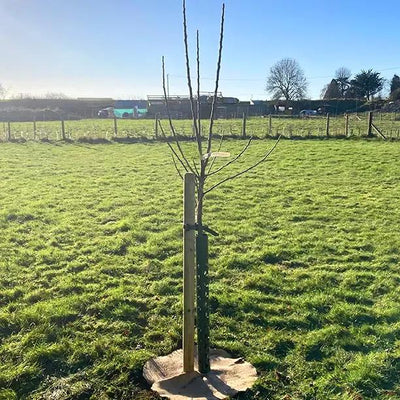
All the plants in the ornamental trees section are graded as standardss, which means that they're measured by their girth in centimetres 1 metre above ground level (basically, their trunk's waist measurement). They aren't measured by their height, which will vary. So, a 6/8 standard has a trunk with a circumference of 6-8 centimetres and an 8/10 standard has a trunk 8-10 centimetres around. This measurement makes no difference to the tree's final height. Most standards are between 2 - 3.5 metres tall, but this is just an average - all trees are different... These are the biggest size that you can order: but for mass plantings, you can also buy smaller, sapling Whitebeam trees.






 Sign In
 Saved items