
Contents
This post concentrates on fruiting plants, but the same principles apply to an ornamental “wall shrub”.
How to start training fruit trees on wires
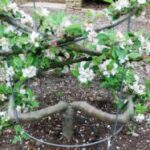
These instructions apply to fixing wires to existing fences or walls for training maiden fruit trees into cordon, espalier, fan, and sometimes “step-over” shapes.
Some nurseries sell some of those shapes in a starter form, lashed to a bamboo frame, for reasonables.
At Ashridge we stick to the core forms: Maidens you can train into anything, and starter Bushes and Half-Standards.
When building rows of posts, ideally run them North-South, so that the “sides” face East-West, getting sun on both sides throughout the day.
What are cordons, espaliers, and fans used for?
-
Cordons and espaliers are best for spur-fruiting apples & pears; that’s most varieties.
- Cordons give great value and flexibility to home fruit growers; espaliers are like a storeyed tier of cordons, therefore good for favourite varieties,
- Both forms are great subjects for grafting.
- Both forms are better for a long-lasting framework of branches.
- Fans are best for all stone fruit, so cherries, plums, etc, for figs, and for relatively uncommon tip-bearing apples & pears. Fans are better for removing whole stems at the base.
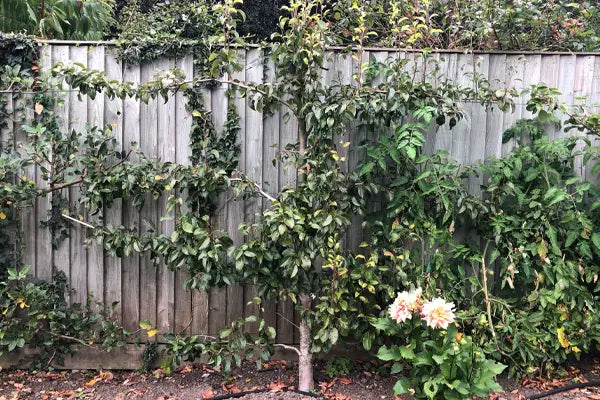
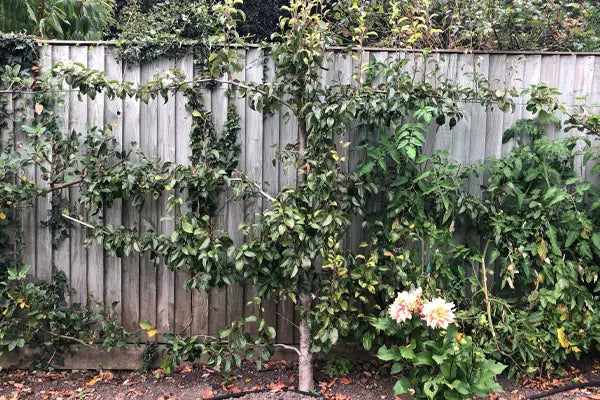
Wire-Trained Fruit Trees Against Wall or Fence
| Facing Direction of wall or fence | Characteristics | Suitable Plants |
|---|---|---|
| South Facing | Sunniest. Gets dry in summer, so mulching & watering are important. | All. Heat loving plants like Figs & Kiwis require South facing walls. |
| West Facing | Afternoon Sun. Good rainfall. | Cherries, Pears, Plums, Damsons, Gages, Apples, All Berry Bushes |
| East Facing | Morning Sun. Less rainfall & colder than West facing. | Cherries, Early Pears, Plums, Damsons, Gages, Apples, All Berry Bushes |
| North Facing | Least Sun – only certain plants will be able to make a decent crop. | Morello Cherries, Damsons, Early & Cooking Apples, Cordon Currants, Gooseberries, Blackberries |
You will need 14 or 16 gauge galvanised fencing wire.
14 gauge wire is necessary for rows of cordons and espaliers, the thinner 16 gauge wire is fine for fan-trained trees and soft fruit.
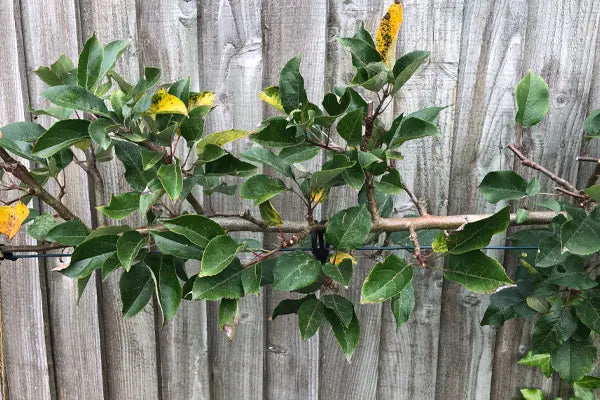
The wire needs to be held away from the wall or fence, standing out by about 2-4 inches / 5-10cm.
You could use wooden battens, or angled metal angle brackets.
Wires Spacings for Different Fruit Tree Types
| Fruit Tree Shape Pruned As: | Wire Spacing |
|---|---|
| Diagonal Cordons | Every 2 feet / 60cm |
| Fan Trained Trees | Every 6 inches / 15cm. Start at 15 inches / 40cm above the ground. |
| Espaliers | Every 15-18 inches / 40-45cm. Start at 15 inches / 40cm above the ground. |
To make the wires nice and tight, you will need to use straining bolts at one end: you can fix the wire to these and then tighten them to make the wire taut.
Ask your local DIY shop for advice; wires to support a large climbing plant are suitable for a fruit tree branch laden with fruit:
Putting Up Wires When You Have The Right Straining Bolts
Putting Up Wires Only Two Old Nails and Any Nut


Leave a Reply