

Sold as:

from £6.99

Sold as:
from £19.99
 5 Star Service Rating




 Secure, One-Tap Checkout
 5 Star Feefo Rating
 Hand Picked, Delivered to Your Door!
 1 Year Bareroot Guarantee
 Platinum Trusted Service Award 2026
 Mail Order Plant Experts - Est. 1949





Quercus robur is a large, slow growing native tree with a stout trunk and a round, fairly low canopy when it's grown in the open. Native Oaks are probably the single best tree for supporting wildlife. Their leaves are eaten by more types of caterpillar than any other British tree, and the deeply ridged bark of the old trees is an excellent home for many other insects. The acorns are a rich source of energy for larger animals that are trying to fatten up during autumn.
Oak leaves are distinctive, with irregular, wavy lobes. They turn brown and muddy yellow in autumn, which makes a good backdrop for other trees with more vivid autumn colour. The short strings of flowers are inconspicuous, appearing at the same time as the new leaf shoots. The flowers develop into green acorns that take over a year to mature and turn brown, usually leaving behind the little "cup" that attached them to the tree when they fall.
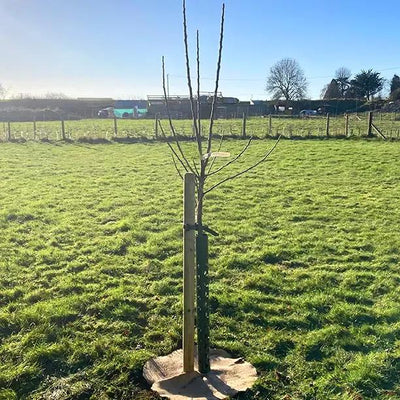
English Oak isn't suitable for a clipped hedge. The plants on this page are young saplings. You can also buy larger English Oak trees along with our other varieties of Oak here.
This Oak's native range is on moist clay soils; it doesn't tolerate strongly acidic or alkaline sites with shallow chalk.
English Oak plants are only delivered bareroot, during winter (Nov-Apr.).
Choosing a size: When you are ordering a large quantity of English Oak for a big planting project, we suggest that you buy smaller plants. They're cheaper than large trees, easier to handle and more likely to cope well with poor conditions. All our young trees and shrubs are measured by their height in centimetres above the ground (the roots aren't measured).
Their familiar looking leaves are used as the National Trust's logo. A durable hardwood tree, Oak was one of the most important timber trees before tropical hardwoods became widely available in Europe. The quality of oak's timber is determined very much by the soil it grows on. Oak trees that grow on poor, acidic soil with high sand or gravel content tend to have the worst timber, developing internal cracks known as shakes. It's thought that the oldest Oak trees in Britain (some are about 1,000 years old) are found on poor soil because they weren't worth cutting down for their wood. Quercus was the Roman word for Oak and robur means hard and strong, as in robust.
Botanical names: Quercus robur, Quercus pedunculata
Common Names: British Oak, English Oak, Common Oak, Pedunculate Oak




 Sign In
 Saved items