



Sold as:

from £10.95

Sold as:
from £19.99
 5 Star Service Rating




 Secure, One-Tap Checkout
 5 Star Feefo Rating
 Hand Picked, Delivered to Your Door!1 Year Bareroot Guarantee
 Platinum Trusted Service Award 2026
 Mail Order Plant Experts - Est. 1949
 1 Year Bulb Guarantee
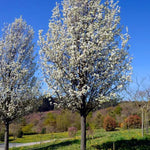
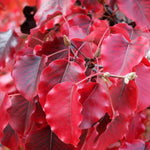




The Callery Pear 'Chanticleer' is a narrowly conical ornamental tree with white spring blossom and glossy leaves that come early and colour red late in autumn. It grows in any fertile soil in full sun and reaches 10 to 12 metres tall.
Pyrus calleryana Chanticleer, the Callery Pear, is an ornamental, flowering specimen with a long season of interest and leaf cover. The glossy, bright green foliage appears very early in the season (often the first) and still looks fresh in autumn. When the leaves finally turn, their autumn colouring is magnificent: a purple-red that can shift to crimson or orange-yellow, depending on the soil, lasting into December in most years. All of which makes it an outstanding subject to use for screening, avenue and roadside planting or as a structural statement.
It's covered in clusters of creamy white blossom in early spring that are a good source of nectar for bees when it's in short supply. The fruit's inedible, inconspicuous and is usually eaten by wildlife.
They grow vigorously and reach 10 to 12 metres.
You can buy eating pear trees, as well as weeping ornamental pears.
Browse our full range of trees.
Delivery season: Pear trees are delivered bareroot from late autumn to early spring, November to April.
Choosing a size: Small trees are cheaper, easier to handle and more forgiving of less than ideal aftercare, so they're best for a big planting project. If instant impact is your priority, or if you are only buying a few plants for use in a place where it's convenient to water them well in their first year, then you may as well use bigger ones. All our bareroot trees are measured by their height in centimetres above the ground (the roots aren't measured).
They'll look best in full sun, partial shade is fine for their Autumn colour as long as they get all the midday sun. They aren't fussy about soil, mildly acidic to chalk is fine, and like heavy clay on well drained areas. They won't be happy right on the coast in sand, but tolerate salty winds well.
If there is heavy snow, gently brush it off with an upwards motion to keep the branches safe from breaking.
It was bred in 1956 in the USA by Edward Scanlon, who used parent trees that were brought from China in the early 1900s by the famous collector Ernest Wilson. The wild tree was first described in 1872 by a French missionary to China, Joseph Callery.
Chanticleer is the name of a cockerel who appears in several medieval stories, including The Nun's Priest's Tale in The Canterbury Tales. It means "sing clearly" in old-ish French.
This tree has a lot of critics in hot areas of America, where the climate reduces its attractive shelf life, causing it to start cracking apart after around thirty-forty years. This is not an issue anywhere in the UK.
It was awarded an RHS Award of Garden Merit in 2002, but lost it in a later review, probably in favour of newer cultivars.
Standard trees are measured by their girth in centimetres 1 metre above ground level: their trunk's waist measurement. Unlike sapling trees and hedge plants, standards aren't measured by their height, which will vary quite a bit both between and within species.
So, a 6/8cm standard tree has a trunk with a circumference of 6-8cm and an 8/10 standard has a trunk 8-10cm around. This measurement makes no difference to the tree's final height.
On average, standard trees are 2-3.5 metres tall when they arrive, but we cannot tell you precisely how tall your trees will be before we deliver them.
Chanticleer is one of three narrow trees that suit a boundary or an avenue. Greenspire Lime is the other narrowly conical street tree, taller in the end and scented in midsummer. The Flagpole Cherry is narrower still and stops at 6 to 8 metres. More ideas are under trees for screening. Dust the roots with Rootgrow as you plant.
Ashridge has sold trees since 1949 and is a Which? Best Plant Supplier 2025. Your Callery Pear comes bareroot, lifted while dormant, or pot-grown for planting in summer. Bareroot trees are guaranteed for 12 months, and so is a potted tree delivered leafless between November and March.
It grows to between 10 and 12 metres tall. It is tall for its width, which is the point of it.
No. It makes small brown fruit that is ornamental and not for eating. Our eating pears are a different species and have their own pages.
Yes. It is narrowly conical, comes into leaf very early and holds its leaves late, often into December, so it screens for more of the year than most deciduous trees.
It can: the upright habit suits training on a frame, and it is often used that way. We sell it as a standard or a younger tree, not ready pleached.
Any fertile soil in full sun: chalk, clay, loam or sand, acid or alkaline, on an exposed or a sheltered site.
Bareroot trees are delivered from November to April, while they are dormant. The pot-grown tree can be delivered and planted in any month when we have it in stock.




 Sign In
 Saved items