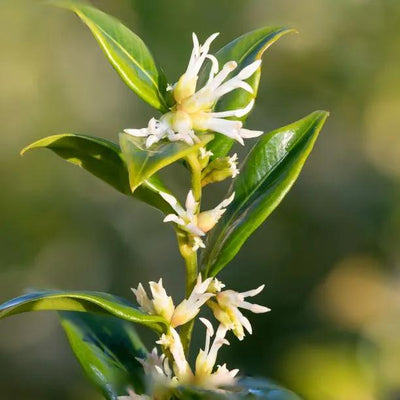
Order Potted Sweet Box (Sarcococca) Plants Now For February/March Delivery
Order Bareroot Box (Buxus) Plants For 2026 Spring Planting Season
What is Box Hedging?
Best used for low, formal hedges and edging within a garden, such as along paths, around a rose border, or to divide areas in a parterre, the original Box is Buxus sempervirens.
Slow growing and shade-tolerant, with small evergreen leaves that clip beautifully, perfect for ornamental hedges and edging within the garden, and topiary.
Buxus sempervirens: Common Box is native and (along with Yew) has been a quintessential formal hedge plant for centuries, intended to be clipped with sharp edges or neat contours to provide structure.
- Common Box grows (very slowly) up to several metres.
- Grows well in full shade, very hardy.
- Requires good air flow to reduce risk of disease.
Sarcococca confusa: Sweet Box, looks a lot less box-like than the others, with larger, darker leaves and a less dense habit, which doesn't lend itself so well to a really formal look, although it's also slow growing.
- Few other shrubs grow so well in dry soil and full shade under other shrubs.
- Its sweet smelling winter flowers make it a classic alongside shady paths.
The Euonymus cultivar Jean Hugues is a good, disease free alternative to Box.
How many Box hedge plants do I need?
Common Box should be planted at 4 or 5 plants per metre (every 20 to 25cm) in a single row.
What size Box hedge plants should I buy?
Our Box Hedging comes in only two sizes, and there is not much between them.
- If you are working to a budget, we recommend starting with the smaller size.
- If you want to save time getting a mature box hedge, or are filling gaps in an existing hedge, then pick the bigger size.
Smaller plants are cheaper, easier to plant, and tend to establish better because they are dug up with most of their roots intact.
You can also clip them attentively and ensure a very bushy plant from the base up.
Your mail order Box hedge plants are delivered by next working day courier.
If there is anything wrong with your plants when they arrive, Contact Us within 5 working days, and our friendly support team will sort it out.
All bareroot plants are covered by our Refund Guarantee, so you can give them a whirl with complete confidence.
Browse our full range of Hedging Plants, or have a look at our Ornamental Shrubs.
Should I choose Box or Sweet Box?
For formal hedges, it has to be Box, which clips perfectly and has a great upright structure.
Sweet box does not clip as crisply, and has a somewhat arching habit that suits an informal style.
What are Sweet Box Plants Good for?
There are three big differences between Sweet Box, Sarcococca confusa, and Common Box:
- It has larger, less dense leaves, and so does not clip quite as nicely into perfect formal lines and curves.
- It has very fragrant flowers. These appear in winter, when there is not much else to smell around the garden.
- It will grow in really full shade, in dry soil under other evergreen plants, and prefers a well sheltered location.
All of those features combined give Sweet Box a special purpose, because it does not really need to be seen to be appreciated.
- It can be used as ground cover around and under bigger plants where it receives no direct sun, and isn't really visible as you walk past.
- In really shady, humid, sheltered areas where the other Boxes are not so ideal, it can still replace them as a low ornamental hedge
Where Can I Grow a Box Hedge?
You can grow box hedges almost anywhere in the UK that has decent drainage. They are all hardy, shade-tolerant, and not fussy about soil type.
Common Box:
- Tolerate full shade well, but needs decent air flow to reduce risk of disease.
- The most important thing is that your Box hedge is in an open situation where there is lots of breezy air movement. The shade is no problem, it is the air flow that is crucial for healthy Buxus. As a rule of thumb, you could plant against a wall or under a big tree with high branches, but both might be too clammy.
- Fine in exposed windy locations, but not in range of salty coastal winds.
- Box blight is a potential problem in humid areas with poor air flow. Use Japanese Box instead.
Sweet Box:
- Exceptionally shade-tolerant, it will grow in dry soil directly underneath evergreen plants where few other things can.
- However, if planted in full sun, it needs a moist, rich soil.
- Does not like exposed, windy locations.
How do I Plant Box Hedging?
Our how to plant a formal hedge video demonstrates with beech, but the principles are the same with Box.
Spacing a Box Hedge:
Common Box and Sweet Box are planted at 3 plants per metre (every 33cm) in a single row.
How long does a Box hedge take to grow?
Box plants are slow growing, no matter your location! But as with any plant, the growth rate is affected by the amount of sun, shelter, local climate, and soil nutrients.
Ranked from slowest to less slow:
Common Box: 7-8 cm per year in ideal conditions.
Given enough time, it can grow to several metres tall, but most box hedges are around 50cm to 1.5metres.
Sweet Box:Because it is usually grown in deep shade, expect less than 10cm per year, but it can do up to 15cm in sunnier spots.
It is good for hedges up to about 1 - 1.5m tall.
How and When to Clip your Box hedge
Trimming Common Box:
To avoid risk of Box Blight disease, the best time to trim is during a period of dry weather, so keep an eye on the forecast. Any time between May and August is probably best.
You can also trim in dry winter weather, whenever the temperature is above freezing, but then you are likely to need to trim again in summer if you want that classic near, formal look.
There is an old custom of clipping your Box hedge on Derby Day in June, but that is only the best date to achieve a neat, formal look with only one trim per year, because Buxus does most of its growing in the cooler Spring weather.
Always collect or rake up and burn fallen leaves, then apply mulch to cover the soil.
Trimming Sweet Box:
Clip once per year, after flowering - in May or April is fine.


 Sign In
 Saved items


 5 Star Service Rating




 Secure, One-Tap Checkout
 5 Star Feefo Rating
 Hand Picked, Delivered to Your Door!
 1 Year Bareroot Guarantee
 Platinum Trusted Service Award 2026
 Mail Order Plant Experts - Est. 1949
 1 Year Bulb Guarantee