Buying Large Poplar & Aspen Trees Online:
Order Bareroot Poplar & Aspen Trees For 2026 Spring Planting Season
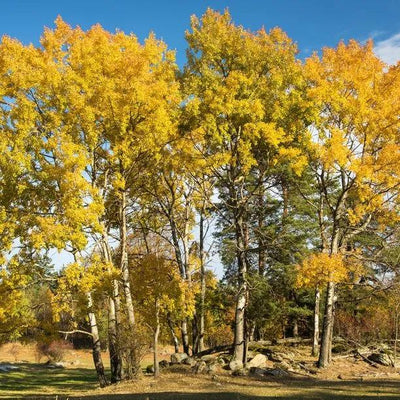
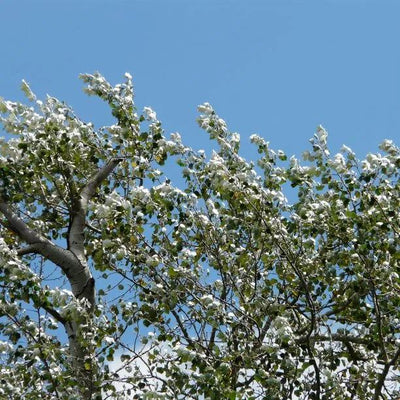
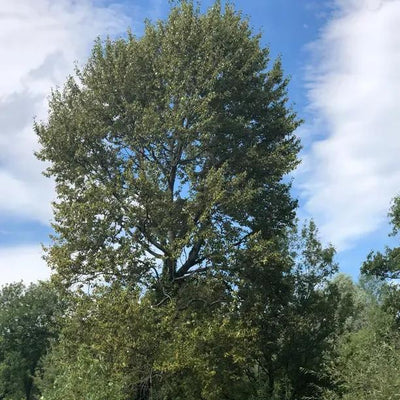
The Poplars, Populus species, are fast-growing trees that get pretty big, and several of them have a suckering habit, which means they produce a thicket of smaller stems around their base, which is great for wildlife.
They need plenty of sun and love growing in damp soil close to water, but will grow in any soil type.
What size Poplar trees should I buy?
- If you are not in a hurry to get a full sized Poplar tree, we recommend starting with the smaller 6/8cm girth size.
- If you are in a hurry and need instant impact, then go for the 8/10cm girth size.
Standard trees are measured by their girth 1 metre above the ground, and young saplings are measured by height.
So, a 6/8cm Standard Poplar tree is much bigger than an 60/80cm Poplar sapling tree or hedge plant.If a tree is available in both sizes, it will be noted in the product description.
Browse all our trees in standard sizes.
- When your order is ready: your mail order trees are delivered by next working day courier (not the next working day after ordering!)
- Friendly support: if there is anything wrong with your plants when you inspect them, Contact Us within 5 working days
All bareroot plants are covered by our Refund Guarantee, so you can give them a whirl with complete confidence.
What is a Standard Size Tree?
Standard trees, unlike their younger versions listed in the Hedging & Saplings section, are graded by their girth in centimetres, not their height.
Trees of the same grade will be roughly in proportion when planted.
We mostly deliver two sizes of standard:
• 6/8cm Girth = Light standards: cheaper & easier to care for.• 8/10cm Girth = Regular standards: instant impact.
If you are planting a larger project or putting trees on a site where watering is harder, you should use the smaller 6-8cm sizes.
It is always vital to water new trees during their first summer, but smaller trees are better at coping with "low" maintenance.
What is the difference between Bareroot and Pot Grown Trees?
Bareroot plants are by far the best value, the easiest to handle & plant because they weigh so little, and offer the most selection.
They are only delivered during winter and early spring, about November to March, when the plants are dormant, which is the best time of year to plant almost all woody species.
Some plants or larger sizes can only be delivered in pots, and some popular species are sold both bareroot in winter and potted the rest of the year.
There is nothing wrong with Pot Grown plants, but where you have a choice, bareroot is always even better!
Where Can I Grow Poplar Trees?
Poplars need plenty of sun, but otherwise will grow in any soil - damp or dry, rich or poor, they are not fussy.
They won't quite grow in totally waterlogged soil like Willows and Alder, but they thrive in damp soil near water.
When and How do I Plant Poplar & Aspen Trees?
Poplar trees are only delivered and planted bareroot during late Autumn to early Spring, from November to March.
This is the best time to plant any tree, because bareroot trees are cheaper, easier to carry and plant, and tend to establish even better than their pot grown equivalents.
Watch our Tree Planting Video for instructions.
Although optional, we strongly recommend using Rootgrow.
Aftercare:
Remember: the two biggest killers of recently transplanted trees are underwatering, and being choked by weeds and grass.
- Regular, thorough watering is vital during dry weather in their first spring and summer, and highly recommended the following summer, especially if there is a heat wave.
- Either remove weeds and grass by hand periodically, or use some form of mulch to suppress them.
Tree Planting Accessories
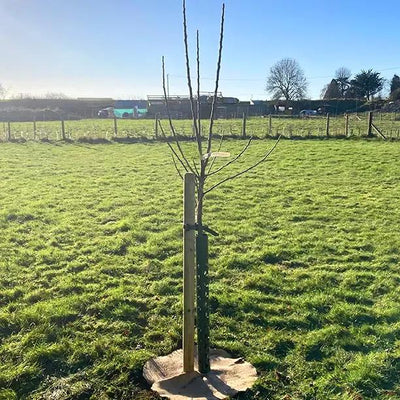
Standards that are 6/8cm in girth and upwards are quite big trees, so they need a tree planting stake and a tree tie (with a buffer between the tree and the stake) during their first couple of years.
A mulch mat is will suppress weeds & grass, and preserve moisture: remember that dry soil and competition with weeds are the two biggest killers of new trees.
Even with a mat, you should remove anything that manages to grow up between the mat and the trunk in late spring and summer.
You can buy those items separately, or save money with our Tree Planting Pack.
You definitely need a tree guard if there are deer or rabbits about.
In urban areas with no wild animals, tree guards are great for protecting against mowers and strimmers.For that purpose, you can cut one tree guard into several pieces about 20-25cm long, to act as skirting around the base of the tree.
Mycorrhizal Fungi
We cannot recommend using Rootgrow fungi enough: it makes a huge difference, especially with larger trees, which are scrambling to regrow the root systems that they lost when we dug them up, in order to support their now top-heavy growth above ground.
Mycorrhizal fungi assist the roots in accessing soil nutrients and water, and protect the roots from soil critters.
In return, the tree shares sugar with them, and the result can be over 50% more growth above ground!


 Sign In
 Saved items


 5 Star Service Rating




 Secure, One-Tap Checkout
 5 Star Feefo Rating
 Hand Picked, Delivered to Your Door!
 1 Year Bareroot Guarantee
 Platinum Trusted Service Award 2026
 Mail Order Plant Experts - Est. 1949