
Contents
Most clematis are deciduous, bare through winter and in flower for a few weeks in spring or summer. But three groups stay in leaf all year. They flower at different times, grow to different sizes, and prefer different walls. Pretty much, all they have in common is they are evergreen and they belong to pruning group 1.
- Armandii group: spring-flowering, strongly scented, vigorous to 8m. The best known evergreen clematis. Flowers March to April.
- Cirrhosa group: winter-flowering, nodding cream bells, to 5m. These are the plants that flower when almost nothing else does. Flowers November to February.
- Forsteri group: spring-flowering, masses of small white stars, to 3m. Finely cut ferny foliage. Less widely grown but hard to fault. Flowers March to April.
The one other thing the three groups have in common: all must be planted at pot level, not deep. This is the opposite of the advice for most other clematis. The section on planting below explains why.
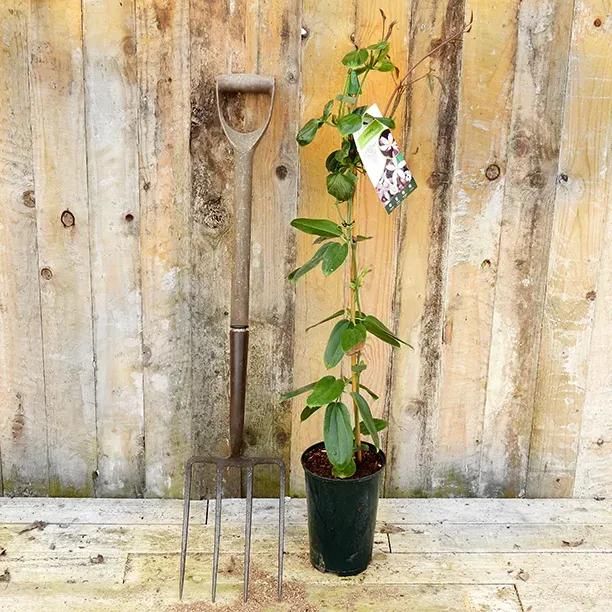
Clematis Armandii
Clematis armandii is one of those plants that surprises people the first time they see it in full leaf. The foliage is nothing like most gardeners’ mental image of clematis leaves. These are long, strap-shaped leaves in groups of three, dark and glossy, with a subtropical quality that has no business looking at home on an English house wall. And yet it does. In winter. And it is scented.
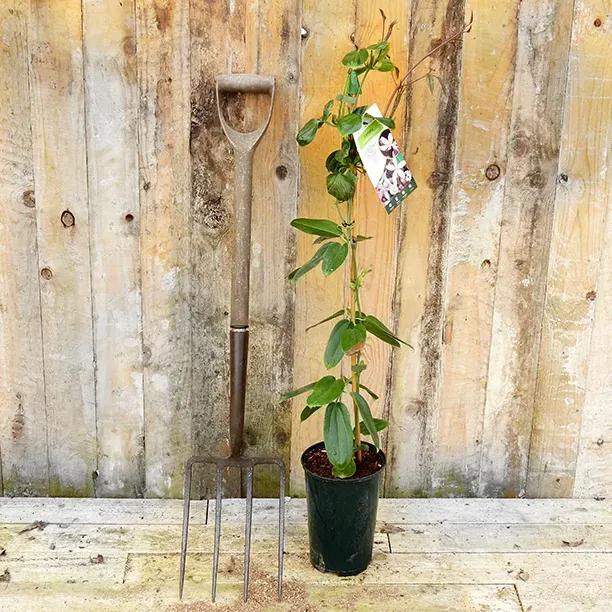
In March and April the plant covers itself in flat, four-petalled white flowers, carried in clusters along the stems. The scent is strong and sweet, closer to vanilla than anything sharply floral, and it carries in the cold air. On a calm spring morning, you will smell a well-established armandii before you can see it. It grows vigorously, to 6m or 8m in a good position, and a mature specimen on a warm south or west wall is a sight to behold.
The most popular variety is Apple Blossom, which holds an RHS Award of Garden Merit. The flowers open from pink-flushed buds to palest blush-white, picking up the colouring of an apple tree in blossom. That is where it gets its name, and it is where it looks most at home, growing through the branches of one. The species form, C. armandii, is pure white (but also looks good in a tree).
Growing Clematis Armandii
Armandii needs a sheltered position. It is rated H4, which means it will handle most British winters, but its flower buds can be killed by a sharp spring frost and a hard easterly in January will scorch the foliage. A south or west-facing wall that takes the edge off winter wind is ideal. The books say an east-facing wall works in milder gardens but we disagree. East gets the deadly combination of hard frost and a quick thaw that destroys plant cells when the sun rises. This is also why you should never plant a pear on an east wall.
The soil needs to be free-draining. Armandii hates wet. Raise the planting site slightly if your ground stays wet. It does well on chalk and alkaline soils; like most clematis, this one actively appreciates lime.
Give it proper support from the start. The stems are woody and get heavier as the plant matures, and it is very boring to try and mend a flimsy, broken Clematis in sub-zero temperatures in February. On a wall, fix horizontal wires 30–40cm apart up the full height you want the plant to reach using galvanised wire or vine eyes with tensioned lines. Armandii climbs by twisting its leaf stalks. It cannot cling to a smooth surface directly, and cannot grip a wire thicker than about 3mm without help.
Choose the planting location carefully as Armandii dislikes being moved once established. Its roots go deep and wide, and a mature plant disturbed at the root will sulk for a year or two at best. At worst…
Pruning Clematis Armandii
Armandii flowers on the previous year’s growth. The rule is: prune immediately after flowering, in April or May, and cut back only what you need to. Remove stems that have grown where you do not want them (over a window, into guttering, across a path) and tidy up any dead or winter-damaged wood. You will not lose next year’s flowers, because the plant spends the summer producing new growth that will carry them.
The timing matters more than almost anything else with this plant. Prune in autumn or winter and you remove all the following season’s buds. Prune in summer and you lose some growth but the plant recovers. Never prune in autumn.
If your armandii has outgrown its space, it can be reduced after flowering, but do it gradually. Armandii does not regenerate as freely from very old, thick, woody stems as montana does. Spread hard pruning over two or three years, taking out a third of the oldest wood each time, and the plant will remain productive. Cut it all the way back to stumps in one go and it may not recover well. My late half-sister, Cosima Armitage, who was a passionate lifelong gardener, asked me to help “renovate” a very large Clematis Armandii. Her view was I should cut through the main trunk about 30cm above the ground. If it grew, great and if it died, well that was a pity but it was simply too big and heavy. It died.
Winter-Flowering Clematis Cirrhosa
The cirrhosa group flowers from November to February. There is no other hardy climbing plant that does quite the same thing. While the rest of the garden is dormant, a well-sited cirrhosa carries nodding, lantern-shaped bells in cream, pale yellow, or cream spotted with red-brown, its glossy foliage a dark backdrop to flowers that look as though they belong in a more sheltered season than the one they have chosen.
Four varieties are in the Ashridge range, plus Winter Beauty, a closely related species that behaves in the same way:
- Freckles (AGM): cream flowers heavily spotted with red-purple inside. The markings are the point: you need to tip the bells up to see them, and they are worth it.
- Wisley Cream (AGM): clean, unspotted creamy-white. Simple and elegant.
- Jingle Bells: very similar to Wisley Cream; creamy-white, reliable, and well named for the time of year it flowers.
- Ourika Valley: pale greenish-yellow bells. Comes from a valley in the Atlas Mountains of Morocco; the warmest provenance of any cirrhosa in the range and correspondingly the least cold-tolerant.
- Winter Beauty: C. urophylla rather than C. cirrhosa strictly, but behaves identically: small, scented, creamy-white bells from November onwards. Probably the most fragrant of the winter group.
Growing Clematis Cirrhosa
Cirrhosa needs a sunny, sheltered wall. A south or west aspect with good protection from cold wind is the correct position. This is not a plant for an open fence or a shaded corner: it flowers in mid-winter, when the buds are easily killed by a sharp frost. Planted in a cold, exposed spot, you will see nothing. On a warm wall, with a bit of overhang from eaves or a pergola beam above, the flowers open in December and keep going until February or March.
The soil requirements are the same as for armandii: free-draining, ideally gritty, and if anything a little on the dry side once established. Do not plant in ground that stays wet over winter.
One thing to know about its summer foliage. Cirrhosa can look a bit sorry for itself from June to September. The foliage may bronze, some leaves may fall, and the plant generally does not put on a great display when the rest of your garden is looking great. This is normal. It is building up reserves and growing new stems for winter. By October the foliage freshens, and when everything else has gone to sleep, it is just getting started.
This makes cirrhosa an excellent candidate for a wall shared with a summer-flowering climber: a honeysuckle, a late-season clematis, or a climbing rose — where each plant holds its own at a different time of year and neither smothers the other.
Pruning Clematis Cirrhosa
Cirrhosa flowers on wood made the previous year and is a Group 1 clematis. Prune immediately after flowering ends, typically March or April, and only as much as you need to. Tidying up is usually the right description: remove any dead or damaged stems, cut back any growth that has gone out of bounds, and leave the rest. Avoid pruning in summer or autumn, which removes the wood that carries next winter’s flowers.
Clematis Early Sensation
Clematis Early Sensation is different in character from both armandii and cirrhosa. It is a hybrid derived from New Zealand species in the Forsteri group, and the New Zealand influence shows: the foliage is finely cut and ferny, quite unlike the bold strap leaves of armandii or the darker, rounded leaves of cirrhosa. The flowers are small, six-petalled, white, and carried in masses in March and April. The effect is that of a fine lace curtain rather than the bolder statement of armandii.
It grows to about 3m, compact by evergreen clematis standards and excellent in a smaller garden. Early Sensation is also hardier than Armandii and Cirrhosa, making it a realistic choice for a wider range of garden positions. A sunny or lightly shaded fence, an obelisk, or a trellis against a reasonably sheltered wall all work. It also does well in a large container.
Pruning follows the same Group 1 rule as the others: after flowering in late spring, and only as much as necessary.
How to Plant Evergreen Clematis
Evergreen clematis should be planted at pot level, meaning the soil surface in the pot should correspond to the soil surface in the ground when planting is finished. Do not bury the crown deeper than this.
This is the critical difference between the evergreen groups and the rest of the clematis range. For Group 2 and Group 3 clematis, deep planting of 8–10cm below pot level is strongly recommended; it promotes vigorous growth and helps recovery from wilt. The evergreen groups do not work this way. They do not regenerate from stems buried below the soil surface. Burying the crown risks crown rot, which is most commonly fatal in armandii and cirrhosa. Plant them at pot level and no deeper.
The planting method otherwise follows the same principles as for any clematis:
- Dig a hole roughly twice the width of the pot and slightly deeper, so the crown sits at the right level with good drainage beneath it.
- Improve the surrounding soil with compost or well-rotted manure, but fill the immediate planting hole with grit-enriched compost rather than heavy organic matter.
- On clay soils, consider planting into a slight mound to ensure the crown stays above ground that might pool water after heavy rain.
- Use rootgrow or bonemeal when planting, not both.
- Water thoroughly after planting and keep well watered through the first growing season.
- Mulch generously, but keep the mulch a few centimetres clear of the crown and stems.
Full planting method and soil preparation detail is in our main clematis growing guide.
Evergreen Clematis for Shade and North-Facing Walls
None of the evergreen clematis will flower well on a true north-facing wall. They all need some sun to perform. That said, there is a useful distinction between the groups:
Armandii is the most shade-tolerant of the three. It can manage in dappled shade under a large tree, though flowering will be less abundant than on a south or west wall. Apple Blossom on an east aspect, growing up through a mature apple tree, is a classic combination.
Cirrhosa needs more sun than armandii. It flowers in mid-winter, when the sun is low and light levels are minimal; it cannot cope with shade on top of that. A south or west wall is not optional for cirrhosa: it needs that sort of position to flower.
Early Sensation sits between the two. It tolerates a lightly shaded, sheltered position better than cirrhosa, and it is more robust through winter than armandii. It is the most forgiving of the three.
For other climbers suited to shade and north-facing walls, see our guide to climbing plants for shade and north-facing walls.
Frequently Asked Questions
Is clematis armandii evergreen?
Yes. Clematis armandii keeps its leaves all year and the foliage is one of its strongest ornamental features. A mature specimen on a wall gives year-round cover and structure that few other climbing plants can match. Apple Blossom is the most widely grown form.
When do evergreen clematis flower?
It depends on the group: the cirrhosa types (Freckles, Wisley Cream, Jingle Bells, Ourika Valley, and Winter Beauty) flower from November to February, in the depths of winter. Clematis armandii (including Apple Blossom) flowers in March and April. Clematis Early Sensation also flowers in March and April. So between them, the evergreen groups cover five months of the year, from November to April, with very little overlap with the main summer clematis season.
Do evergreen clematis smell?
Clematis armandii is strongly scented with the creamier Apple Blossom being as fragrant as the species form. Among the winter group, Winter Beauty has a light, pleasant scent; the cirrhosa varieties are generally lightly scented or unscented, though Freckles has a faint sweetness. If scent is important to you, armandii is the group to go for.
Can I grow evergreen clematis in a pot?
Clematis Early Sensation is the most practical choice for a large container. It grows to about 3m, responds well to regular watering and feeding, and can be supported on a tall obelisk or against a wall. Armandii is possible in a very large container but grows vigorously enough that it quickly becomes difficult to manage. Cirrhosa varieties need a warm sheltered spot to flower, which is harder to guarantee in an exposed container position.
Why hasn’t my Clematis armandii flowered?
The most common reason is pruning at the wrong time. Armandii flowers on wood made the previous year. If it was pruned in autumn or winter, even lightly, the flower buds were removed and there will be nothing to open in spring. The second common cause is a cold or exposed position: buds can be killed by a sharp spring frost. A plant that has been in the ground for less than a year may not flower in its first season regardless; give it another year before worrying.
Do evergreen clematis lose their leaves in winter?
No. Staying evergreen through winter is the whole point. That said, some leaf drop is normal and does not mean anything is wrong. Older leaves at the base of armandii turn yellow and fall periodically throughout the year, and some foliage discolouration is common after hard frost. The cirrhosa group can look a bit brownish and thin in summer, which is normal; they refresh again as temperatures drop in autumn and are in their best condition precisely when they need to be, in November and December.
How hard can I prune clematis armandii?
Immediately after flowering, you can cut back quite firmly — removing whole stems that have grown out of bounds and taking the overall size back by a third or more. The plant will produce a flush of new growth through summer that carries next year’s flowers. What you should not do is cut back into very old, thick, woody stems all in one go. Armandii does not regenerate from old wood as freely as montana. If you need to reduce a large, established plant significantly, spread the work over two or three years, removing the oldest wood a section at a time. And never prune in autumn or winter.



Leave a Reply