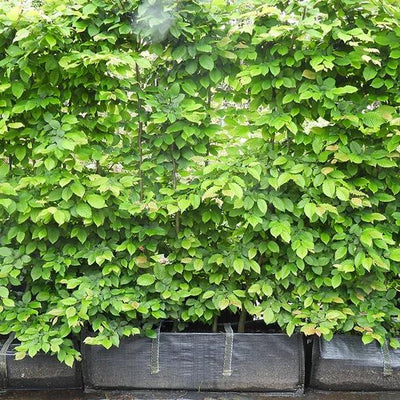
Buy The Best Carpinus betulus Hedge Plants
Order Potted Hornbeam & Troughs Now For Spring Delivery
Order Bareroot Hornbeam Plants For 2026 Spring Planting Season
What is Hornbeam Hedging?
Hornbeam hedging, Carpinus betulus, is the go-to replacement for a green Beech hedge in shady locations and/or heavy and badly drained soils.
Like beech, it is not evergreen but holds its Autumn leaves into winter when it is clipped as a hedge.Left to its own devices, Hornbeam grows into a medium-sized deciduous tree.
- Uses: Formal and stock-friendly hedges from 100cm upwards
- Good Points: Native, holds leaves into winter, clips beautifully
- Position: Heavy and poorly drained soils. Tolerates shade
- Growth: 30+ cm p.a.
How many Hornbeam hedge plants do I need?
The planting density for your Hornbeam hedge depends on the purpose:
- For a normal garden boundary hedge, plant at 3 plants per metre (every 33cm) in a single row.
- A stock-proof country hedge requires 2 staggered single rows (i.e. start one row 16.5cm after the other), with 40cm between rows. That works out at 5 plants per metre in total.
- An interior hedge for purely decorative purposes can be planted at 2 plants per metre (every 50cm) in a single row.
What size Hornbeam hedge plants should I buy?
- If you are not in a hurry to get a full sized Hornbeam hedge, we recommend starting with smaller sizes: up to 60cm tall.
- If you are in a hurry and need instant impact, or are filling gaps in an existing hedge, then of course pick the biggest size that fits your budget.
Smaller plants are cheaper, easier to plant, and tend to establish better because they are dug up with most of their roots intact.
You can also clip them attentively and ensure a very bushy plant from the base up.
If you still aren't sure, then 60/80cm tall is considered the ideal compromise between price, size, and waiting time until you get a mature hedge.
Should I use Bareroot or Potted Hornbeam?
We always recommend using bareroot Hornbeam plants: they are cheaper, stronger, easier to handle and because they are planted in winter in heavy, wet ground, they need less watering in spring than potted plants.
Looking for a big Hornbeam tree instead of a hedge?
Our large Hornbeam Standards are the same species as hedging, but delivered at a larger size and grown with a straight trunk.Fastigiate Hornbeam is a compact, upright ornamental variety, much more suitable for the average garden.
Browse our other hedge plants.
Your mail order Hornbeam Hedging plants are delivered by next working day courier.
If there is anything wrong with your plants when they arrive, Contact Us within 5 working days, and our friendly support team will sort it out.
All bareroot plants are covered by our Refund Guarantee, so you can give them a whirl with complete confidence.
Native to the UK, hornbeam creates a vigorous and almost indestructible hedge, thriving in shady positions with heavy and poorly draining soils.
What is the Difference Between Hornbeam and Beech?
Green Beech, Fagus sylvatica, and Hornbeam, Carpinus betulus, are unrelated but similar looking when grown as a hedge.
Basically, Beech is best, but if it's not suitable for your location, Hornbeam is a pretty close substitute.
Difference in Appearance:
- Beech is definitely the most popular due to its faster growth and more beautiful, smooth green leaves, which hang onto the branches through most of Winter
- Hornbeam leaves are wrinkled, a more muted shade of green, and only remain on the branches for part of the Winter.
Difference in Growing Conditions:
- Beech really needs plenty of sun and well drained soil: it does not perform well in the shade, nor in damp soils that waterlog in Winter.
- Hornbeam pretty much grows anywhere, and is definitely suitable for shady sites and damp soils.
If there are puddles of rainwater where you are going to plant your hedge 12-24 hours after heavy rain, the ground is probably too wet for beech.
Where can I grow a hornbeam hedge?
Hornbeam hedge plants are very hardy, and wind resistant, but not suitable for coastal areas with salty wind. They love heavy clay soil and do not mind damp or shady conditions.
They do not like dry, thin, sandy, or chalky soils.
When and How to plant a hornbeam hedge?
You can plant Hornbeam hedging at any time of year, except when the soil is frozen.
The best time to plant hornbeam is in winter (November to March), using bareroot stock, which is cheaper, easier to carry and plant, and tends to establish even better than the pot grown equivalents.
Hornbeam Hedge Planting Instructions:
For Hornbeam up to 60/80cm, which are small enough to be slit planted, watch our film on how to plant a country hedge with one key difference: don't cut hornbeam back by 50% after planting, just trim an inch off the tips of the stems. For Hornbeam 80/100cm upwards, the larger roots will need trench planting, so watch our film on how to plant a formal hedge.
Spacing a Hornbeam Hedge:
Beech and Hornbeam are both fine to plant in a normal single row at 3 plants per metre, especially when the hedge will be allowed to grow reasonably wide, at least 150cm at the base.
However, theylook better in late Winter as a staggered double row: 50cm between plants along each row, so 4 plants per metre in total.
How and When to prune a hornbeam hedge?
Once your Hornbeam hedge is planted (on the same day if fine) give them a very light trim by snipping off the top bud from the end of each stem - this will encourage them to become bushier.
When the hedge is established, trim in late spring and again in early August: this is essential to make it hold onto its leaves in winterIf necessary, carry out heavier pruning and remedial work in winter. You can be drastic as all members of the Carpinus family regrow from old wood when they are cut back hard.
Is hornbeam hedging evergreen?
No, but unlike most other deciduous plants, it does not drop its dead autumn leaves right away when it is clipped as a hedge. They will remain on the branches well into winter, adding privacy, visual interest, and shelter from wind.


 Sign In
 Saved items



 5 Star Service Rating




 Secure, One-Tap Checkout
 5 Star Feefo Rating
 Hand Picked, Delivered to Your Door!
 Platinum Trusted Service Award 2026
 Mail Order Plant Experts - Est. 1949
 1 Year Bulb Guarantee