DescriptionPlanting InstructionsAfter CareDelivery & Guarantee
Blenheim Orange Apple Trees - Delivered by Mail Order from the Nursery with a 1 Year Guarantee
Blenheim Orange apple trees produce early-mid season eating apples that also cook well.
Browse all of our other apple tree varieties here or read our guide to buying the right apple tree.
Characteristics of Blenheim Orange Trees:
- Use: Eating. A sweet and nutty flavour with a crumbly texture that goes very well with cheese. When cooked it bakes to a firm puree: slices on top of a pie will keep their shape.
- Partial Tip Bearer: suitable for cordons & training on wires.
- Tree's growth habit: Strong vigour. Spreading form with thick branches.
- Harvest: From late September to early October.
- Store & ripen in a cool, dry place:
Until November.
General description of Blenheim Orange:
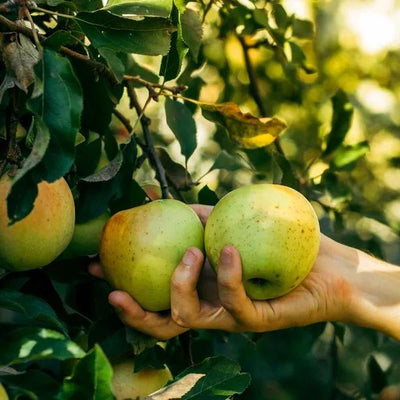
As an eater, this large, flat shaped apple has quite a soft bite with a lovely flavour, slightly nutty, that goes tremendously well with cheese for dessert. It is a handsome apple, flushed red/orange, sometimes with stripes all on a yellow green skin and some fruit can have little golden blown spots and markings. The fresh apples taste best when they have ripened off the branch for about 2 weeks. We think the flavour is even better when the apple is cooked and very few apples make an Apple Charlotte as well as a Blenheim Orange.
This is a really vigorous tree and although it can be a bit slow to start fruiting, mature trees will crop so heavily that they need to have their fruit thinned to control their biennial habit.
Rootstocks:
All of our Blenheim Orange trees are grown on MM106 rootstocks, except for the cordons, which are grown on M9 rootstocks.
Pollination Partners for Blenheim Orange:
Your trees are self sterile triploids: their flowers must be pollinated to make any fruit and they cannot pollinate other trees.
Blenheim Orange is in pollination Group D.
This means that they can be pollinated by other apple trees in pollination Groups C, D and E.
This tree's flowers have poor frost resistance.
See our Guide to Apple Tree Pollination for a full list of partners & more tips about pollination.
Blenheim Orange Disease notes:
Disease resistance: Mildew (excellent), Fireblight, Brown Rot.
Disease susceptibility: Scab.
History & Parentage:
This tree was first found growing wild by a Mr Kempster, close to Blenheim Palace in about 1740. Originally it was called Kempsters Seedling, but the name changed when nurseries began to sell it in 1818. It won the Banksian medal from the RHS in 1822. It was grown widely on both sides of the Atlantic until the 1930's, when it was replaced by modern varieties in commercial orchards.
This tree's parents are unknown, but it has produced several new trees, including Annie Elizabeth, Howgate Wonder, Newton Wonder, Edward VII and Golden Reinette.
How Apple Trees are Measured & Delivered:
Our fruit trees are delivered in up to 3 shapes and you can also buy selected apple trees as ready made cordons.
Maiden: This unbranched tree is the smallest starting size. You can train maidens into espaliers and cordons.
Cordon: Blenheim Orange trees are partial tip-bearers, so they can be made into cordons and espaliers.
Bush: This is a style of freestanding tree with a short trunk of about 60cms. It will grow to about 3 metres tall.
Half-Standard: This is a freestanding style that will grow into a full sized, "normal" apple tree, about 4 metres tall.
Notes on planting Blenheim Orange trees:
All fruit trees like a rich soil with decent drainage, protection from the wind and plenty of sun. Apple trees like clay soil, as long as it is not prone to bad waterlogging.
This tree is suitable for organic growing in the drier East of Britain, where mildew is more common. It is not recommended for the North & Scotland because its flowers are easily damaged by late spring frosts.
Prepare your site before planting:
Improving the soil in advance of planting your apple trees will help them establish quickly and be productive for years to come. After you have destroyed all the weeds and grass (use a glyphosate based weed-killer for tough weeds), you can dig the soil over. Remove any stones and rubbish and mix in well rotted compost or manure down to the depth of about 2 spades.
You can do this on planting day, but when you do it weeks or months in advance, you will give the soil time to settle again.
Spacing Blenheim Orange apple trees:
Freestanding bushes: 12-18 feet (4-6 metres) between trees and rows.
Freestanding half-standards: 18-30 feet (6-10 metres) between trees and rows.
In general, allow 1 more metre between rows than there is between each tree in the row.
Wire-trained cordons can be planted in rows 60-100cms apart.
Espaliers need to be spaced at 10-18 feet (3-6 metres) apart.
Watch our video on how to plant a fruit tree for full instructions on planting a bush or half-standard sized tree.
If you are growing a maiden sized apple tree into a freestanding tree, a bamboo cane is enough support.
If you are growing a cordon or espalier, you will need to install training wires to support them.
Remember to water establishing apple trees during dry weather for at least a year after planting.
Apple Tree Planting Accessories:
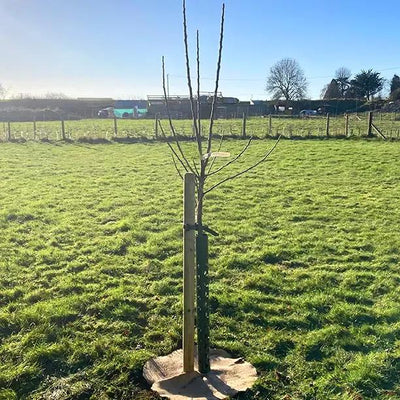
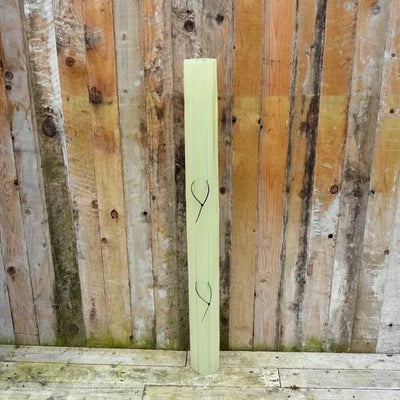
For bush and half standard apple trees, our tree planting pack includes a wooden stake & rubber tie to support the tree and a biodegradable mulch mat with pegs, which protects the soil at the base of your tree from drying out and stops weeds from sprouting.
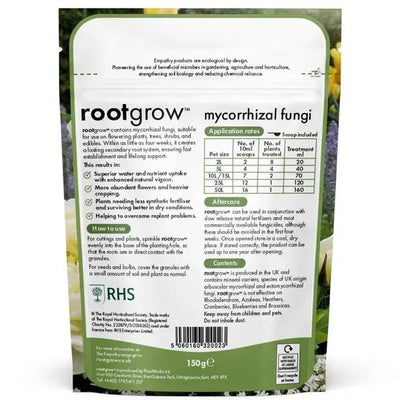
We recommend using mycorrhizal "friendly fungi" on the roots of all new trees, especially if your soil is poorly fertile.
After you plant an apple tree, the most important thing to do is water it in dry weather and weed around it. Both of these will be necessary for at least a year after planting. We recommend using a mulch mat as well.
The best tip for helping your tree to establish and quickly become mature and productive is to remove all the fruit that it produces in the first year after planting, as soon as the flowers fade. This will give the tree a chance to develop its roots, which are the foundation of the tree's strength, and sturdy branches that can bear the weight of a heavy crop without snapping.
Biennial habit: This tree naturally has a tendency to crop very well in some years, then give a poor harvest the following year. When your trees have established and begun their cropping life, it is important to notice if there is a large crop on the way and thin it out in late June or early July. This is best for the tree and will help it to give a more consistent crop from year to year.
All fruit trees will need formative pruning during their first years. Although this is not complicated, it is important to research and understand the process so that you can apply it to your particular tree and situation.
Harvesting Blenheim Orange apples:
Your trees should crop in Late September to Mid October. Blenheim Orange apples will store in a cool, frost-free place for about 1-2 months.
Read more about picking and storing apples here.
Hygiene & Diseases:
Dead, damaged or diseased wood can be pruned off as soon as it appears.
Disinfect your pruning tools between every cut if there is any sign of disease.
Burn or dispose of any diseased material, do not compost it.
Read our full terms and conditions here.
Delivery:
The basic delivery charge for all orders containing fruit trees of any size (bareroot or pot-grown) is £12.55 + VAT.
Because couriers sometimes experience delays, we schedule delivery by week, not by day. Therefore, please plan your planting day for the weekend at the end of the delivery week or for the week following delivery, at the earliest.
You can choose the delivery week that suits you during checkout and we will email you the day before your plants are due to arrive.
Payment: We do not charge your card until we begin to prepare your order for packing.
Guarantee: If any plants die within a year, we will replace them. We only ask that you follow our planting & growing instructions and sent us clear photographs of the dead plants in situ, so we can help to make sure that the replacement plants succeed. You only pay for the delivery of the replacements.
Please note that our guarantee is void if there is a hosepipe ban in your area: your newly planted fruit trees must be watered in dry weather while they are establishing. The best way to water is very thoroughly every few days: at least once a week if there is no heavy rain.
Our nursery has been supplying container grown and bareroot fruit trees to gardeners and orchard owners since 1949. Our website started in 2003, so we do understand the concerns that you may have about buying fruit trees online. If any of your plants are damaged when they arrive or if you are otherwise not satisfied with your order after you inspect it, please repackage it and contact us. We will give you a refund or send replacements and send a courier to come and collect the unwanted plants.
Your 12 Month Guarantee
If any of the plants that you buy from our nursery die within a year of delivery, we will replace them.
You only pay for the delivery of the replacements.
We do ask for clear photos of the plants in the soil, both taking in the planting area and close up. These will help us to work out what went wrong so we can give you the right advice for looking after your replacements.
The most important thing to do with establishing plants is to water them in dry weather. Water very thoroughly, but not too frequently: allow the top 2 inches of soil to dry out before you water again. In hot summer weather, this should mean that you are watering 1 to 3 times per week, depending on your site's drainage and exposure to wind and sun.
If there is heavy rain, that counts as a watering for your plants. If there is only very light rain during hot weather, this probably won't be of much use to your plants and they will still need watering.
Weeding is also very important; we strongly recommend using a mulch mat (for trees) or mulch fabric (for hedges) if weeding your new plants will be impractical.
Outside your 1 Year Guarantee period?
If your plants die or get sick after their first year, you are still welcome to take some photos and send them in: we will still be happy to give you what advice we can.
We can't make any promises, but if you want to buy replacements from us, give us a call and we'll see if we can arrange a discount for you.
Place an order for £250 excluding VAT and delivery and we deliver it for FREE!
Bare-root Plants are only delivered in the winter season, from November to April. Pot grown plants can be delivered all year round
Advantages of Bare-root plants:
You pay less for the same size plants.
You can carry and plan them easily.
You only plant them in winter, so they need less maintenance after
planting. The rain will water them for their first few months.
You get the biggest selection: Many trees are not sold pot-grown.
They are "asleep" in winter - this is the best time to transplant any tree.
They use fewer fertilisers & fungicides, less water and fuel in their production & delivery.
Advantages of Pot Grown plants:
Pot grown plants can be delivered & planted all year round.
Plants with tender roots & larger specimens must be delivered in pots.
Plants in pots can be kept for months longer if there is a delay in planting.
Our Advice to You:
If you can't wait to get planting, order Pot grown plants now.
If you are not in a hurry, order bare-root plants for delivery this winter. Simply add them to your basket and choose a winter delivery date that suits you during checkout.
This will reserve your plants before they sell out.
We won't charge you until the day before delivery, so cancelling your order is always easy.
If you are only ordering chemicals and other small items, delivery is £3.50
Our delivery charge for all other orders is £6.50 + VAT.
If you live in the Scottish Highlands or the Isle of Wight, there will be an extra charge of £15 + VAT on top of the appropriate basic charge, as listed above.
If your order is over £250 exc. VAT, there will be no delivery charge.
If you are uncertain, just add items to your basket which will calculate the basic shipping charge for you.