
What are the best climbing plants for UK gardens?
The best climbing plants for UK gardens include clematis, wisteria, honeysuckle, Virginia creeper, ivy, star jasmine, passion flower and jasmine — each suited to different aspects, purposes and soil conditions. Choosing the right climber means matching the plant’s needs to your situation: aspect, support type, desired effect and how much maintenance you are prepared to do.
Related guides
- Clematis pruning groups explained — Groups 1, 2 and 3 with variety lists
- Clematis wilt — what it is, how to prevent it, and which varieties resist it
- Do climbing plants damage walls and fences?
- Evergreen climbing plants — year-round cover for walls, fences and screens
- How deep do I plant a clematis?
How do I choose a climbing plant for my situation?
Start with your aspect and support, then decide what you want the plant to do — screen, scent, colour or wildlife value. The table below gives a quick cross-reference of the most popular climbers by situation; the sections that follow go deeper into each category.
| Situation | Top choices | Avoid |
|---|---|---|
| Sunny south- or west-facing wall | Wisteria, star jasmine, passion flower, large-flowered clematis | Ivy (scorches), most honeysuckle (prefers roots in shade) |
| North- or east-facing wall | Ivy, Virginia creeper, Clematis montana, climbing hydrangea | Wisteria, passion flower, star jasmine |
| Timber fence or trellis | Clematis, honeysuckle, jasmine, passion flower | Wisteria (too heavy long-term), Virginia creeper (self-clinging) |
| Quick screening | Russian vine (very vigorous — use with caution), Clematis montana, Virginia creeper | Slow starters: wisteria, star jasmine |
| Scent | Wisteria, honeysuckle, jasmine, star jasmine, some clematis | Virginia creeper, ivy, passion flower |
| Evergreen cover | Ivy, star jasmine, Clematis armandii, Clematis cirrhosa | Virginia creeper, wisteria, standard honeysuckle |
| Wildlife and pollinators | Ivy, honeysuckle, clematis (hips for birds), passion flower | Highly doubled flower forms (poor pollen access) |
What are the best climbing plants for walls?
The best climbers for walls depend on whether the wall is solid masonry or rendered — and whether you want a self-clinging plant that needs no fixings, or one that needs wires or trellis.
Self-clinging climbers such as ivy and Virginia creeper attach directly to the surface using adhesive pads or modified roots. They are ideal for large, sound brick or stone walls where fixing trellis would be difficult, but they are not suitable for walls with loose or flaking mortar, or for timber cladding. For a detailed look at whether these plants cause damage, see our guide: Do climbing plants damage walls and fences?
Wire-trained climbers — wisteria, roses, trained clematis and star jasmine — are attached to horizontal galvanised wires held proud of the wall by vine eyes. This allows air circulation and makes it easy to repaint or repoint behind the plant.
Wisteria is arguably the most spectacular wall climber for a sunny aspect. It is vigorous (ultimately reaching 10–15 m), long-lived and produces extraordinary hanging racemes of scented flowers in late spring. It needs firm support — substantial vine eyes and 3 mm galvanised wire — and twice-yearly pruning to keep it tidy and flowering freely. See our full guide: How to grow wisteria. Browse our wisteria collection.
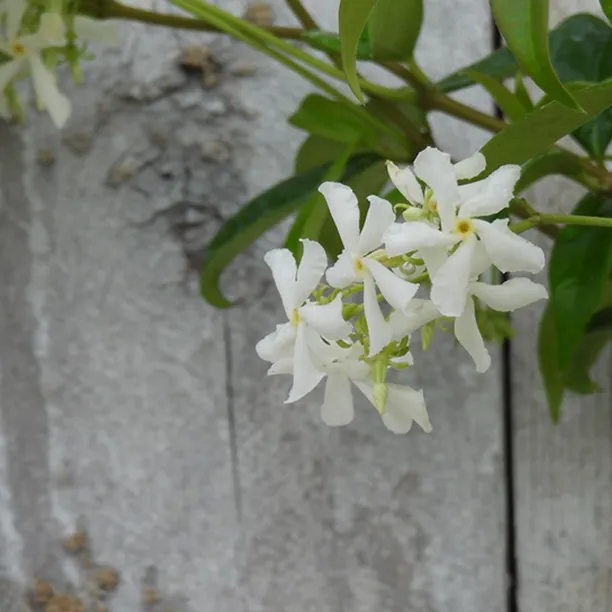
Star jasmine (Trachelospermum jasminoides) is a refined evergreen twiner producing masses of white, intensely scented flowers in summer. It is slower-growing than wisteria but reliably covers a sunny or lightly shaded wall over three to five years. Hardy to around −10 °C in a sheltered spot, it needs protection in colder counties. Explore our star jasmine range.
Virginia creeper turns the most spectacular crimson-scarlet in autumn and will cover an entire house wall without any fixings. It is fully deciduous and so gives no winter cover, but the autumn display is unmatched. See our Virginia creeper collection.
What are the best climbing plants for fences?
Fences — particularly timber panel fences — need lighter, well-behaved climbers that will not pull the structure down as they mature. Twining and tendril climbers are ideal; heavy self-clinging species are generally not suitable.
Clematis is the premier fence climber. It is lightweight, flowers brilliantly, and the annual pruning required by most Group 3 varieties prevents it ever becoming unmanageably heavy. A well-chosen selection of early, mid-season and late-flowering varieties will give colour from February through to November. See our full clematis collection and our guide to clematis pruning groups to understand which varieties need cutting back and when.
Honeysuckle is equally well suited to fences and provides scent as a bonus. It twines rather than grips, so it will weave attractively through trellis or wire without putting undue strain on panels. Our honeysuckle collection includes both scented deciduous forms and the more vigorous semi-evergreen types.
Passion flower (Passiflora caerulea) is surprisingly tough in sheltered gardens and provides striking exotic-looking flowers followed by orange-yellow fruits. It is vigorous but controllable on a fence. Browse our passion flower collection.
For the widest range of fence-suitable climbers, see our curated collection: Best Plants for Covering Fences.
Which climbing plants have the best scent?
The most heavily scented climbing plants for UK gardens are wisteria, honeysuckle, jasmine, star jasmine and some clematis cultivars — each peaking at different times of year, so it is possible to have fragrance from spring through to autumn.
| Plant | Scent season | Scent character | Best aspect |
|---|---|---|---|
| Wisteria | Late spring (May) | Sweet, vanilla-rich, pervasive | South or west |
| Honeysuckle | June–September | Sweet, honey, strongest at dusk | Any, roots in shade |
| Jasmine (J. officinale) | July–September | Classic jasmine, intense | South or west |
| Star jasmine | June–August | Sweet, jasmine-like, long-lasting | South, west or sheltered east |
| Clematis montana (e.g. Elizabeth) | April–May | Vanilla, light but widespread | Any except deep shade |
| Clematis armandii (Armandii) | February–March | Almond, vanilla, very early | Sheltered south or west |
Honeysuckle is particularly effective near a seating area or open window. The native Lonicera periclymenum and its cultivars are loved by moths and bumblebees as well as gardeners. For planting and training advice see our guide: How to grow honeysuckle. We also have a short video guide to planting climbing honeysuckle.
Jasmine (Jasminum officinale) is the classic cottage-garden scented climber for a sunny wall. It is vigorous and somewhat unruly if not trained annually, but the scent on a warm evening is worth the effort. Our jasmine collection includes several tried-and-tested forms.
For the earliest scent of the year, Clematis armandii flowers in February and March — an extraordinary sight and smell when little else is in bloom. Its almond-vanilla fragrance drifts surprisingly far on still days.
What are the best climbing plants for shade and north-facing walls?
Ivy, Virginia creeper, Clematis montana and climbing hydrangea are the most reliable climbing plants for shade and north-facing walls. Most scented climbers need sun to perform well, but there are more options for shady walls than many gardeners realise.
Ivy is unmatched for dense, year-round cover on a north wall. It supports significant wildlife — birds nest in it, and the late-autumn flowers are a vital nectar source for insects before winter. Contrary to popular belief, ivy on sound walls rarely causes structural damage. Our ivy collection includes variegated forms that brighten a dark wall considerably.
Clematis montana is remarkably tolerant of shade and north-facing aspects, producing clouds of small flowers in spring. Varieties such as Elizabeth (soft pink, vanilla scent), Broughton Star (deep pink, semi-double) and Fragrant Spring all cope well on a cool aspect.
Virginia creeper will grow happily on a north wall and still produce good autumn colour — though not quite as vivid as on a sunny wall.
For a deeper treatment of this topic, see our dedicated guide: Best climbing plants for shade and north-facing walls.
Which climbing plants grow the fastest?
The fastest-growing climbers in UK gardens are Clematis montana, Virginia creeper and, if space allows, wisteria — all capable of adding 3–6 metres or more in a single season once established. Russian vine (Fallopia baldschuanica) is the fastest of all but is extremely difficult to control and is generally not recommended for domestic gardens.
| Climber | Annual growth (established) | Ultimate size | Controllable? |
|---|---|---|---|
| Clematis montana | 3–5 m | 7–12 m | Yes, prune after flowering |
| Virginia creeper | 3–5 m | 15–20 m | Yes, clip in late summer |
| Wisteria | 3–6 m | 10–20 m | Yes, twice-yearly pruning essential |
| Honeysuckle | 1–2 m | 4–7 m | Yes, prune after flowering |
| Large-flowered clematis | 1.5–3 m | 2.5–4 m | Yes, easy to manage |
| Star jasmine | 0.5–1 m | 4–6 m | Yes, responds well to pruning |
Bear in mind that “fast” and “well-behaved” are not always compatible. The very fastest climbers — montana clematis and Virginia creeper — need an appropriately large structure or they will need cutting back hard every one to two years. On a modest garden fence, a large-flowered clematis is a more sensible choice than a montana, which could overwhelm the structure within a few seasons.
What are the best evergreen climbing plants?
The best evergreen climbing plants for UK gardens are ivy, star jasmine, Clematis armandii, Clematis cirrhosa and, in milder areas, passion flower and some honeysuckle varieties. Evergreen climbers are especially valuable in small gardens where a bare fence or wall in winter would be particularly exposed or uninviting.
Clematis armandii is the most handsome evergreen clematis — large, glossy, ribbed leaves and masses of small white or pale pink flowers in February and March. Clematis armandii needs a sheltered, sunny wall; it is borderline hardy in the coldest northern and Scottish gardens. Early Sensation is a similar white-flowered evergreen with excellent hardiness.
For a full treatment of this subject, including hardiness ratings and aspect guidance for each species, see our dedicated article: Evergreen climbing plants — year-round cover for walls, fences and screens. For evergreen clematis in particular, see Evergreen Clematis — Year-Round Cover.
Which clematis is best for my garden?
There is a clematis for virtually every situation in the UK — from tiny balconies to large country walls, from deep shade to full sun, and from February to November. The key is matching the pruning group to your available time and the variety’s vigour to your available space.
Group 1 — early-flowering, prune after flowering only: Includes Clematis montana and C. armandii. Very vigorous; ideal for large walls, fences, pergolas or growing through trees. Varieties to consider: Elizabeth (pale pink, scented), Broughton Star (deep pink, semi-double), Fragrant Spring (white, strong scent).
Group 2 — large-flowered, light prune in late winter: The showiest flowers, often with a repeat flush in late summer. Many are compact enough for a small garden fence. Varieties to consider: Doctor Ruppel (deep pink with darker bar), Bees’ Jubilee (mauve-pink, reliable), Crystal Fountain (lavender, extraordinary central boss), Belle of Woking (silvery mauve, double), Apple Blossom (pink fading to white).
Group 3 — hard prune each February: The easiest clematis to look after — cut to ankle height every winter and they regrow to 2–3 m each season. Ideal for fences, obelisks and through shrubs. Varieties to consider: Étoile Violette (deep violet, prolific), Ernest Markham (rich red), Duchess of Cornwall (pink and cream, semi-double), Bill MacKenzie (yellow lanterns, excellent seed heads), Diana’s Delight (pale lavender, vigorous).
For a fully illustrated guide to choosing between varieties, see Which Clematis Should I Grow? and our planting guide How to grow clematis. If you are worried about clematis wilt, our guide Clematis wilt — what it is, how to prevent it, and which varieties resist it will reassure you that with good planting technique (burying the rootball 5–7 cm below soil level) most modern varieties recover well even if wilt strikes.
What are the best climbers for pergolas and arches?
Pergolas and arches suit wisteria, roses, clematis and honeysuckle best — plants that can be trained along horizontal beams, flower prolifically at head height and, ideally, provide scent directly where people pass beneath.
Wisteria over a pergola is a classic for good reason: the long, pendulous racemes hang at exactly the right level to appreciate the scent. A pergola also gives the structure that wisteria needs to support its considerable weight as it matures. For pruning details see our guide: How and when to prune wisteria — summer and winter pruning explained.
Combining clematis with a climbing rose on a pergola is a time-honoured pairing. The clematis threads through the rose without needing separate support, and the two plants flower at complementary times. Group 3 clematis such as Étoile Violette are particularly good companions because they are hard-pruned in winter, making it far easier to attend to the rose without a tangle of clematis stems in the way.
What do I need to know before planting a climber?
Most climbing plant failures are caused by poor soil preparation, inadequate support or planting too close to a wall where the soil is dry. A few fundamental principles will make an enormous difference to establishment.
- Keep the rootball away from the base of the wall. Plant 30–45 cm away from the base and lean the cane towards the wall. The soil at the base of a wall is often dry, compacted and alkaline from lime leaching out of mortar.
- Improve the soil. Dig in a generous amount of garden compost or well-rotted manure before planting. Most climbing plants are greedy feeders and benefit enormously from good soil preparation.
- Water regularly in the first two seasons. Climbers establish more slowly than they appear to; the roots need two full growing seasons to reach the moister soil beyond the immediate planting zone.
- Plant clematis deep. Clematis should be planted so the top of the rootball is 5–7 cm below the soil surface. This encourages multiple stems to develop and protects the plant if wilt strikes. Our guide How deep do I plant a clematis? covers this in detail.
- Fix support before planting. Horizontal wires, trellis or battens should be in place before the plant goes in so you can tie in new growth immediately.
Frequently Asked Questions
What is the fastest-growing climbing plant for a fence?
Clematis montana is the fastest practical choice for a fence, adding 3–5 m a year once established. It is controllable, unlike Russian vine, which is extremely invasive. See our clematis collection.
Which climbing plants are best for a north-facing wall?
Ivy, Virginia creeper and Clematis montana all thrive on north-facing walls. Climbing hydrangea is also excellent. Full guidance is in our article Best climbing plants for shade and north-facing walls.
What is the best climbing plant for scent?
Wisteria, honeysuckle and jasmine are the most powerfully scented climbers for UK gardens. Clematis armandii provides almond-scented flowers surprisingly early in late winter, making it uniquely valuable.
Which climbers stay evergreen in winter?
Ivy and star jasmine are the most reliably evergreen climbers across the UK. Clematis armandii and passion flower are also evergreen in sheltered gardens. See our evergreen climbers guide.
Do climbing plants damage walls?
Self-clinging climbers such as ivy can loosen already-defective mortar, but on sound walls the risk is very low. Wire-trained climbers cause no direct damage. Our article Do climbing plants damage walls and fences? covers this in full.
What is the best climbing plant for covering an ugly fence quickly?
Clematis montana will cover a large fence quickly and is easier to manage than Virginia creeper on timber. For a curated selection, see our Best Plants for Covering Fences collection.
What climbing plant is best for wildlife?
Ivy is the single best climber for wildlife: it provides nesting sites, autumn nectar and winter berries. Honeysuckle supports moths, bumblebees and thrushes; clematis seed heads feed small birds through winter.
Can I grow clematis and wisteria together?
Yes, but only on a very large, strong structure such as a substantial pergola or a wide house wall. Wisteria is very vigorous and will eventually dominate, so give each plant its own allocated section.
Which clematis is easiest to look after?
Group 3 clematis such as Étoile Violette or Ernest Markham are the simplest — cut to ankle height in February and they do the rest. No complicated pruning decisions needed.
How deep should I plant a clematis?
Plant clematis 5–7 cm deeper than it was in its pot, burying the lowest pair of leaf joints. This encourages multiple stems and protects against wilt. Full guidance: How deep do I plant a clematis?
Is passion flower hardy in the UK?
Passiflora caerulea is hardy to around −10 °C in a sheltered spot and survives most UK winters. Even if top growth is killed, it regrows from the roots. Browse our passion flower collection for available forms.
What is the best clematis for a small garden?
Large-flowered Group 2 varieties such as Crystal Fountain or Bees’ Jubilee reach only 2–2.5 m, making them perfect for small fences, obelisks or containers in a compact garden.
Related Products
- Shop All Climbing Plants
- Clematis
- Wisteria
- Honeysuckle
- Jasmine
- Star Jasmine
- Ivy
- Virginia Creeper
- Passion Flower
- Best Plants for Covering Fences
Related Articles
- Best climbing plants for shade and north-facing walls
- Evergreen climbing plants — year-round cover for walls, fences and screens
- Which Clematis Should I Grow?
- How to grow clematis — planting, feeding, watering and first-year care
- Clematis pruning groups explained — Groups 1, 2 and 3 with variety lists
- Clematis wilt — what it is, how to prevent it, and which varieties resist it
- How to grow wisteria — species, pruning, training and getting it to flower
- How and when to prune wisteria — summer and winter pruning explained
- How to grow honeysuckle — planting, training, pruning and scent
- How to plant climbing honeysuckle (video guide)
- Do climbing plants damage walls and fences?
- How deep do I plant a clematis?
- Evergreen Clematis — Year-Round Cover
Leave a Reply