
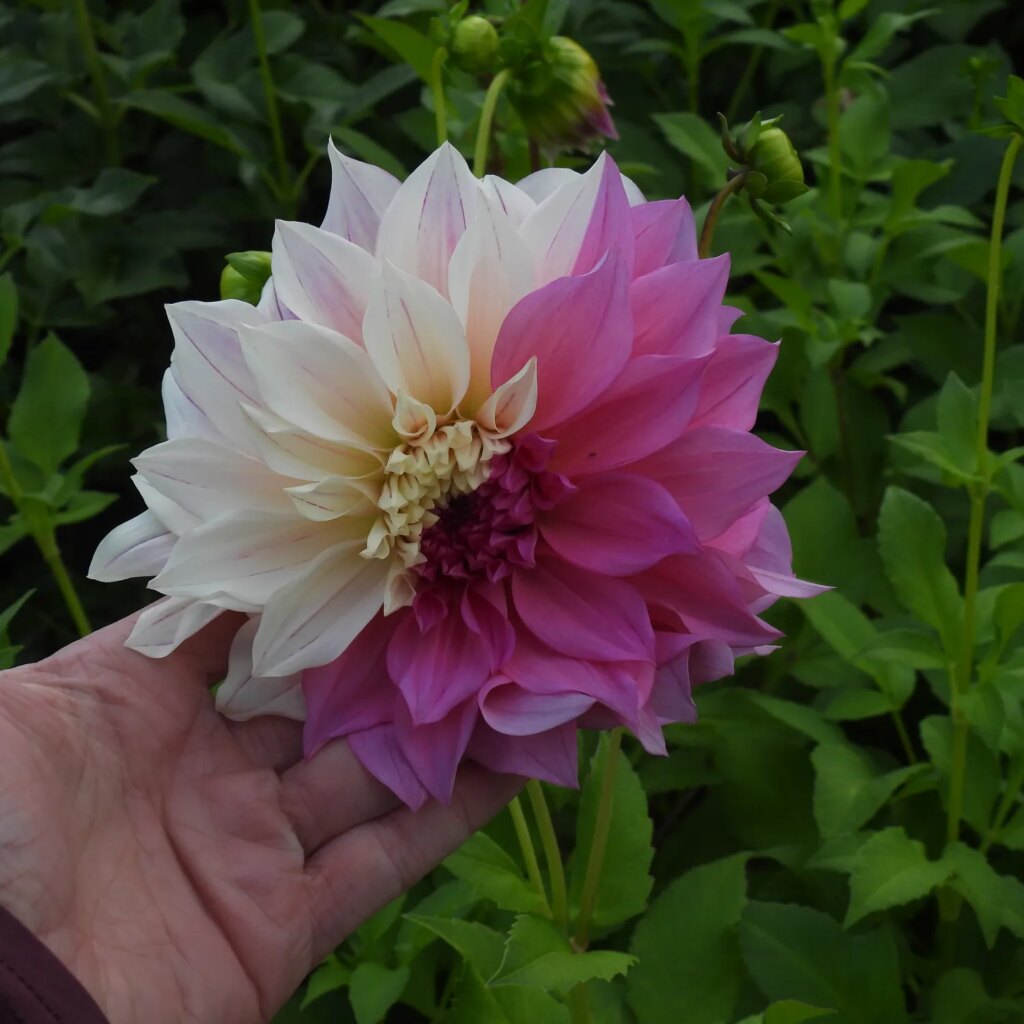
In mid-October, on a row of ‘Café au Lait Royal’ that had been flowering faithfully since July, one bloom opened in two colours. One half was the expected Royal pink, deepened by the cool nights. The other was creamy white, feathered with lilac veins. The line between them ran straight through the middle of the flower, centre and all, as if someone had taken a knife to it.
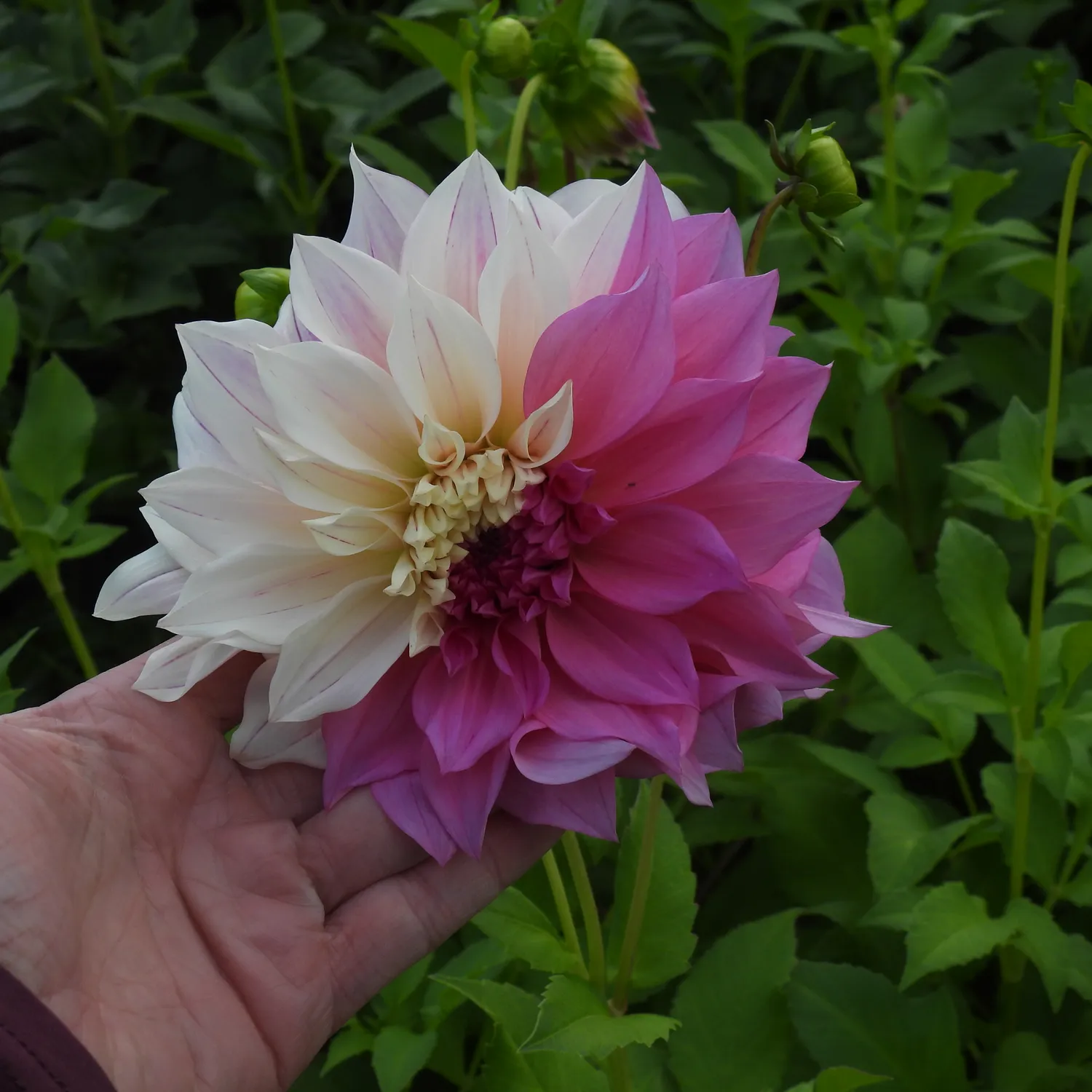
It is not a trick of the light, and it is not a disease. It is a genetic accident with a proper name, and it is one of the more interesting things a dahlia can do. If you grow dahlias for long enough, sooner or later one of yours will do it too.
What is a sectorial chimera?
A dahlia flower is built by a tiny dome of dividing cells at the tip of the shoot, called the growing point. Every petal, and every one of the small florets packed into the centre, descends from those few cells.
Now and then, one of them mutates. The change usually affects a single gene controlling pigment, so that cell and all its descendants make a different colour. Because the growing point builds the flower outwards in a radiating pattern, the descendants of that one cell form a wedge. The result is a flower in two colours with a clean boundary between them. Botanists call it a sectorial chimera, after the Greek monster assembled from parts of different animals.
The tell-tale sign is that the split runs right through the centre. On this flower even the tight inner florets are cream on one side and magenta on the other. No amount of weather or feeding could produce that. Only a difference in the cells themselves can.
Why ‘Café au Lait Royal’?
Dahlias are notoriously changeable. Their genetics are complicated, with eight sets of chromosomes where you and I make do with two, and their pigment genes are unusually prone to switching on and off. A great many named dahlias began life as a sport: a single shoot on an established plant that came up a different colour, was noticed, and was propagated.
‘Café au Lait Royal’ is one of them. It arose as a sport of ‘Café au Lait’, the blush-cream dinner-plate dahlia beloved of wedding florists, and it carries the same form in a richer pink. Sports often keep a tendency to revert, and that is what seems to have happened here. The pale, lilac-veined half looks very like a step back towards the paler parent, while the other half stayed Royal.
The Royal half also looks pinker than it does in August. That part is not genetic. Dahlias colour up as the nights cool, so October flowers are often noticeably deeper than summer ones.
Is it a virus?
Almost certainly not, and the difference is easy to see once you know what to look for. Viruses can also change flower colour, an effect called colour-breaking, but they do it messily and they rarely leave the leaves alone.
| Sectorial chimera | Virus | |
|---|---|---|
| Flower colour | Clean, straight-edged wedge or half | Irregular streaks, flecks or blotches scattered across petals |
| Centre of flower | Split along the same line | Usually unaffected in any orderly way |
| Leaves | Healthy and normal | Often mottled, yellow-ringed, crinkled or stunted |
| Rest of the plant | Other flowers normal | Symptoms tend to spread and worsen |
If your plant has a split flower and clean, green leaves, enjoy it. If the leaves are mottled or the plant is stunted, lift it and put it in the bin, not the compost heap, rather than keep the tubers, as dahlia viruses are spread by aphids and on cutting tools.
Will it happen again?
Probably not on the same plant. A chimera like this usually affects a single flower, or at most a single stem, because the mutation happened in that one growing point. The next flowers along are likely to come normal.
If you would like to try to catch it, this is how new varieties are found:
- Tie a label to the stem now, so you can find it after the frost has blackened the foliage.
- Watch any later buds on that stem. If they also open split, or entirely in the new colour, you may be on to something.
- When you lift the clump for winter, label the tuber that stem grew from.
- In spring, start it into growth indoors and take cuttings from the shoots that come from the crown at the base of that stem.
- Grow the cuttings on and see what they do. Most will flower normally; the rare one that holds the new colour is a sport in the making.
The odds are long, but every dahlia sport in commerce started with someone noticing one odd flower and bothering to label it.
A flower to enjoy, not to worry about
A split flower tells you nothing bad about your plant. Your ‘Café au Lait Royal’ will go on producing its usual pink blooms, and next summer it should flower exactly as it did this one. Cut the odd one for a vase on the kitchen table, where it will start more conversations than a whole bucket of normal ones.
If one of your dahlias does this, send a photo to marketing@ashridgetrees.co.uk. You won’t be the first, and you may not be the last, but it is always a pleasure to see.






Leave a Reply