

Sold as:

from £6.99

Sold as:
from £19.99
 5 Star Service Rating




 Secure, One-Tap Checkout
 5 Star Feefo Rating
 Hand Picked, Delivered to Your Door!
 1 Year Bareroot Guarantee
 Platinum Trusted Service Award 2026
 Mail Order Plant Experts - Est. 1949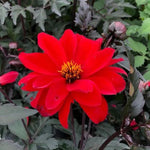
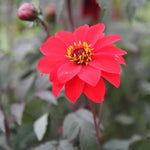

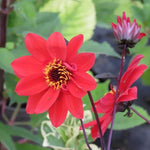





Before the Bishop, dahlias were allotment flowers. Worthy, reliable, a bit old-fashioned. Then Christopher Lloyd started planting Bishop of Llandaff at Great Dixter in the 1990s, and suddenly dark foliage with scarlet flowers was turning up in Chelsea show gardens and Sunday supplement planting schemes. The dahlia revival started here.
The flowers are single to semi-double, bright scarlet with a dark central disc that bees find irresistible. But it's the foliage that changed everything: deeply cut leaves in dark plum, almost black, that would earn a place in any border even if the plant never flowered. Most dahlias have green leaves that fade into the background. The Bishop's leaves are the feature.
At 90cm tall and 90cm across, it fills its space without being difficult. It rarely needs staking, which is unusual for a dahlia this size. The stems are strong and long, the flowers are excellent for cutting, and the plant produces them non-stop from July until the frosts. The AGM it received in 1928 has been confirmed at every review since. Nearly a century of proving itself.
Fred Treseder, a Cardiff nurseryman, bred it in 1924 and invited the Anglican Bishop of Llandaff, Joshua Pritchard Hughes, to select a seedling from his trial beds. The Bishop chose this one. Treseder named it 'Bishop Hughes', but the real Bishop objected to his name being used on a plant. It was changed to 'The Bishop', then changed again because naming rules forbade 'The'. They settled on 'Bishop of Llandaff'. Three names before they stuck. A whole series of Bishop dahlias has since followed, all sharing the dark foliage but with different flower colours.
Dark foliage with scarlet flowers works with hot schemes and surprisingly well with cool ones. Plant the Bishop with David Howard (its own seedling, burnt orange with the same dark leaves) for a family planting that tells a story. For more heat, add Rip City (deep red semi-cactus spikes) and Bishop of York (golden yellow, same dark foliage). For a surprising contrast, try lilac asters alongside. Bronze Carex and cannas with dark leaves extend the tropical-exotic feel. Because the flowers are open-centred, Bishop of Llandaff is one of the best dahlias for pollinator gardens.
Our dahlia tubers are Dutch first-class quality, imported direct and hand-graded by us. We reject undersized tubers so you get a clump with viable eyes, ready to grow. Delivered by next-day courier from March, with our one-year plant guarantee, Which? Best Plant Supplier, and real people on the phone in Somerset if anything isn't right. Browse the complete dahlia collection.
One of the best dahlias you can grow for pollinators. The open, single-to-semi-double flower form means bees and hoverflies can reach the central disc easily, unlike fully double dahlias where the petals block access. If you want a dahlia border that feeds the bees as well as fills the vase, start with the Bishop.
David Howard is actually a seedling from Bishop of Llandaff, spotted by a teenager in Norfolk in the 1950s. Both share the dark foliage. The flowers are completely different: the Bishop's are single, open, scarlet, pollinator-friendly. David Howard's are fully double, rounded, burnt orange, better for cutting. Both hold the RHS AGM. Plant them together and you've got a parent-and-child border.
A whole series. Bishop of York is golden yellow, Bishop of Auckland is velvety crimson. All share the characteristic dark foliage from the original. They look superb planted as a group, three or four varieties running together, dark leaves throughout and the flower colours changing as you move along the border.
Very well. At 90cm with small 7cm flowers, it's compact and doesn't become top-heavy. It's one of the dahlias that genuinely thrives in a container. Use a pot at least 30cm across and deep, feed fortnightly from June, and plant with a bronze grass like Carex comans for a stunning patio combination. Our dahlias in pots guide has the detail.
Usually not, unless you're in a windy spot. The stems are strong and the flowers are small and light. A light support ring at planting time is sensible insurance but most plants hold themselves up perfectly well. Full planting and seasonal care advice is in our dahlia growing guide.


 Sign In
 Saved items