Buying Mixed Fruit Tree Collections Online:
Order Bareroot Trees For 2026 Spring Planting Season
- When your order is ready: your mail order fruit trees are delivered by next working day courier (not the next working day after ordering!)
- Friendly support: if there is anything wrong with your plants when you inspect them, Contact Us within 5 working days
All bareroot plants are covered by our Refund Guarantee, so you can give them a whirl with complete confidence.
Fruit Tree Delivery Sizes: Maidens, Bushes, Half-Standards
Most of our fruit trees are sold bareroot or pot grown in more than one size: something to fit almost any garden.
- Maidens are unbranched, grafted one year prior.
- They are the youngest, cheapest fruit tree you can buy.
- They are the basic "building block" from which all other tree shapes are formed.
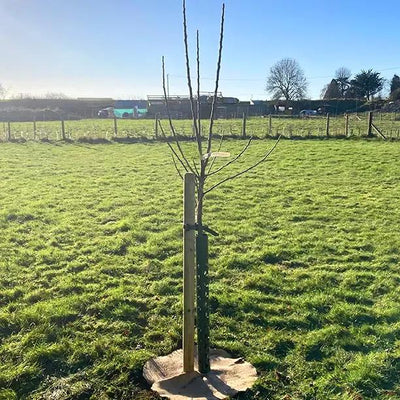
- "Bush" and half-standards forms are branched, grafted two or three years prior.
- They are the most popular options for most gardeners, giving you a real head start on a mature tree:
- The difference is that the bush form has a short trunk about 75cm tall, and the half-standard form has a trunk about 1.25cm tall.
- The bush form is easy to harvest and takes up less space.
- The half-standard form produces more fruit, and you can push a lawn mower around it more easily.
Read more about fruit tree sizes.
Growing Fruit Essential Tips
Plant fruit trees in well-prepared, square holes that are at least 50% wider than the roots.
Unless you are on heavy clay, improve the soil by mixing in well rotted organic matter to the depth of one or two spades (on heavy clay, apply the organic matter afterwards as a mulch).Apply Rootgrow directly to the roots before filling the hole, and make sure that the tree is at the same level in the soil as it was before being transplanted.
Water in well, and then water regularly in dry weather.
Plant bush and half standard fruit trees in the same way as any other tree, as in our fruit tree planting video, with a stout support stake and a strong, padded tie; maidens only need a bamboo cane and some garden twine to hold them upright.
Good hygiene: Remove leaf litter and fallen fruit to prevent pests and diseases overwintering: it is safer to burn this than to compost it, unless you are certain that your compost gets really hot, at least 65C.
Another option is to use debris from your fruit trees as mulch for unrelated plants a reasonable distance away.
Mulch prevents grass and weeds growing around your trees, preserves soil moisture, and slowly releases nutrients. Woodchips or straw are excellent, but whatever you use, do not pile it up against the trunk of your new tree: leave a few inches clear around it.
Protect your fruit trees from pests and diseases: aphids can reduce the vigour of young trees in summer, and an organic winter wash kills the overwintering eggs and larvae of several pests.
How to Get Fruit Quickly?
1. Remove the First Fruit on New Trees
Your trees will establish faster if you remove all of their fruitlets right after flowering in the first year that they do flower, and the majority of them in the second year - leave only one nice specimen per main branch to ripen.What you really want to grow are the roots and the main branches, so a little patience pays off!
In the third and subsequent years, merely thin the fruitlets enough so that the young branches don't snap.
2. Use Mulch
In the early years, you want your establishing trees to have:
- Zero competition from weeds & grass
- Consistently moist soil
- Active soil life - the basis of soil fertility
Mulch will help hugely with all of those things, whether you use a woven plastic sheet like Mypex, something biodegradable like our hemp mulch mats, or organic matter like woodchips, compost, lawn clippings, or Autumn leaves.
Remember that because mulch is not dug into the soil, it does not need to be rotted.
The exceptions are horse and chicken manure, which are too high in Nitrogen when fresh and should be aged for a year first.
3. Plant Soft Fruit at the Same Time
To get fruit quickly, try planting soft fruit bushes around your young fruit trees, especially if you are planting an orchard and therefore preparing and irrigating long strips of ground.
Give the new fruit trees about a metre of space around their trunk at first, they need a couple of years to take over the root zone around them with no competition, after which the soft fruit won't be a problem for them.
Soft fruit canes like raspberries are easy to lift and move in winter, and strawberries are propagated by runners, so after five or so years, when your fruit trees are getting big and casting more shade, you can redeploy or pot up your by-then huge beds of soft fruit.
Pruning Fruit Trees
Prune fruit trees with sharp, clean tools.
Ideally, disinfect your tools with alcohol between each tree, and between each cut if there is any sign of disease.
As with any tree, remove DDD wood at any time: Dead, Diseased, and Damaged wood.
Do most pruning in winter, except on stone fruit (Prunus species: cherry, plum, gage, damson), which should only be pruned in dry weather during late spring and summer, when the sap is flowing.
Our pruning videos show you how easy it is to train maidens into your own Open Centre Bush or Half Standard forms, and cordons for spur bearing apples and pears (if you buy those forms ready-made, skip the year one video and start at year two).
Choosing Fruit Trees
Should I Buy Bareroot or Pot Grown Fruit Trees?
We recommend that you plant bareroot fruit trees during winter, November to March.
Bareroot plants are cheaper, easier to handle, and more certain to establish well.
With that said, there is nothing wrong with pot grown fruit trees, and they have the advantage of being ready to plant at any time, as long as you can water them without fail during the growing season.
Which Variety Should I Choose?
To begin choosing varieties that will grow well in your soil and local conditions, talk to your fruit-growing neighbours (especially down the allotment), read our fruit tree descriptions, and call us if you have any doubts.
- In Scotland and the North, trees that flower later are more likely to avoid late frosts.
- In partial shade, fruit that is intended for cooking has less sugar and so requires less sun to ripen.
- In full shade, nothing really fruits well: Morello sour cherries, Hazelnuts, and Elderberry are some of your only options for a modest crop.
Which Fruit Tree Shape Should I Choose?
The best fruit tree shape for you will mostly depend on how much space you have.
- For a normal town garden, a tree prepared as a bush (i.e. with a short trunk) is ideal, and should grow to under 3 metres.
- A half standard is a proper orchard tree that will reach around 4 metres.
- Selected varieties are available as ready-made cordons, which are grown diagonally on wires, usually against a sunny wall.
One-year-old maidens are the cheapest way to buy a fruit tree, from which you can make any shape; you must start with a maiden for training fans or espaliers.
Our fruit tree shapes page has more details.
Fruit Tree Pollination
Most fruit trees require a pollination partner to produce crops, and even most varieties listed as "self-fertile" still produce better crops with one.
What is a Pollination Partner?
A pollination partner is a tree of the same species but a different variety that is in flower at the same time.
So, an apple tree will not pollinate a cherry tree, and one James Grieve apple tree will not pollinate another James Grieve.
The good news is that, in most parts of the UK, there are almost always suitable pollination partners already in your area.
Cultivated and wild apples, pears, cherries, and plums (which includes damsons, gages etc) are very common, both for fruit production and as ornamental or hedge plants, so pollination partners are mostly a concern for gardeners in isolated, wind-swept areas, and for commercial orchard growers.
Our pollination checker has more details.





 Sign In
 Saved items
 Secure, One-Tap Checkout
 5 Star Feefo Rating
 Hand Picked, Delivered to Your Door!
 1 Year Bareroot Guarantee
 Platinum Trusted Service Award 2026
 Mail Order Plant Experts - Est. 1949