


Sold as:

from £10.95

Sold as:
from £19.99
 5 Star Service Rating




 Secure, One-Tap Checkout
 5 Star Feefo Rating
 Hand Picked, Delivered to Your Door!1 Year Bareroot Guarantee
 Platinum Trusted Service Award 2026
 Mail Order Plant Experts - Est. 1949
 1 Year Bulb Guarantee
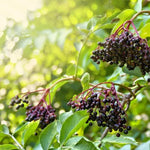
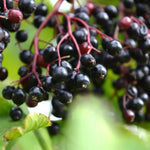
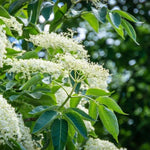
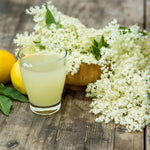




Elder is a native large shrub or small tree with fragrant cream flowers in early summer and black berries after them, and you can use both in the kitchen. It grows almost anywhere, extreme chalk included, and it takes hard pruning. As a hedge it is rough and vigorous, so give it a run of its own.
The Common Elderflower or Elderberry tree, Sambucus nigra, is a large native shrub or small tree with graceful, fern-like leaves. It produces deliciously scented white flowers and purple berries, which are both edible. It can be used as a rough, rugged country hedging plant and will grow almost anywhere.
Left alone, Elderflower makes a verdant tree about 6 metres high: for more ornamental value, have a look at our Golden Elder or the lovely cultivar Black Lace.
Browse our selection of native hedging or our full range of hedging plants.
Delivery season: Bareroot plants are delivered during late autumn and winter, approximately November-April inclusive.
It's indestructible and will grow practically anywhere in the UK, including piles of construction rubbish, and very sandy coastal soils. In full shade, it'll become sparse and produce few flowers, but otherwise be fine. Few shrubs are easier to grow. I once hacked an old elder to smithereens to remove it, and dumped the pieces into an area of the garden that was left to grow wild with plenty of nettles and brambles: two years later, there was an Elder thicket there, already higher than the weeds.
Spacing an Elderflower hedge: Being such a bulky beast, a 50cm spacing is fine.
This plant makes a nice solid hedge by itself, but it's aggressive and is not recommended for a mixed hedge. It'll never form a tidy, formal hedge and looks best when it's allowed to get a bit overgrown.
Elder is included in some mixed hedging packs although isn't really suitable for planting in the middle of a native hedge because it'll aggressively grow into the plants beside it. You can control this with hard pruning, but to save you the effort we recommend using it only at the end of a hedge, on a strip by itself, or planting it away from the hedge and letting it grow as a large shrub or small tree. Letting it grow freely will also give you a lot more flower heads and then berries. A farm near us has about 100m of solid elder hedge that they cut back in alternating 2-3 metre sections every year, so that there is always a good crop of flowers on the sections that were not trimmed.
Our own Elderflower cordial recipe makes a fabulous soft drink, and easy to prepare. With a bit more work, you can also make Elderflower syrup and Elderflower champagne. It is widely used in alcoholic drinks across Europe, such as types of Hungarian brandy and Swedish snaps. You can also try battering the flowers and quickly frying them for a cheap but exotic snack.
It is usually the case with widespread native plants that are also useful to humans to have a lot of common names from various regions, which include: acte, arn, boon, bur, boor and pipe tree.
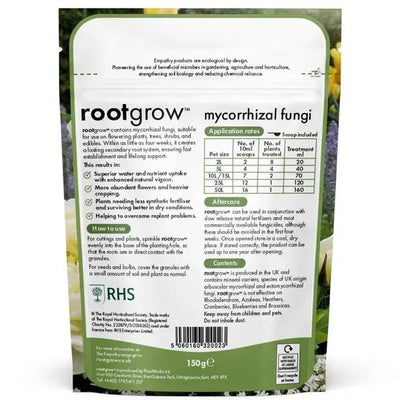
Elder elbows its neighbours, so plant it at the end of a native hedge of Hawthorn and Hazel, or on a strip of its own. For more colour from the same plant, Golden Elder and Black Lace are garden forms of it. Dust bareroot roots with Rootgrow as you plant.
Hedging is not a sideline here: your Elder is grown for us as hedging by specialist growers. Bareroot plants are lifted to order while dormant and guaranteed for 12 months. Ashridge has sold plants since 1949 and is a Which? Best Plant Supplier 2025.
Yes. Sambucus nigra is a native plant.
Left alone, it makes a bushy large shrub or small tree to about 6 metres tall and 2.5 to 4 metres wide. It tolerates hard pruning, so you can hold it well below that.
We advise against it. Elder grows hard into the plants beside it. Use it at the end of a hedge, on a strip by itself, or as a free-standing shrub, where it also flowers and fruits more.
Yes. It thrives even on extremely chalky sites, and it is easy in any moderately fertile, moist but well-drained soil.
In partial shade, yes. In full shade it becomes sparse and carries few flowers, so give it some sun if you want Elderflowers and berries.
As hard as you like. To keep the flowers coming, cut alternate sections back each year, so that the sections you left alone carry the crop.
Bareroot only, from November to April, while the plants are dormant. You can order at any time of year and your plants are lifted and sent once the season opens.




 Sign In
 Saved items