


Sold as:

from £10.95

Sold as:
from £19.99
 5 Star Service Rating




 Secure, One-Tap Checkout
 5 Star Feefo Rating
 Hand Picked, Delivered to Your Door!
 1 Year Bareroot Guarantee
 Platinum Trusted Service Award 2026
 Mail Order Plant Experts - Est. 1949
 1 Year Bulb Guarantee





Black Poplar is a large, fast-growing tree with a broad, rounded head and a trunk that develops the deep fissures and distinctive burrs (knobbly woody outgrowths) that make mature specimens so recognisable. It thrives in damp ground where many other trees struggle, and tolerates heavy clay, wet sites and atmospheric pollution. The diamond-shaped leaves open bronze in spring, darken to a glossy green through summer, and turn yellow in autumn. Red catkins appear on male trees in spring before the leaves unfurl.
Once common on floodplains and river valleys across lowland Britain, Black Poplar numbers have been falling for two centuries. Fewer than 7,000 trees are thought to remain in the wild, of which less than 10% are female. Drainage of wetlands, hybridisation with commercial poplar cultivars, and the loss of its traditional uses in timber have all contributed to the decline. Planting Black Poplar — whether for screening, wildlife or conservation — is a practical step towards keeping this tree in the British landscape. We are unable to determine the sex of your trees before delivery, but they are more likely to be male than female.
Give it space. Black Poplar grows into a big tree with powerful, wide-spreading roots that can extend 30m or more from the trunk. Do not plant within 25m of buildings, walls, drains or foundations. It is a tree for open ground: field boundaries, large rural gardens, farm windbreaks, pond margins, and floodplain restoration schemes. The wetter the site, the happier the tree. It will grow in drier soils too, but its natural home is damp, low-lying ground. Full sun is preferred.
For screening, space saplings 3–5m apart. Growth is rapid — young trees can put on a metre or more a year in good conditions — so a row of saplings planted in winter will form a credible screen within a few seasons. Black Poplar is not suitable for clipping as a hedge.
Over 100 insect species are associated with Black Poplar, including the Poplar Hawk Moth, the Hornet Moth, and the Figure of Eight. The catkins provide one of the earliest sources of pollen for bees in spring. Seeds are eaten by finches. The burred, fissured bark of older trees creates habitat for invertebrates, fungi, lichens and cavity-nesting birds. Few native trees support as many specialist species.
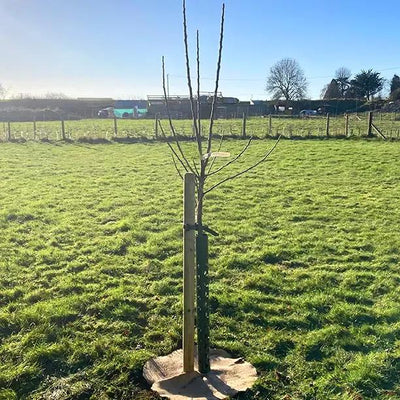
UK-grown bareroot saplings, dispatched dormant during the winter planting season (November–March) by next-day courier. All bareroot trees carry our one-year guarantee. We've been growing and selling trees since 1949 and hold the Feefo Platinum Service Award and the Which? Gardening Best Plant Supplier award. If anything's not right, contact us.
This is Populus nigra, the European Black Poplar species. For the native British subspecies, Populus nigra subsp. betulifolia (also known as the Manchester or Midland Poplar), see our Native Black Poplar page.
Fast. Young trees on a damp site can add 1–2m of height per year. A sapling planted in November will be noticeably taller by the following autumn. Expect a substantial tree within ten years.
At least 25m away — further if possible. Black Poplars have aggressive, wide-spreading root systems that can damage drains, foundations and boundary walls. This is a tree for open ground, not small gardens.
It will cope with most soils except dry chalk, but it performs best in damp or heavy ground. Poplars are naturally floodplain trees and really thrive where it's wet.
No — it grows too large and doesn't respond to regular clipping. Use it as a screening tree instead, planting a row 3–5m apart. For a more formal screen, Lombardy Poplar gives a narrower, more columnar form.
Bareroot trees are delivered during the dormant season, November to March. You'll receive an email with your expected delivery window once you've ordered. Plant as soon as possible after delivery, and water in well.


 Sign In
 Saved items