


Sold as:

from £10.95

Sold as:
from £19.99
 5 Star Service Rating




 Secure, One-Tap Checkout
 5 Star Feefo Rating
 Hand Picked, Delivered to Your Door!1 Year Bareroot Guarantee
 Platinum Trusted Service Award 2026
 Mail Order Plant Experts - Est. 1949
 1 Year Bulb Guarantee
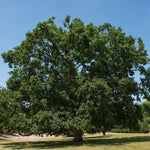

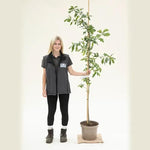
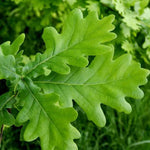






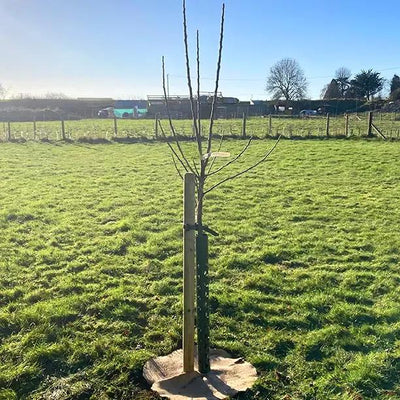
English Oak, Quercus robur, is the native common oak: a large deciduous tree of 20 to 40m with a broad crown, lobed dark green leaves and acorns on stalks. It wants deep, moist but well-drained soil, takes lime, and is planted for your grandchildren as much as for you.
Quercus robur, the Common or Pedunculate Oak AKA just English Oak, is an enormously strong tree with spreading branches; old oaks are often a bit wider than they're tall. It has distinctive, deep green lobed leaves and short strings of light green, wind-pollinated flowers in spring that ripen into acorns.
They can reach a height of 20 to 40 metres.
You can also buy Common Oak as smaller saplings.
Browse our other Oak tree varieties, or all of our trees.
Delivery season: Oak trees are delivered bareroot during late autumn and winter, approximately November-April inclusive. Pot-grown trees are delivered all year, whenever they are in stock.
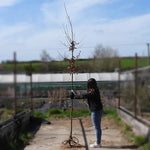
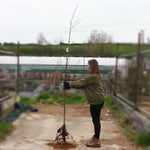
Choosing a size: Small trees are cheaper, easier to handle and more forgiving of less than ideal aftercare, so they're best for a big planting project. If instant impact is your priority, or if you are only buying a few plants for use in a place where it's convenient to water them well in their first year, then you may as well use bigger ones. All our bareroot trees are measured by their height in centimetres above the ground (the roots aren't measured).
Oak will grow in most soils, tolerates a bit of damp, and loves rich clay. Young oak trees are shade-tolerant and can take their time growing up into the sunlight. They're often interplanted with fast-growing conifers.
The Sessile Oak is a better choice for rocky hillsides with sharper drainage and higher altitude.
Quercus is Latin for oak, and robur, as in robust, refers to the strength of the wood.
A mature native oak is probably the single best tree for supporting wildlife, playing host to over 400 insect species and attracting jays. The bark of older trees is deeply ridged and provides a home or place to lay eggs for insects. The acorns are eaten by all sorts of animals, and pigs love them. Pollarding trees used to be a common practice to provide easily accessible firewood and fodder for animals.
Oak timber is excellent and was prized for ship-building in the past, and is still in demand for furniture and the interiors of houses: you can't beat an oak floorboard.
Then here’s to the oak, the brave old oak,
Who stands in his pride alone;
And still flourish he, a hale green tree,
When a hundred years are gone!
Standard trees are measured by their girth in centimetres 1 metre above ground level: their trunk's waist measurement. Unlike sapling trees and hedge plants, standards aren't measured by their height, which will vary quite a bit both between and within species.
So, a 6/8cm standard tree has a trunk with a circumference of 6-8cm and an 8/10 standard has a trunk 8-10cm around. This measurement makes no difference to the tree's final height.
On average, standard trees are 2-3.5 metres tall when they arrive, but we cannot tell you precisely how tall your trees will be before we deliver them.
An oak keeps the company of the hedgerow. Hawthorn and field maple run along beneath it in every old field boundary, and a Green Beech is the other great native for a big space. Where you want speed, Turkey Oak is the fast-growing cousin. You will find the rest of the natives among our native British trees, and the big ones gathered under trees for large gardens and parkland.
Ashridge has been in business since 1949 and is a Which? Best Plant Supplier 2025. Your oak is grown for us by specialist growers, in five sizes. Bareroot trees are guaranteed for 12 months, as are pot-grown trees delivered leafless between November and March.
Look for the stalk. English oak carries acorns on stalks and its leaves have almost none; sessile oak is the reverse. English is the lowland tree of clay and hedgerows, sessile the upland one.
For most gardens, yes. It reaches 20 to 40m with a crown wider than 8m. Give it a field corner, a paddock or parkland to grow into and it will outlive the house.
English oak is lime tolerant, so chalk is no bar where there is depth of soil over it. It is happiest on deep, moist but well-drained ground, and rich clay suits it.
An oak takes about forty years to bear its first real crop. After that crops vary from year to year, and wildlife eats much of what falls before it can germinate.
Saplings for a wood, a hedge or a long view: they are cheap and establish easily. A standard where you want a tree you can see from the house in its first year.




 Sign In
 Saved items