


Sold as:

from £10.95

Sold as:
from £19.99
 5 Star Service Rating




 Secure, One-Tap Checkout
 5 Star Feefo Rating
 Hand Picked, Delivered to Your Door!1 Year Bareroot Guarantee
 Platinum Trusted Service Award 2026
 Mail Order Plant Experts - Est. 1949
 1 Year Bulb Guarantee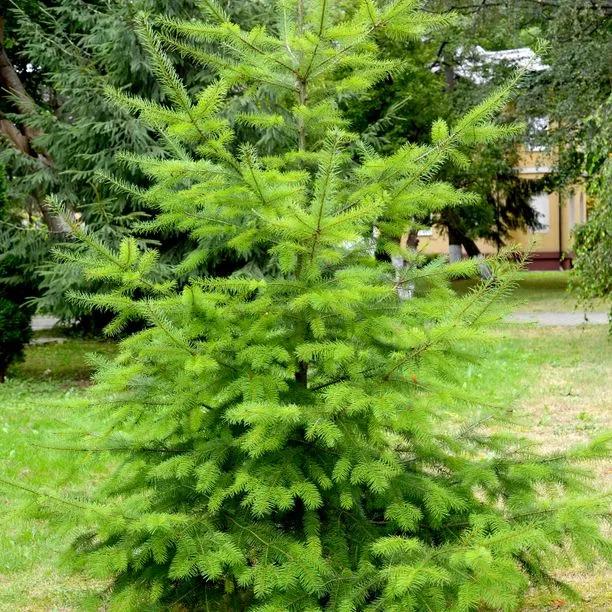



Douglas Fir is one of the great timber trees: a fast, conical evergreen that in time becomes very tall, with thick, rugged bark. Plant it for a high screen, a windbreak or a woodland, in full sun and any drained soil except chalk. It is rated H6 and stands an exposed site.
Douglas Fir trees, Pseudotsuga menziesii, are large and vigorous evergreen conifers. Mature trees in the open have a lush, attractive canopy.
For such a big tree, the Douglas Fir has a fairly compact canopy, with downward pointing lower branches that do a great job of blocking out sight from about 5 metres off the ground when they're mature. Older trees have very thick, corky bark with lovely sinuous ridges.
They're not suitable for a clipped hedge, and can be grown as a tall windbreak and screening tree up to about 55+ metres high.
Delivery season: Firs are delivered bareroot from late autumn to early spring, November to April.
They're great for poor soil, as long as the site isn't too dry: British rainfall should be enough for them. As with any tree that grows in dry conditions, it still needs watering to establish.
For a mixed conifer screen, plant it with Scots Pine and Norway Spruce. If you want a conifer that you can clip as a hedge, Western Red Cedar is the one to use. The rest are with our conifers. Dust the roots with Rootgrow as you plant.
Hedging and young trees are not a sideline here: your Douglas Fir saplings are grown for us by specialist growers. Bareroot plants are lifted to order while dormant and guaranteed for 12 months. Ashridge has sold plants since 1949 and is a Which? Best Plant Supplier 2025.
Very tall indeed: well over 12 metres, and it keeps growing for more than fifty years. It is a tree for a big space.
Fast. Give it room from the start.
No. It wants a well-drained soil that is acid to neutral, in full sun.
No. It is a screening and woodland tree. It needs little pruning beyond removing a competing leader on a young tree.
By the cones. They hang down, reach about 10cm, and have a three-pointed bract sticking out between the scales.
In their first year, yes. Once established, ordinary British rainfall is enough.
Bareroot only, from November to April, while the plants are dormant. You can order at any time of year and your plants are lifted and sent once the season opens.


 Sign In
 Saved items