 1.webp)
 1.webp)
 2.webp)
 3.webp)
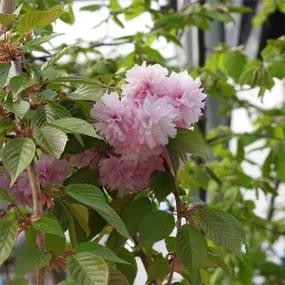
Cheal's Weeping Japanese Cherry Trees


- Short, weeping tree.
- Early flowering.
- Rich pink blossom.
- Max. Height: 4m
Recommended extras
Description
Prunus Kiku-shidare Zakura: Bareroot Cheal's Weeping Cherry Trees in Standard Sizes
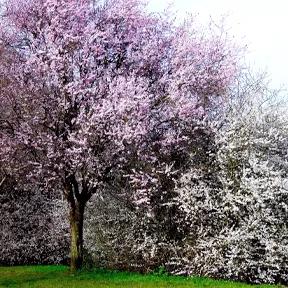
Kiku shidare is a Japanese cherry blossom tree (Zakura) with an exceptionally compact and weeping habit that makes it one of the smallest ornamental cherry trees, suitable for almost any garden. The soft pink, extremely double blossoms, with rows of slightly pointed petals, are likened to chrysanthemums. They come out in force in April and May, while the young leaves are still small and richly coloured, so that all you can see from a distance is a low dome of flowers that trail down to the ground. In autumn, the leaves turn into a warm muddle of purple-red and orange.
It is ideal for the centre-piece of a lawn and looks superb near a pond - the best example that we have seen was planted directly above the pond's artificial waterfall, so that the stream of water emerged from the hanging branches. Children love playing under the canopy when it is in flower, and we suggest that you treat yourself on a bright spring day by taking a blanket outside, spreading it underneath your tree, lying down and gazing up at the sky through a dome of cherry blossom.
It will reach a height of about 4 metres.
Browse our variety of flowering cherry trees or our full range of garden trees.
Delivery season: Kiku-shidare cherry trees are delivered bareroot during late autumn and winter, approximately November-March inclusive.
Choosing a size: Small trees are cheaper, easier to handle and more forgiving of less than ideal aftercare, so they are best for a big planting project. If instant impact is your priority, or if you are only buying a few plants for use in a place where it is convenient to water them well in their first year, then you may as well use bigger ones. All our bareroot trees are measured by their height in centimetres above the ground (the roots aren't measured).
Features:
- Height: 4m, compact, weeping habit
- Soil: Any decently well drained
- Use: Specimen, small garden, large container
- Colour: Light pink, very double flowers in April
- Bareroot delivery only: November-March
Growing Kiku-shidare Cherry Trees
Suitable for any fertile, well drained soil, we recommend planting in full sun. Ideal for large containers designed for trees.
Only prune dead, diseased or damaged wood.
Planting Instructions
Notes on planting Prunus Kiku Shidare Zakura Cherry trees:
They trees prefer fertile, moist soil with good drainage. They like heavy clay, as long as the site doesn't become waterlogged in winter. They are good to grow on chalky soil.
Although they are tolerant of shade, we really recommend them for full sun. Cherry trees in the shade tend to become spindly and won't flower very well.
We don't recommend them for exposed, windy sites, where they will be blown out of shape by the wind.
Although your trees are hardy, late spring frosts can ruin their flower display. Avoid planting cherry blossom trees in frost pockets or North facing sites in colder areas.
Prepare your site before planting:
It is good to dig over the site where you plant a tree several months in advance. Kill the weeds first: for tough weeds like nettles, brambles and ground elder, you will usually need a weed-killer to get rid of them. When you dig the soil over, remove stones and other rubbish and mix in well rotted compost or manure down to the depth of about 2 spades.
Watch our video on how to plant a tree for full instructions.
Remember to water establishing trees during dry weather for at least a year after planting.
Tree Planting accessories:
Prepare your site for planting by killing the weeds and grass.
You can buy a tree planting pack with a wooden stake & rubber tie to support the tree and a mulch mat with pegs to protect the soil around the base of your tree from weeds and drying out.
We suggest that you use mycorrhizal "friendly fungi" on the roots of all newly planted large trees: if your soil quality is poor, we strongly recommend it.
You can also improve your soil with bonemeal organic fertiliser.
Did You Know?
This tree is often listed as Cheal's Weeping Cherry in Britain: the two trees are so similar that they can't really be told apart and one is frequently sold as the other, but they are in fact different varieties. Most trees sold as Cheal's in the UK are in fact Kiku Shidare.
The Japanese name means Chrysanthemum (kiku) Weeping (shidare) Cherry (zakura); Chrysanthemum refers to the exceptionally large number of petals.
Old sources may list is as Prunus serrulata Rosea.
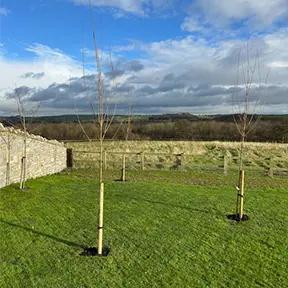
Standard trees are measured by their girth in centimetres 1 metre above ground level: their trunk's waist measurement. Unlike sapling trees and hedge plants, standards aren't measured by their height, which will vary quite a bit both between and within species.
So, a 6/8cm standard tree has a trunk with a circumference of 6-8cm and an 8/10 standard has a trunk 8-10cm around. This measurement makes no difference to the tree's final height.
On average, standard trees are 2-3.5 metres tall when they arrive, but we cannot tell you precisely how tall your trees will be before we deliver them.
It's Spring Planting Season 2025
Pot Grown & Plug Plants Delivered

Direct from the Nursery Value

No more broken plants in the post!