Hedge Plants and Sapling Trees
Buy potted plants and Hedge Troughs now for quick delivery
Order bareroot hedge plants for 2026 autumn planting season
Browse our UK-grown hedge plants and sapling trees for garden and field boundaries, tall privacy screening, and wildlife habitat.
Available bareroot (November-March delivery) or potted year-round.
Popular Choices:
What is so good about bareroot hedging?
The majority of hedging and sapling trees planted in the UK is bareroot. Buying plants with no soil around the roots doesn't sound ideal the first time you hear it, but it really does mean better plants that are cheaper and easier to work with than pot grown.
The strong, field grown stock transplants so well because it's sleeping in winter, minimising stress.
While out of the ground, plants are kept in ideal cold, humid conditions until picked, quality-checked, and sent by next-day delivery.
Bareroot hedge plants are, compared to pot grown equivalents:
- Cheaper
- Stronger, field grown plants
- Faster growing & better establishing
- Weigh much less = easier to handle and plant
- More eco-friendly, plastic free cultivation
- Wider selection available
- Only delivered November-March
Some plants or larger sizes only come in pots. We have some popular species for sale as bareroot in winter and potted the rest of the year.
Where you have a choice, bareroot is better.
- When your order is ready: your mail order hedge plants are delivered by next working day courier (not the next working day after ordering!)
- Friendly support: if there is anything wrong with your plants when you inspect them, Contact Us within 5 working days
All bareroot plants are covered by our Refund Guarantee, so you can give them a whirl with complete confidence.
To add interest to a new hedge or woodland, you cannot beat a range of garden bulbs .
What are the cheapest hedge plants?
Bareroot is always cheaper than pot grown. Small sizes of hedging plant are better value than large.
Top 4 cheapest deciduous hedges:
Top 4 cheapest evergreen hedges:
For larger projects, mixed hedge packs offer the best value per plant.
Choosing Which Size Hedge Plants to Order
At Ashridge Nurseries, we have a wide selection of UK-grown hedge plants for sale online; the most popular species are delivered in sizes ranging from little 40/60cm tall unbranched 'whips', up to over 1.5m, feathered with side branches.
- If you are in a hurry for privacy and need instant impact, then pick the biggest size that fits your budget
- Otherwise, we recommend planting smaller plants, which require less maintenance to reliably produce a satisfyingly dense mature hedge
- If you are filling gaps in an existing hedge, large replacements are usually better, but small plants can slide into tough soil full of roots, and require less water.
Smaller plants have several advantages
- Cheaper
- Easier to plant
- Establish well because they are dug up with most of their roots intact
- Need less water in their first summer (but watering is still essential in dry weather)
- Can be clipped attentively to ensure a bushy base & dense growth
So Which Size Hedging Should I Order?
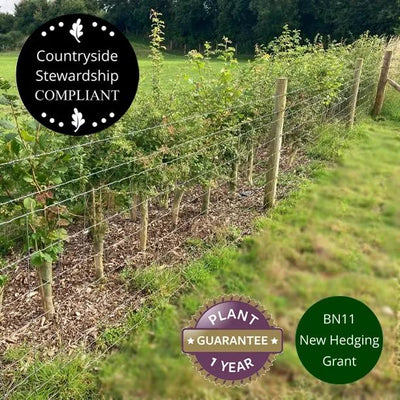
- Farmers and other large scale hedge or forestry projects prefer 40/60cm tall: it's the minimum required size for Countryside Stewardship hedging , and has the best success rate in field conditions.
- Bareroot conifers typically have to be sold a bit smaller, e.g. 20/40cm tall for a Sitka Spruce .
- Many people choose 60/80cm tall as a great compromise between price, size, and waiting time until you get a mature hedge.
- Plants over 80cm tall are good for creating privacy ASAP, or filling gaps in mature hedges. Popular choice for short, housefront hedges that are only a few metres long.
- Remember, big plants need more water in their first year to thrive.
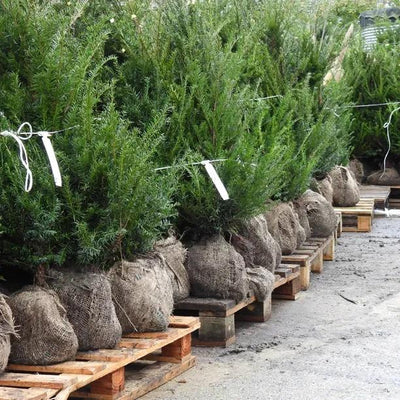
- Rootballed Yew is the biggest hedging we deliver, along with Instant Hedge Troughs .
Choose the Best Hedging for Me
Most people plant evergreen hedges or beech / hornbeam around their homes for privacy and year round interest, and rugged, deciduous native plants everywhere else.
Most popular hedge plants lists:
More Useful Hedge Plant Lists:
What plants can't I use in a hedge?
Most hedge plants are sapling trees, but not all sapling trees make good hedge plants.
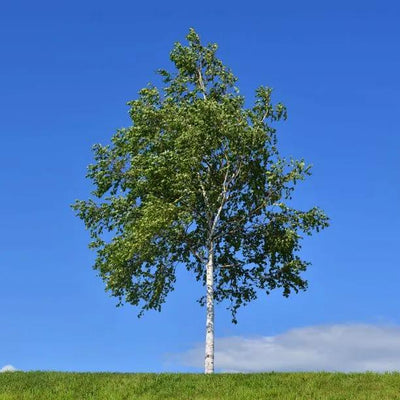
Trees like Birch, Oak, Sycamore, Rowan, and Wild Cherries on their own don't produce satisfying hedges, especially in winter when bare branches provide little screening.
You will spot them growing wild in mixed native country hedges, looking fine surrounded by solid hedge plants like Hawthorn and Blackthorn, but it's not standard practice to buy and plant them as part of the clipped hedge.
However, their hedge-sized saplings or "tree whips" are good for any garden or forestry purpose, and they are often planted every few metres along country hedges, intended to grow as hedgerow standard trees above the hedge line, not clipped with it.
Use tree guards on hedgerow trees so their tops aren't trimmed with the hedge.
When and how do I plant hedging?
Bareroot: November to March
Pot grown: Year round
See our step-by-step guides:
How many hedge plants per metre?
Standard spacing for most hedging:
- Single row garden hedge: 3 plants per metre, 33cm apart
- Double row stockproof, grant compliant: 6 plants per metre, 33cm apart along each row, rows 40cm apart
- Interior garden hedges: 2 per metre
- Beech & Hornbeam double row: 4 plants per metre, 50cm apart along each row, rows 35-50cm apart
- Box - Buxus: 5 plants per metre (20cm apart)
For detailed spacing by plant type and purpose, see our complete hedge spacing guide .
Aftercare
New hedges need watering and weeding in their first year to establish, and mulch is recommended. Read more about new hedge aftercare .
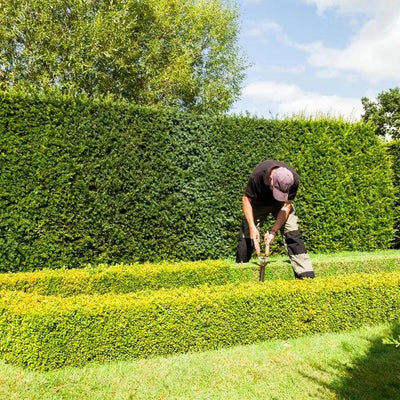
Hedge Trimming
Trimming is essential for dense hedges. Best timing: autumn to early spring (avoid pruning during nesting season, March-August).
For detailed trimming instructions by hedge type:


 Sign In
 Saved items


 5 Star Service Rating




 Secure, One-Tap Checkout
 5 Star Feefo Rating
 Hand Picked, Delivered to Your Door!
 1 Year Bareroot Guarantee
 Platinum Trusted Service Award 2026
 Mail Order Plant Experts - Est. 1949