
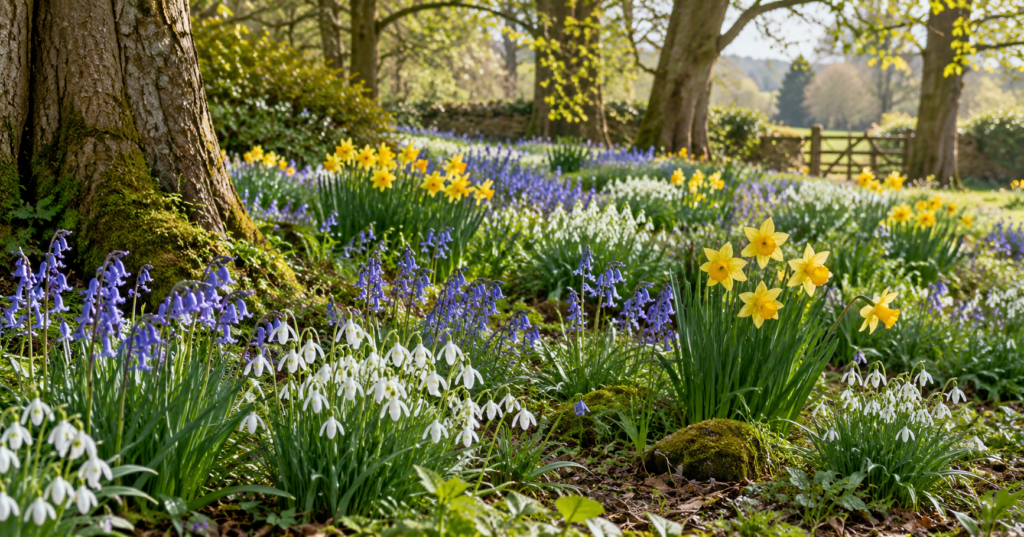
September is the ideal month to plant spring-flowering bulbs across the UK — soil is still warm enough for root growth before winter, and bulbs planted now have the longest possible head start on spring. Bluebells and snowdrops go in at 7–10cm deep, daffodils a little deeper at 15cm, with spacing between 5cm and 15cm depending on the bulb.
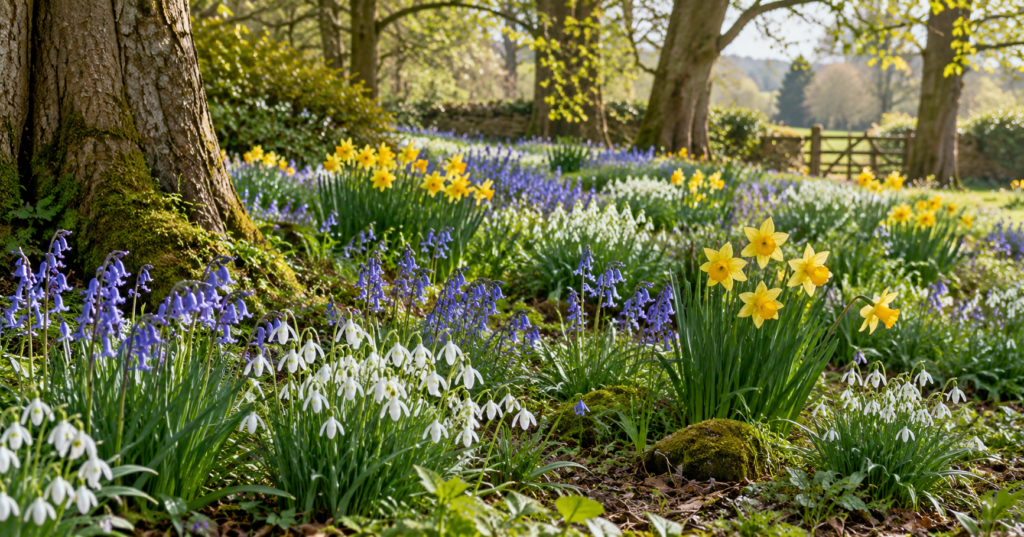
There’s a particular kind of impatience that sets in around now, isn’t there? The garden’s winding down, the light’s going earlier, and part of you is already thinking about spring before autumn’s even properly arrived. Good news: this is exactly the moment to do something about it. Every bulb we get in the ground this month is a small bet on next spring paying off — and unlike most gardening jobs, this one’s genuinely satisfying, because you get to forget about it completely until it rewards you months later.
We plant hundreds of these three every autumn — bluebells, snowdrops, daffodils — and between us we’ve made most of the mistakes there are to make with bulb depth and spacing, so you don’t have to. Here’s exactly how deep and how far apart to plant each one, plus why they naturalise so beautifully together once they’re established.
Why September is the best month to plant
We’ll be honest: bulbs are pretty forgiving, and you can get away with planting later into autumn if life gets in the way. But if you want the strongest possible show next spring, September has a real edge, and it’s mostly down to soil temperature rather than anything mystical. Get bulbs in while the ground’s still warm from summer and they’ll spend autumn quietly building roots, rather than sitting in cold, wet soil doing very little.
- Soil is still workable. September ground is a joy to dig compared with the heavy, waterlogged soil you’re often fighting by November.
- Roots get a head start. Bulbs planted now develop roots through autumn, ready to put all their energy into flowering rather than establishing, come spring.
- You avoid the bareroot rush. Bulb planting and bareroot pre-ordering both land in autumn — get bulbs sorted now and November’s diary stays clear for everything else.
A note from Somerset: does your postcode change the planting window?
We’re based in Castle Cary, in Somerset, and our own trial beds sit in that gentle, mild South West climate — soil here tends to stay workable well into autumn, and our first proper frosts often hold off until late October or even November. But we despatch bulbs the length and breadth of the UK, and if you’re gardening further north, or somewhere that gets a harder frost early, it’s worth shifting your own timing a little earlier than ours.
- Northern England, Scotland, and anywhere at altitude: aim to get bulbs in the ground by early-to-mid September if you can. Ground frost and a hard freeze can arrive several weeks earlier than in the South West, and bulbs need those weeks of root growth before the soil turns properly cold.
- Southern and coastal England (including us, here in Somerset): you’ve generally got a bit more room to breathe — planting comfortably continues through October, and daffodils in particular will still do well planted into early November.
- Not sure which camp you’re in? A good rule of thumb is your average first frost date: if it typically falls in October, treat this month as your priority window rather than a flexible one.
Planting depths and spacing at a glance
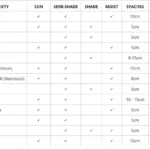
If you only remember one thing from this whole guide, make it this table — we’ve had this pinned up in the potting shed for longer than we’d like to admit.
| Bulb | Planting depth | Spacing | Best position |
|---|---|---|---|
| Bluebells | 10cm (4in) | 10cm apart | Dappled shade, under trees or in a woodland-style border |
| Snowdrops | 7–10cm (3–4in) | 5–8cm apart | Light shade, borders or naturalised in short grass |
| Daffodils | 15cm (6in) | 10–15cm apart | Full sun to light shade, borders, grass, or containers |
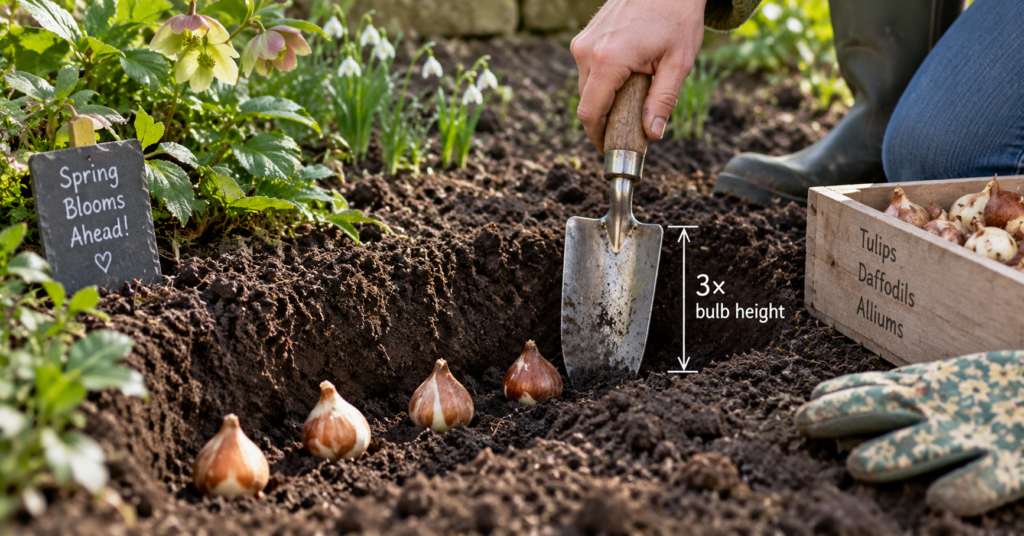
The rule of thumb we always come back to: plant at a depth of roughly two to three times the bulb’s own height. Daffodil bulbs are the biggest of the three, so naturally they go in deeper than their smaller bluebell and snowdrop cousins.
Bluebells: depth, spacing, and where to plant them
Native English bluebells (Hyacinthoides non-scripta) genuinely don’t want to be planted in neat rows, and we’d gently discourage you from trying — the whole appeal is that slightly wild, drifted look, so our advice is to scatter the bulbs by hand and plant them roughly where they land. They’re at their happiest in dappled shade, which makes them a natural fit for the ground under deciduous trees or large shrubs, where they get plenty of light before the canopy fills back in each spring.
- Depth: 10cm (4in)
- Spacing: around 10cm apart, in loose, informal drifts
- Position: dappled or light shade, humus-rich soil
Snowdrops: depth, spacing, and where to plant them
Snowdrops (Galanthus) are the ones that make the whole garden feel like it’s waking up again, often pushing through as early as January when everything else still looks thoroughly asleep. Dry bulbs planted this September will establish well; you’ll also see snowdrops sold “in the green” (with leaves still attached) in late winter, which is another perfectly good way to plant them — but if you’re working with dry bulbs now, September gives them the longest possible run at rooting in before they flower.
- Depth: 7–10cm (3–4in)
- Spacing: 5–8cm apart, planted in small clumps rather than singly
- Position: light shade, borders, or naturalised in grass under trees
Daffodils: depth, spacing, and where to plant them
Daffodils (Narcissus) are the reliable friend of the bulb world — they’ll naturalise happily in grass, hold their own in a border, and do just as well crammed into a container by the front door. Because the bulbs are that bit larger, they need a deeper hole than bluebells or snowdrops, and a little extra elbow room besides, so the foliage has somewhere to flop and die back naturally after flowering without the whole patch looking like it needs a haircut.
- Depth: 15cm (6in)
- Spacing: 10–15cm apart
- Position: full sun to light shade, borders, grass, or large containers
General planting tips for all spring bulbs
- Plant pointy end up. And if you genuinely can’t tell which end is which (it happens to all of us), just plant it on its side — the bulb will sort itself out.
- Water in after planting to settle the soil around the bulb, even if the ground already feels damp underfoot.
- Don’t cut the foliage back after flowering until it’s died back naturally on its own — unsightly as it looks, those leaves are quietly feeding next year’s flowers.
- Add grit to heavy clay soil if drainage is poor. In our experience, far more bulbs are lost to sitting in waterlogged ground than are ever lost to cold.
Frequently asked questions
As a general rule, plant bulbs at a depth of two to three times the bulb’s own height. Daffodils need roughly 15cm, while smaller bulbs like bluebells and snowdrops only need 7 to 10cm.
Yes, most spring bulbs can be planted through October and into November, but September planting gives the strongest root development before winter and the earliest spring display.
Yes, both prefer dappled or light shade, which makes them well suited to planting under deciduous trees or large shrubs. Daffodils are more flexible and tolerate full sun as well as light shade.
The most common causes are planting too shallow, waterlogged soil causing the bulb to rot, or cutting back the foliage too early the previous year before it had died back naturally.
The short version
September is the best time to get spring bulbs into the ground: bluebells and snowdrops at 7–10cm deep, daffodils a little deeper at 15cm, spacing anywhere from 5cm to 15cm depending on the bulb. Plant now, forget about it, and let next spring do the rest.



Leave a Reply