
Contents
What is Honey Fungus?
Honey fungus is a spreading, parasitic fungus that live yeah s on trees, woody shrubs, and occasionally herbaceous perennials.
It plays a crucial role in the regeneration of forests: at the destruction end!
It is capable of killing complete woodlands, which is wonderful for the churning gyre of biodiversity and evolution, but no fun for the human owners of those trees.
It’s one of the biggest living organisms in the world. The largest recorded honey fungus is nearly 4 miles square and several thousand years old.
Characteristics
- Honey fungus spreads through bootlace-like structures called rhizomorphs, which grow under the soil at a rate of about 1 metre a year.
- Rhizomorphs are red-brown or black and usually hard to find.
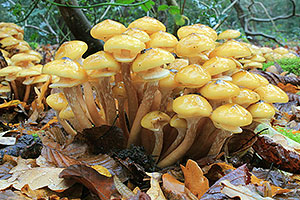
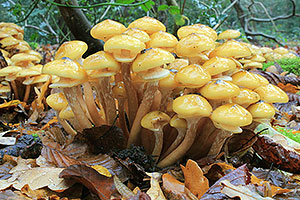
- Mushrooms appear in winter between November and January on wood, growing in dense clusters with sticky, yellow-brown caps.
How Does it Kill?
- Honey fungus kills its hosts by growing through the tree and encircling the cambium layer at ground level, cutting off the supply of sap and nutrients.
- Infected plants will suddenly start to die back or fail to produce leaves in the spring.
- Resin can seep from the trunks of conifers
- A “swan song” may occur where plants under attack flower and fruit before dying.
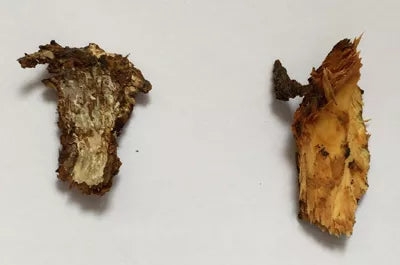
- Affected plants are covered in mycelium under the bark, a white fungal sheet, which has a strong mushroom smell.
- Unlike most parasites, which need a living host, honey fungus can kill its host and continue living on the decaying matter for many years.
Honey fungus symptoms
- The die back of upper parts of the plant. This can happen quickly, particularly in hot dry weather, or may take years to gradually kill off branches.
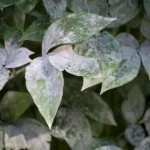
- The leaves may fail to develop in spring, or be smaller and paler than usual.
- The plant may fail to flower, or in some cases suddenly flower and fruit profusely before dying.
- There can be signs of cracking and bleeding at the base of the trunk or stem. The red-brown rhizomorphs can sometimes be seen between the bark and the wood of trees.
- The fruiting bodies of the fungi are honey coloured toadstools. They may be seen in autumn growing on infected wood, at the base of a tree or on a nearby stump.
- Below the ground, the tree roots steadily rot from the ends inwards.
- The base of the trunk is often covered in white fungal strands (smelling strongly of that damp mushroomy odour) that can spread up between the bark and the wood, in severe cases for up to a metre.
Treating honey fungus infections
At present, there is no chemical fungicidal control for honey fungus.
To reduce the impact of honey fungus in your garden:
- Remove infected plants: Take out infected plants and as much of their root system as possible to prevent the fungus from spreading. If a tree is too big to pull, have the stump ground out until it is at least 8 inches (20cm) below soil level.
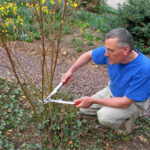
- Prevent future infections: Get rid of trees that have died for other reasons and disinfect all tools after removal of infected material.
- Improve soil quality: Mulch regularly with good organic matter to keep plants healthy and less vulnerable to honey fungus attacks.
- Destroy infected material: Burn all infected material, including stumps and roots, to prevent the fungus from spreading.
- Create a barrier: Bury a butyl rubber lining at least 45cm down and 2-3cm above soil level to create a barrier that prevents rhizomorphs from penetrating.
- Choose a resistant species: Once you have removed an infected plant or created a necessary barrier, replant with a more resistant species (see lists below).
Honey Fungus Resistant Trees and Shrubs
No woody plant is completely resistant to honey fungus.
Only herbaceous perennials (and annual bedding plants, but they only live for a year anyway) are generally not at risk.
The RHS has a complete list of honey fungus resistant and susceptible plants, separated into four risk categories:
- Top honey fungus host
- Frequently affected
- Sometimes affected
- Rarely affected
Listed below are the “rarely affected” and “sometimes affected” trees, shrubs, and climbers that we grow here at Ashridge:
Most Resistant, Rarely Affected Trees
- Acacia, Mimosa
- Arbutus, Strawberry Tree
- Ficus, Fig Trees
- Ginkgo biloba, Maidenhair Tree
- Larix species, Larch
- Laurus, Bay Leaf Laurel. Good evergreen hedging.
- Morus, Mulberry
- Pyrus, pear trees: more the ornamentals like Chanticleer or Pendula than edible pears, which are mostly grafted onto quince rootstocks; quince is “sometimes affected”, see below
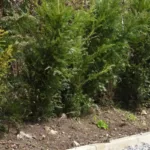
- Taxus baccata, Yew. The King of formal, native evergreen hedges.
Most Resistant, Rarely Affected Shrubs
- Buxus sempervirens, Boxwood. Slow growing evergreen hedging, very shade-tolerant.
- Callistemon, Bottle Brush Tree
- Convolvulus
- Griselinia. Good evergreen hedging.
- Hydrangea
- Hypericum
- Lavandula, Lavender
- Lonicera nitida, shrub honeysuckle. Good evergreen hedging.
- Philadelphus, Mock Orange. Decent informal hedging.
- Pittosporum
- Rhamnus species, Buckthorn. Good country hedging.
- Rosemary
- Rubus species, which includes Blackberry and Raspberry. .
- Salvia species
- Sarcococca, Sweet Box
- Symphoricarpos, Snowberry
- Tamarix. Good coastal hedging.
- Vaccinium, which includes blueberries and cranberries.
Moderately Resistant, Sometimes Affected Trees
- Acers, Maple and Sycamore. Field maple is good country hedging.
- Carpinus betulus, Hornbeam. Good formal hedging.
- Corylus, hazel. Good native hedging.
- Cydonia, quince
- Eucalyptus
- Euonymus
- Fagus, beech. The Queen of formal hedging.
- Ilex, holly. Good native evergreen hedging.
- Malus, Apples and Crab Apples
- Picea species, Spruces like Blue Spruce
- Pinus species, Pines like Scot’s Pine
- Populus species
- Prunus species, which include fruit trees like Cherry and Plum, and evergreen hedging like Cherry Laurel.
- Sambucus, Elderflower, can be used as country hedging, ideally as a single species.
- Tilia species, Lime trees
- Ulmus species, Elm trees
Moderately Resistant, Sometimes Affected Shrubs
- Acer negundo
- Actinida
- Berberis species, Barberry. Good thorny hedging.
- Cornus, dogwood. All are good hedging; Cornus sanguinea is the native species.
- Hebe
- Lavatera
- Perovskia
- Potentilla
- Roses
- Senecio
Most Resistant, Rarely Affected Climbing Plants
- Akebia, Chocolate Vine
- Hedera, Ivy
- Hydrangea
- Jasminum species, Jasmine (not Trachelospermum species, which are sometimes affected)
- Lonicera species, Honeysuckle
- Passiflora, Passion Flower
- Wisteria
Should gardeners live in fear of Armillaria?
In my opinion, having lost more than a couple of trees to it down the years (a lovely opportunity to grow something else), not really.
Honey fungus is found in practically every location that has groups of mature trees and rotting wood on the ground. In the wild, it is “in balance” with all sorts of other organisms, playing an essential role in the ecological turnover of forests.
It is mainly orchard owners and forestry managers who have a real cause for concern. Firstly, it’s their livelihood, and secondly man-made monocultures create the conditions where any pest or parasite can go berserk on the banquet before them, with no biological bouncers to bring them back into ‘balance’.
Have you had any first-hand experience of dealing with honey fungus? Please do let us know in the comments box below.
Killed off mature Walnut in my gardenseveral years ago, followed by Eucalyptus gunnii and two silver birches, hawthorn then pyracantha. Armillatox, which is now prohibited for garden use, seemed to help a bit. Other eucalypts have not, so far, been affected. That’s most of my 100′ square back garden infested. Other trees alongside road at the front also affected, one died last year with incredible amount of fungi sprouting this year. Presumably it is pretty rife throughout our neighbourhood which was originally uncultivated parkland
I think the RHS list is a guide only. The fungus is attacking my elder tree and some bamboo, both of which are supposed to more resistant.
I’ve put down some early purple orchid (orchis mascula) seeds because it controls the fungus. If only they would grow more easily …
Mature (30 years plus) winter flowering Cherry lost all of it’s leaves about one year ago.Have now felled the tree. Did not take much notice until toadstools appeared at the base of stump. I have removed the stump and most roots. But in comparison to known symptoms there is no bootlaces or a strong smell and only half of the roots seem to be affected.
think this may be a reaction to the way you treat your garden. Have you been using chemicals or removed other fungus that is supposed to live naturally in your garden? The honey fungus is a natural part of the eco system, and it will appear in cultivated gardens that are not treated the way the need to be.
It’s probably there to balance out the harm you’ve done to your garden, which may take some years, so you could just leave it and let it do it’s job.
I have a hawthorn hedge planted in a row of oak trees. Sections of the hawthorn 2 or three plants are totally dead an pull out of the ground fairly easily, there is no sign of fungus just litchen type growth on the branches but the main body is very soft internally when pulled up.
Some branches on the oak have died but not sure how serious until the buds break into leaf.
At a loss to know if this is honey fungus or something to do with a very large fairy ring nearby
It could also be oak tree root rot/s. Not qualified to advise, alas.
Best thing: call local tree surgeon. They will give you free advice and a free quote…
Good luck
Hello, i had a log pile at the back of the garden where I was going to make a fernery from the logs I had collected. A year later I’ve noticed long bootlace rhizomorphs spreading a metre or so around the log pile under the weed matting I’d our down around it. They look exactly like honey bootlaces but they are white, slightly orange in parts. Can they be white when very young? I fear I may have introduced it into my garden and if so I want to act fast!
I’ve removed all the logs and started removing some soil as I’m fearing the worst, but it would be good to know for sure if It’s honey fungus rhizomorphs!
Is there any way of testing the soil before planting another tree in a nearby area to the killed off apple tree.
Thanks for your email.
I don’t think there is anything available to test for the presence of honey fungus. And, to be honest, although a tremendous amount is talked about “bootlaces” in the soil, I have seen any number of honey fungus victims and am still waiting for my first bootlace sighting. So, loads of good compost, follow good planting practice, keep the new plant well watered and stress free until it is established and try not to plant sepcies that are especially prone to honey fungus.
Good luck
A 100 yr old apparently healthy Hornbeam fell during the night into a school playing field. Falling the opposit way would have demolished the bungalow in which I live. The debris was examined and determined by DEFRA test to be honey fungus.
Over the past 2 years an adjacent cypress hedge has died one tree at a time, now at 20 metres 40 metres to go. I cannot stop it. All supposedly resistant trees and shrubs planted in the old Hornbeam area have died, except for one apple tree which is still struggling.
What can I do……?
Hello there, I have honey fungus in my cottage garden and had to cut down some trees. But I am not feeling aggressive against the fungus and would like to know if there would be a way of encouraging other types of fungus in the garden to compete with the existing honey one… Who knows there may be a type of fungus that feeds on honey fungus. Thank you for your time if you find someone to answer me! I would be most grateful.
Thank you for your comment. Honey fungus is indeed difficult to deal with. Wishing you success. Kind regards Ashridge.
Thank you for your comment. Honey fungus is indeed difficult to deal with. Wishing you success.
Thank you for your comment. Honey fungus is indeed difficult to deal with.
Fungi are complex, and it’s only an educated, reasonable guess that honey fungus is less able to infect healthy trees where other fungi, especially Rootgrow-type Mycorrhiza, are active.
Cherries don’t actually have a very long lifespan – 20-40 years at most. So yours could well have just come to the end of its life.