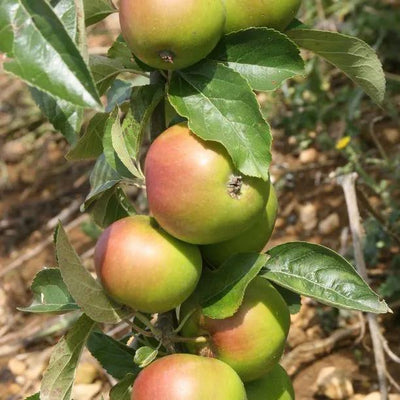
Why pollination group matters
Here's the thing most people don't realise until their apple tree flowers beautifully and fruits... not at all: most varieties can't pollinate themselves. They need pollen from a different variety, ferried over by bees, with both trees in blossom at the same time. Miss that overlap and you'll get plenty of lovely blossom and precious little fruit.
That's where flowering groups come in. Every apple variety is sorted by when it blossoms, so pairing up with something from the same group — or the one just before or after — gives you the timing overlap you need for a reliable crop.
Which varieties are in Group A
The above varieties all flower in this early window, so any two (or more) will happily pollinate each other.
A note on frost risk
Flowering early has its perks, but exposure to late spring frosts is the trade-off — Group A blossom is more likely to catch a cold snap than the later-blooming groups. If frost is a regular visitor in your garden, you might get more reliable crops from a Group B or C variety instead.
A note on triploid varieties
A handful of apple varieties are what's called triploid — their pollen is sterile, so they can't do the pollinating job themselves. That means they need two other compatible varieties planted nearby, not just one. We've flagged these on the relevant product pages, so you'll know exactly where you stand.
Looking for a partner outside Group A?
Group B varieties overlap in flowering time too, so they'll cross-pollinate with your Group A trees just fine. For the full picture across every group, our pollination guide has you covered.


 Sign In
 Saved items


 5 Star Service Rating




 Secure, One-Tap Checkout
 5 Star Feefo Rating
 Hand Picked, Delivered to Your Door!
 1 Year Bareroot Guarantee
 Platinum Trusted Service Award 2026
 Mail Order Plant Experts - Est. 1949
 1 Year Bulb Guarantee