Which Amelanchier should you choose?
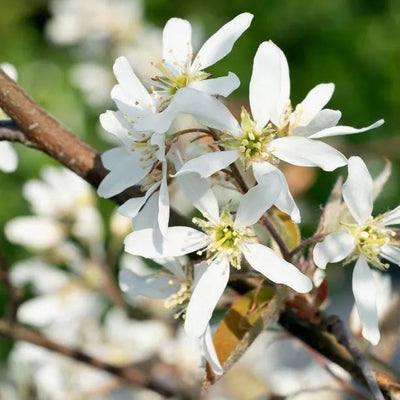
- Ballerina: the largest white flowers of the three, on a bushy tree 4 to 8m tall and as wide. It tolerates town air and some shade, so it is the one for an urban garden.
- Robin Hill: pink buds that open pale pink and fade to white, on an upright tree. Bred in New York State in the 1960s, it holds the RHS Award of Garden Merit.
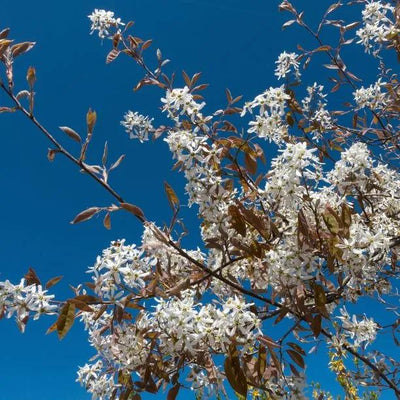
- Snowy Mespilus (Amelanchier canadensis): the classic white-flowered species, about 6 to 8m tall, with an RHS Award of Garden Merit since 1993. Left to its own devices it becomes a large, multi-stemmed shrub.
- Juneberry hedging plants (Amelanchier lamarckii): bareroot young plants from £2.99, for an informal flowering hedge, or to grow on into a tree or shrub of your own shape. It looks practically the same as Snowy Mespilus.
Choosing a size
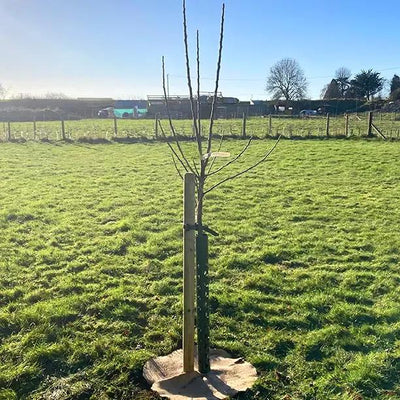
The three named trees are sold as standards: a young tree with a clear, straight trunk, measured by its girth, the circumference of the trunk 1m above the ground. A 6/8cm girth standard is the cheaper choice and settles in quickly; an 8/10cm standard gives more impact from the start. Both are usually 2 to 3.5m tall when they arrive.
The Juneberry hedging plants are bareroot saplings of 40 to 80cm, which grow about 30 to 40cm a year and clip well as a hedge.
Growing Amelanchier
The one thing an Amelanchier will not tolerate is lime. It needs an acid or neutral soil that holds moisture but drains well, so it is not a tree for chalk or limestone. If your soil is chalky, choose a hawthorn or a crab apple instead: they are close relatives of much the same size, and both take chalk.
Give it full sun for the best autumn colour, though it flowers and fruits in partial shade too. It is fully hardy anywhere in Britain. A mulch in late spring helps, especially on dry ground.
Amelanchiers send up suckers from the base. Cut them off if you want a tree with a single clean trunk; leave them, and over the years it becomes a broad, multi-stemmed shrub, which is how many gardeners prefer it.
The berries
All Amelanchiers are self-fertile, so a single tree will fruit. The berries ripen in summer from red to dark purple, look and taste a little like blueberries, and vary in sweetness from tree to tree and year to year. If yours are sharp, cook them. Either way, pick them promptly: the blackbirds know when they are ripe as well as you do.
One tree, many names
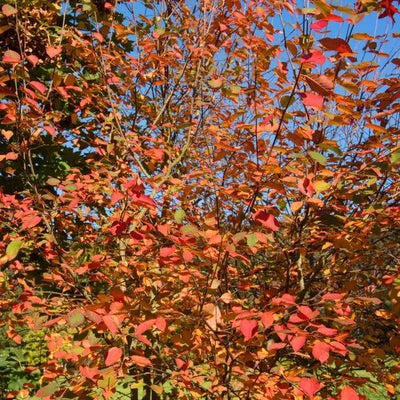
Amelanchier comes from North America, where it collected names wherever it grew: serviceberry, Juneberry, shadbush (it flowers when the shad fish run up the rivers to spawn), sugarplum and more. In Britain it is usually Snowy Mespilus, after the clouds of white blossom.
Questions
Will Amelanchier grow on chalk? No. It needs a lime-free soil. On chalk, plant a hawthorn or a crab apple.
How big will it get? Most Amelanchiers grow 4 to 9m tall over 10 to 20 years. Ballerina stays the most compact.
Do I need two trees for berries? No. They are self-fertile, so one tree is enough.
When are bareroot trees delivered? Through the winter, from November, while the trees are dormant. All bareroot trees are covered by our 1-year guarantee.
See also: Small Garden Trees · Hawthorn Trees · Crab Apple Trees



 Sign In
 Saved items




 5 Star Service Rating





 Secure, One-Tap Checkout
 5 Star Feefo Rating
 Hand Picked, Delivered to Your Door!
 Platinum Trusted Service Award 2026
 Mail Order Plant Experts - Est. 1949
 1 Year Bulb Guarantee