Bulbs Chosen for Vase Life
Every bulb in this collection is here for one reason above colour or height: it lasts in a vase. Expect a week from most, close to a fortnight from alliums, and tulips that carry on growing after you cut them. That is either charming or exasperating, depending on how carefully you arranged them.
Grow them in rows, not the border
If you can spare a strip of the vegetable garden or a raised bed, plant your cutting bulbs there in rows and cut without a second thought. Raiding the border leaves gaps just when it should look its best. In a cutting patch, tulips can go in almost shoulder to shoulder, since bulbs grown purely for the vase are best treated as annuals and replaced each autumn.
Tulips: the backbone
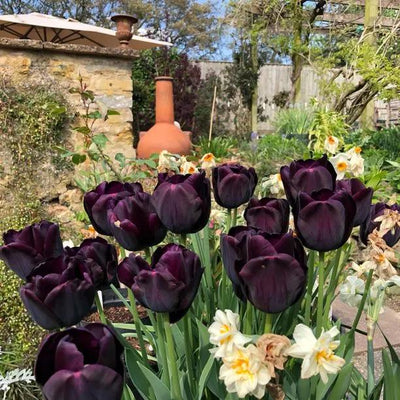
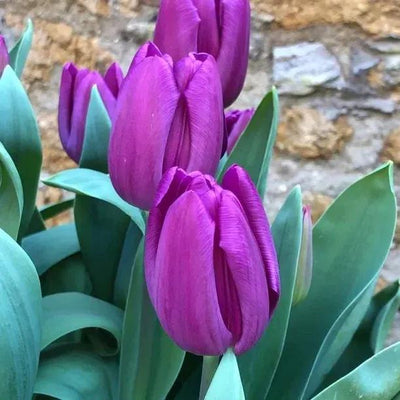
For long stems, choose the Single Late and Darwin Hybrid groups. 'Queen of Night' is the darkest maroon you will find in a tulip, on 60cm stems in May, and looks best with something pale beside it. 'Dordogne' is tall and late, rose flushed with apricot. 'Apeldoorn' and 'Golden Apeldoorn' are Darwin Hybrids with thick, sturdy stems that hold up well in water.
The Parrots, 'Black Parrot' and 'Cabanna', are for a table where people can look at them closely: frilled, twisting and never the same two days running. For a small jug, 'Princess Irene' is shorter at around 35cm, orange flamed with purple, and lightly scented, as is the lily-flowered 'Ballerina'.
Cut tulips when the buds show colour but are still closed. If the stems flop, wrap the bunch tightly in newspaper and stand it in water for a few hours; they will straighten.
Daffodils: choose the scented ones
The multi-headed and double daffodils are the ones to grow for the house. 'Bridal Crown' and 'Cheerfulness' carry several creamy, double, sweetly scented flowers to a stem, and a handful will scent a room. 'Thalia' is pure white with nodding heads and is one of the most graceful daffodils in a glass.
Daffodils need one piece of handling. Their stems leak a sap that shortens the life of other flowers, so stand them on their own in water overnight before adding them to a mixed arrangement, and don't recut the stems afterwards.
Alliums: the long-stayers
Alliums last longest of all in water, often two weeks. 'Purple Sensation' gives deep violet globes on 80cm stems in May and June. Allium christophii has huge starry heads that dry well, so you can hang them up when they have finished in the vase and keep them until Christmas. 'Nigrum' is white with a dark green eye, and Allium sphaerocephalon brings small claret drumsticks in July, after almost everything else has finished.
Change the water every couple of days and you will avoid any oniony smell.
Anemones: the jewel box
The De Caen anemones and 'Sylphide' have poppy-like flowers in deep blue, scarlet and magenta around a dark centre, and they open and close with the light even after cutting. Soak the corms overnight before planting. In colder gardens, put a cloche over them through winter.
Also worth cutting
Camassia sends up spires of blue or white to about 90cm in May, and its flowers open steadily up the stem in water. Hyacinths have short stems but enough scent to fill a hallway from a low bowl. Snake's head fritillaries and grape hyacinths are made for egg cups and bud vases.
Planting times
Plant daffodils, alliums and camassias in September and October. Tulips are best planted in November, when the colder soil lowers the risk of disease. Anemones can go in through autumn. For more detail, see our Growing Tulips Guide.


 Sign In
 Saved items


 5 Star Service Rating




 Secure, One-Tap Checkout
 5 Star Feefo Rating
 Hand Picked, Delivered to Your Door!
 1 Year Bareroot Guarantee
 Platinum Trusted Service Award 2026
 Mail Order Plant Experts - Est. 1949
 1 Year Bulb Guarantee