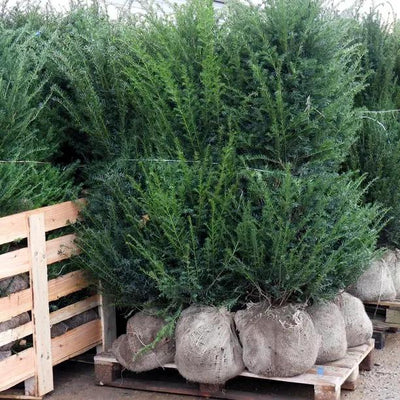
Order Potted Yew Plants Now For October Delivery
Order Bareroot Yew Hedging For 2026 Spring Planting Season
What is Yew Hedging?
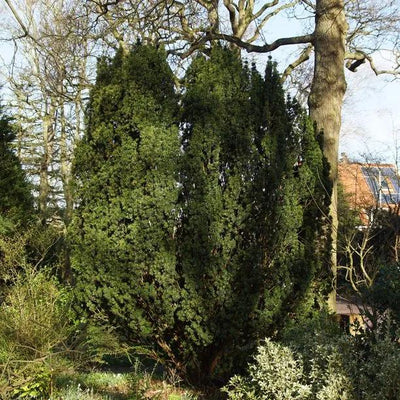
Yew hedging probably adds more value than any other formal hedge. Practically every classic formal garden uses Yew for its large boundary and interior hedges.
An unusual conifer with red "berries", Yew has deep green, dense foliage that is easily clipped into precise sides, corners and curves, perfect for hedges and topiary.
- Uses: Hedges from 100cm upwards, good for topiary or as a specimen.
- Good Points: Clips beautifully, evergreen, native, bomb-proof, adds value to your property, regrows from old wood, disease free.
- Position: Anywhere there is drainage.
- Growth: 30cm per year until the top is clipped, then much slower.
How many Yew hedge plants do I need?
The standard planting density for your bareroot and potted yew hedge plants is 3 plants per metre (every 33cm) in a single row.2 plants per metre (every 50cm) is fine for interior, ornamental hedges if you don't mind waiting a while for them to join up.
What size Yew hedge plants should I buy?
- If you are not in a hurry to get a full sized Yew hedge, we recommend starting with smaller sizes: up to 60cm tall.
- If you are in a hurry and need instant impact, or are filling gaps in an existing hedge, then of course pick the biggest size that fits your budget.
Smaller plants are cheaper, easier to plant, and tend to establish better because they are dug up with most of their roots intact.
You can also clip them attentively and ensure a very bushy plant from the base up.
Browse our full range of Hedging Plants, our other formal hedge plants, all evergreen hedging, or have a look at our Ornamental Shrubs.
Your mail order Yew hedge plants are delivered by next working day courier.
If there is anything wrong with your plants when they arrive, Contact Us within 5 working days, and our friendly support team will sort it out.
All bareroot plants are covered by our Refund Guarantee, so you can give them a whirl with complete confidence.
If Beech is the Queen of formal hedges in traditional British stately gardens, then Yew is the King (which probably makes Box an Earl of some kind).
Grown as a tree, it develops beautiful ridged bark and a wide spreading habit, so evocative of ancient churchyards, and great for wildlife.
Are Yew Berries Poisonous?
Almost every part of Yew is poisonous, apart from the red flesh of the "berry" around the seeds. These "berries" are in fact highly modified conifer cones containing only one seed.
The red flesh tastes fine, but has a slimy texture.
The seeds themselves are poisonous if chewed - if you swallowed one whole, it would pass through you.
Honestly, there are much nicer fruits to try in the garden, so we do not recommend trying them: leave them for the birds.
Where can I grow a Yew hedge?
You can grow Yew hedges almost anywhere in the UK.
Yew is very hardy, shade-tolerant, wind resistant, and will grow in absolutely any soil with decent drainage, including heavy clay.
The only place where Yew won't grow well is waterlogged soil: periods of winter flooding should be fine, but if the soil is wet all winter, it will probably succumb to root rot.
How long does a Yew hedge take to grow?
Yew plants are quite slow growing at around 30cm per year, depending on your location (plants generally grow faster in the warmer South & West than in the cooler East & North of Great Britain) and your local conditions (wind-shelter and full sun are ideal).
Yew has a special feature that does not apply to most other hedge plants: when you cut the leading stem (which removes the apical bud, i.e. the topmost growing point), their growth slows dramatically from about 30cm per year down to less than 10cm per year.
Bear in mind that it is common for most plants to put on very little height in their first year after being transplanted into your garden.
There is nothing wrong with this: they are laying down roots first, in readiness for growing upwards and filling out.
How big does a Yew hedge grow?
Yew is suitable for hedges from about 1 metre, up to as tall as you like! For a shorter hedge, Common Box or Box Leaf Holly are good formal alternatives.
When and How do I plant a Yew hedge?
You can plant Yew hedging at any time of year, except when the soil is frozen.
The best time to plant Yew is in winter (November to March), using bareroot stock, which is cheaper, easier to carry and plant, and tends to establish even better than the pot grown equivalents.
Our film on How to Plant a Formal Hedge demonstrates beech, but the process is the same with Yew.
The advice below adds on the film and applies if you have well-drained soil. There are specific instructions about how to prepare poorly drained, heavy clay soil.
Preparing the ground for a Yew Hedge
Dig a trench about 30cm deep and 50-60cm wide.
Remove roots, perennial weeds, stones and other rubbish and incorporate plenty of well-rotted organic matter.Break up any clods and work the whole together well, so you have a fine, crumbly planting medium.
Ideally, this should be done in advance and left to weather prior to planting. However, you can prepare and plant on the same day.
Spacing and Planting Yew Hedging
Depending on size, space your yew at between 2 and 3 per metre in a single row.
A Yew hedge is meant to be formal, so use a string stretched between canes to make sure you are planting straight.
Spread the roots of each plant out well.
Water the bare roots and sprinkle with Rootgrow.Check the spacing between plants one last time before you return the soil around the roots.
Firm it down as you go, making sure that each yew plant ends up at the same level in the soil as it was before we lifted it. Hold the yew stem so it does not sink with the soil.
It is a bad error to plant your yew too deep as the bark on young plants can rot easily.
Aim to end up with a bed that is slightly ridged: 2-3cm higher in the middle than at the edges.This helps water run away from the trunks of the young yew hedge plants, and the ridge itself will erode so the danger of rotting bark is minimised.
Water well and admire your handiwork with a cup of tea.
When and How do I prune my yew hedge?
The ideal time to trim a Yew hedge is in September or October, because this should let you get away with one trim per year.
But you can trim it anytime you like without harming the plants, and for a really tidy look, a second trim as needed in Spring or Summer might be necessary.
Yew plants will regrow from old wood, so they forgive mistakes and can be hard pruned if necessary, unlike most conifers.
Important note: Once you cut the growing tip off the leading stem, the rate of growth slows right down to as little as 5-10cm per year.
Therefore, don't the top of your yew hedge until it has reached its final height. Only clip the sides.
Read more advice on how to prune yew hedges.
Looking after newly planted Yew Hedging
In the first winter after planting, firm down the soil after hard frosts.
In the first year after planting, water yew well when the soil is dry, but don't water at all when the ground is damp: if the earth is damp 3cm down, there is no need to water.
A lot of water infrequently is better than little and often.



 Sign In
 Saved items


 5 Star Service Rating




 Secure, One-Tap Checkout
 5 Star Feefo Rating
 Hand Picked, Delivered to Your Door!
 1 Year Bareroot Guarantee
 Platinum Trusted Service Award 2026
 Mail Order Plant Experts - Est. 1949