


Sold as:

from £6.99


Sold as:
from £19.99
 5 Star Service Rating




 Secure, One-Tap Checkout
 5 Star Feefo Rating
 Hand Picked, Delivered to Your Door!
 1 Year Bareroot Guarantee
 Platinum Trusted Service Award 2026
 Mail Order Plant Experts - Est. 1949
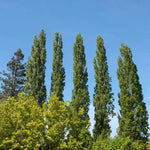

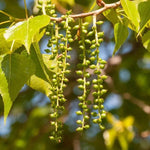





You already know this tree, even if you don't know its name. That row of impossibly narrow, upright trees along a driveway, behind a cricket pitch, or lining a French canal — that's Lombardy Poplar. No other hardy tree in Britain combines this height with this narrowness. At 30m tall and just 5m wide, it gives you a column of green where most trees would give you a dome. Nothing else screens like it without eating your garden.
The branches grow almost vertically, tight against the trunk, which gives the tree its distinctive fastigiate (pillar-like) shape. The diamond-shaped leaves are glossy green, turning clear yellow in autumn. Copper-orange catkins appear in spring before the leaves. Growth is very fast — young trees on a reasonable site will put on a metre or more a year — so a row of winter-planted saplings will begin to look like a serious screen by the second or third summer.
Every Lombardy Poplar in cultivation is a male clone, descended from a single tree selected in northern Italy sometime in the late 1600s. It was introduced to Britain in the 1750s and planted relentlessly ever since.
Screening is the classic use. A row of Lombardy Poplars spaced 3–4m apart forms a tall, narrow barrier to both wind and overlooking neighbours, without the width of a conventional tree line. It needs no pruning to hold its shape. Driveways, boundaries, exposed rural sites, sports grounds, and anywhere you need rapid vertical screening on a tight footprint.
As a single specimen it makes a striking exclamation mark in a flat landscape, and a pair flanking an entrance looks formal without fuss. It is not suitable for clipping as a hedge.
Lombardy Poplar is not a tree for small gardens or for planting near buildings. The root system is vigorous and invasive — keep at least 20m from any structure, drain or foundation. The tree is also relatively short-lived by tree standards: expect 40 to 60 years. After 40 years or so, branches can start shedding and the tree becomes increasingly vulnerable to wind damage, especially if neighbouring trees have already been lost. In exposed positions, plan for eventual replacement.
For large planting projects — boundary screens, farm windbreaks, new avenues — start with saplings. They're cheaper per tree, easier to handle, and establish fast given the species' growth rate. For immediate impact or where you need height now, we also sell Lombardy Poplar in standard sizes. Browse all our poplar varieties.
UK-grown bareroot saplings, dispatched dormant during the winter planting season (November–March) by next-day courier. Bulk discounts on larger orders. All bareroot trees carry our one-year guarantee. We've been growing and selling trees since 1949 and hold the Feefo Platinum Service Award and the Which? Gardening Best Plant Supplier award. If anything's not right, contact us.
Very fast. Young trees can add 1–2m of height per year in good conditions. It is one of the quickest-growing trees you can plant in the UK. A row of saplings planted in November will be noticeably taller by the following autumn.
At least 20m. The root system is aggressive and can damage drains, foundations and hard surfaces. This is a tree for open ground, rural boundaries and large gardens — not for planting against a building or in a confined space.
No. The fastigiate habit is natural and self-maintaining. The branches grow upright without intervention. If a branch is damaged, cut it back cleanly, but routine pruning is not required.
It's unfussy. Most soils work, including poor and dry ground. The one exception is chalk with shallow topsoil, which it dislikes. It grows well on heavy clay and tolerates exposed, windy sites.
Typically 40–60 years — shorter than most large native trees. After about 40 years, branch shedding and wind vulnerability increase. If you're planting a screen, it's worth thinking ahead to eventual replacement. For a longer-lived alternative with a similar narrow form, consider Hornbeam (fastigiate form) or Beech.
Yes. Every tree in cultivation is a male clone of the original Italian selection. You will not get the fluffy cotton-like seeds that female poplars produce.
Lombardy Poplar is a cultivar of Black Poplar (Populus nigra), selected for its extremely narrow, upright habit. Standard Black Poplar grows into a broad-headed tree. We sell both: Black Poplar saplings and Native Black Poplar (P. nigra subsp. betulifolia).
Bareroot trees are delivered November to March. You'll receive an email with your delivery window after ordering. Plant as soon as possible and water in well.


 Sign In
 Saved items