

Sold as:

from £10.95

Sold as:
from £19.99
 5 Star Service Rating




 Secure, One-Tap Checkout
 5 Star Feefo Rating
 Hand Picked, Delivered to Your Door!
 1 Year Bareroot Guarantee
 Platinum Trusted Service Award 2026
 Mail Order Plant Experts - Est. 1949



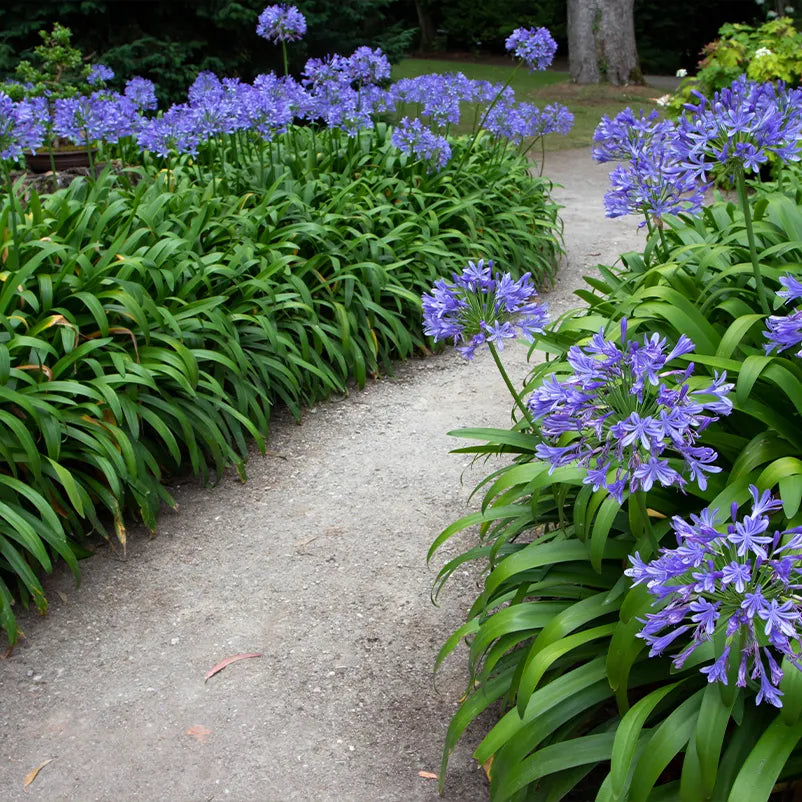





Lapis Lazuli produces some of the richest blue flowers in the agapanthus range. Each trumpet-shaped bloom carries a darker central stripe down every petal, giving the rounded flower heads a depth of colour that earns the comparison with the semi-precious stone. The plant itself is compact, topping out at about 60cm, and forms a tight clump of narrow, strap-shaped leaves that stay green through most winters in sheltered positions. It flowers from July well into September; deadhead spent stems and it will keep producing new ones. Bred in Taranaki, New Zealand, from deciduous parentage, it is tougher than many evergreen agapanthus and copes well with British conditions provided the drainage is right.
Lapis Lazuli is one of the best agapanthus for containers. A row of matching pots either side of a front door or along a sunny terrace is a classic look that few other perennials deliver so effectively. In a border, plant it towards the front where the flower heads catch the sun. The stems are strong enough for cutting, and a single head in a small vase is enough to carry a room. Bees work the flowers enthusiastically.
Full sun and a sheltered spot are the essentials. A south or west-facing position against a warm wall is ideal, especially in northern and more exposed gardens. The soil should be moist but well-drained; agapanthus dislike sitting wet in winter far more than they mind cold. In the ground, mulch the crown with bark or straw in late autumn. In pots, move them to a sheltered position by a house wall or into an unheated greenhouse for the coldest months. Do not let containerised plants dry out completely over winter; they are evergreen and the roots stay active. RHS hardiness rating H4, which means temperatures down to about minus 5°C. In Somerset and lowland southern England, Lapis Lazuli generally sails through winter without special treatment.
In a sunny border, Ever Sapphire extends the agapanthus season with a slightly different shade of blue on a similarly compact frame. For contrast in flower shape and season, dahlias planted behind agapanthus take over as the main event from late August onwards. Lavender shares the same appetite for sun and drainage, and its silver foliage sets off the blue flowers well. Ornamental grasses such as Stipa tenuissima are a natural companion, catching the light beside the bold, rounded flower heads.
We grow Lapis Lazuli on from licensed young plants in peat-free compost at our Somerset nursery. We use biological pest controls and every plant is guaranteed. The people who grow your agapanthus are the people who pack your order and answer your questions. See the full agapanthus collection.
Fairly hardy (RHS H4), surviving temperatures to about minus 5°C. In well-drained soil with a winter mulch, it comes through most southern English winters without trouble. In colder or more exposed areas, grow it in a pot and move under cover for the worst months.
July to September, sometimes into early October if deadheaded regularly. The flowers open over several weeks because the buds in each head open from the outside inwards.
Yes, and it does particularly well. Use a loam-based compost with added grit. Feed fortnightly with a high-potassium liquid feed from May to July. Water freely in the growing season but reduce in winter. Repot every three to four years when the clump fills the container.
Usually one of three things: not enough sun, too much nitrogen-rich feed (which promotes leaves at the expense of flowers), or the plant is too young. Agapanthus from P9 pots may take a season to settle before flowering freely. Patience and potash are the answer.
Semi-evergreen. In mild, sheltered gardens the foliage holds through winter. In colder areas or after a hard frost it may die back partially, regrowing from the crown in spring.


 Sign In
 Saved items