

Out of Stock
Sold as:

from £6.99

Sold as:
from £19.99
 5 Star Service Rating




 Secure, One-Tap Checkout
 5 Star Feefo Rating
 Hand Picked, Delivered to Your Door!
 1 Year Bareroot Guarantee
 Platinum Trusted Service Award 2026
 Mail Order Plant Experts - Est. 1949
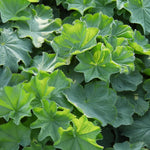


If you have grown Alchemilla mollis you already know the genus: scalloped leaves that catch and hold raindrops like little silver lenses, and sprays of frothy, lime-green flowers that go with everything. Alchemilla erythropoda does all of that in half the space. The mound tops out at about 15 centimetres and spreads slowly to roughly 45 centimetres, so it stays where you put it at the front of a border, along a path edge, in a rockery or tucked under roses. The leaves are a shade bluer than mollis, the stems have a reddish flush (erythropoda means "red foot" in botanical Latin), and the flowers age through chartreuse to a quiet coppery red before you cut them off. It self-seeds, but nothing like as freely as mollis, so you won't be weeding it out of the gravel two years later.
It is one of the easiest plants we sell. It will grow in full sun or partial shade, in clay, chalk, sand or loam, and it is unbothered by slugs, snails, rabbits and deer because the downy leaves are not to their taste. The RHS gave it an Award of Garden Merit, which surprises nobody who has grown it. The name Alchemilla comes from the Arabic word for alchemy; medieval alchemists believed the dewdrops that collect on the leaves were the purest water on earth and used them in their attempts to turn base metal into gold. Whether it works we couldn't say, but the morning dew on a clump of erythropoda in low sunlight is worth getting up for.
Plant in any reasonable soil that doesn't sit waterlogged in winter. Erythropoda is not fussy about pH or fertility; in fact, a lean soil keeps the plant compact. After flowering, cut the whole thing back to the ground with shears and fresh new foliage will appear within a few weeks, looking good well into autumn. In the garden it makes a natural edging under roses, where the lime-green froth softens the stems beautifully. Pair it with Geranium Rozanne for a long-season groundcover combination in blue and green, or set it alongside heucheras where the contrasting foliage colours, blue-green scallops against dark plum or amber leaves, look striking even when neither plant is in flower. It also works well in containers, troughs and raised beds where you can appreciate the dewdrop trick at close quarters.
We grow our perennials in peat-free compost and use biological pest controls rather than chemical sprays. Every plant is checked, packed and dispatched by the same small team at our Somerset nursery, and every plant is guaranteed. Browse the full perennial collection.
Size, mainly. Erythropoda makes a 15 centimetre mound; mollis reaches 40 to 50 centimetres and spreads more aggressively. Erythropoda also self-seeds less freely, has bluer leaves and reddish stems. If you want the lady's mantle look but have a smaller garden or a path edge to fill, erythropoda is the one to choose.
Yes. The downy leaves are unpalatable to slugs and snails, and rabbits and deer generally leave it alone too. It is one of very few groundcover perennials that survives heavy slug pressure without pellets or intervention.
Partial shade is fine and it will flower well enough, though the flowers may be slightly less prolific than in full sun. Deep, dry shade under mature trees is the one situation where it may struggle; it does need some moisture in the soil.
After flowering, once the foliage starts to look tired, usually late July or August. Cut the whole plant back to ground level with shears. Fresh new leaves will appear within a couple of weeks and stay looking good into autumn.
Gently, by rhizomes and a modest amount of self-seeding. It is not invasive. If you want to stop the self-seeding entirely, cut off the flower heads before they set seed. Otherwise, the seedlings are easy to move or give away.


 Sign In
 Saved items