


Sold as:

from £6.99

Sold as:
from £19.99
 5 Star Service Rating




 Secure, One-Tap Checkout
 5 Star Feefo Rating
 Hand Picked, Delivered to Your Door!
 1 Year Bareroot Guarantee
 Platinum Trusted Service Award 2026
 Mail Order Plant Experts - Est. 1949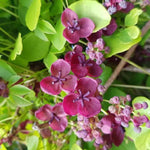





The chocolate vine earns its common name from the scent, not the colour — though the colour is remarkable too. The flowers are dark purple, small, and carried in hanging clusters in March, April and May, when very few other climbers are doing anything at all. And they smell of vanilla. Not faintly, not arguably. Walk past on a warm spring morning and the air is unmistakably sweet, somewhere between chocolate and vanilla, the kind of fragrance that makes people stop and look for the source.
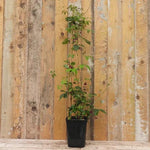
Akebia quinata is a twining climber with elegant five-lobed leaves that give it a lightness most evergreen climbers lack. In warm, sunny positions it holds those leaves through winter. In colder or more exposed gardens, it drops them — but the bare stems have a wiry beauty of their own and the plant is fully hardy. It reaches 8m or more, vigorous enough for a large pergola, a substantial wall, or scrambling into a mature tree.
In a warm summer, particularly after hand-pollination, the chocolate vine produces fat, sausage-shaped seed pods in a dusky purple. They are edible in Japan, where the plant is native, though rarely eaten here. Even without fruit, the early flowers and architectural foliage make it one of the more distinctive climbers in the range. Plant it near a path or seating area where the spring scent can be appreciated. For a succession of fragrance, combine it with summer jasmine on an adjacent support and honeysuckle for evening scent — three climbers, three seasons, three different fragrances.
Every plant is guaranteed, delivered by next-day courier, and backed by Which? Best Plant Supplier. Real people in Somerset if you need advice. Browse the full climbing plant range.
Semi-evergreen. In sheltered, mild gardens it keeps its leaves through winter. In colder positions it drops them. The plant is fully hardy either way — it regrows strongly in spring, and the early flowers arrive on bare or barely-leafed stems, which makes them more visible.
It can, but British summers are not always warm enough. The flowers are not self-fertile — you ideally need two genetically distinct plants for cross-pollination, or you can hand-pollinate with a small brush. The seed pods are decorative, fat and sausage-shaped, in a dusky purple. In Japan, the pods are eaten as a delicacy.
After flowering, in late spring or early summer. Cut back any stems that have outgrown their space and thin congested growth. Akebia flowers on the previous year's wood, so avoid hard pruning in late summer or autumn — you would be removing next spring's flower buds. If the plant has become a tangled mass, a hard renovation prune after flowering will restore order.
It flowers most freely in sun but is shade-tolerant. A west-facing wall works well — afternoon warmth intensifies the fragrance. In deep shade the plant grows well but flowers less. The scent is noticeably stronger on warm days, so the sunniest position you can give it will maximise the chocolate-vanilla fragrance.


 Sign In
 Saved items