


Sold as:

from £10.95

Sold as:
from £19.99
 5 Star Service Rating




 Secure, One-Tap Checkout
 5 Star Feefo Rating
 Hand Picked, Delivered to Your Door!
 1 Year Bareroot Guarantee
 Platinum Trusted Service Award 2026
 Mail Order Plant Experts - Est. 1949
 1 Year Bulb Guarantee

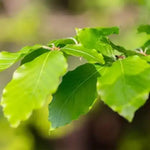
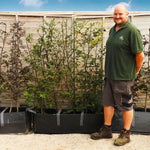
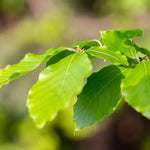
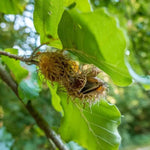
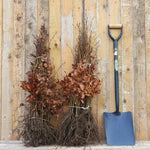
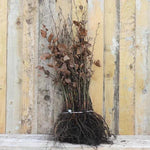
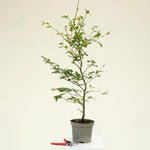
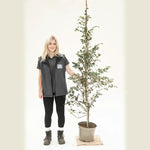
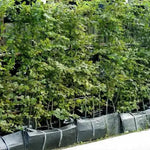





Green beech hedging (Fagus sylvatica) is Britain's classic formal deciduous hedge — a fresh, bright green that grows 30–60cm a year and, once clipped, holds its coppery-brown leaves right through winter instead of dropping them like a hedge left to grow naturally. It clips to as sharp a face as any evergreen, on a fraction of the maintenance.
Beech's trick is called marcescence — trim a beech hedge in late summer and the dead leaves stay attached through winter rather than falling, giving genuine screening and colour from a plant that's technically deciduous. Left unclipped, a beech tree drops its leaves like anything else; it's the annual cut that keeps the winter leaves on. That single fact is why beech reads, from a distance, almost like an evergreen hedge for most of the year.
It wants lighter, free-draining soil and a reasonably sunny spot to do this well. On heavy clay or ground that holds winter wet, beech struggles and thins at the base — hornbeam, its near-identical cousin in every respect except soil tolerance, is the honest choice there instead.
The Meikleour Beech Hedge in Perthshire, planted in the autumn of 1745, now stands around 30 metres tall and roughly 530 metres long — Guinness-recognised as both the tallest and the longest hedge on the planet, trimmed only about once a decade. Local tradition holds that it grows so vigorously because the men who planted it fell at the Battle of Culloden the following year and never returned to tend it; the death of Robert Murray Nairne at Culloden in 1746 is recorded history, whatever truth lies behind the folklore about the hedge itself.
Beech wood has a working history to match its garden presence: it smoked much of the nation's herring and, being close-grained and hard-wearing, supplied kitchen utensils, tool handles and furniture for generations.
Green beech's most natural partner is its own purple-leaved relative, copper beech — mixing the two in one run makes the traditional tapestry hedge, since both grow at exactly the same rate. On wetter or heavier ground, hornbeam is the site-driven alternative rather than a struggling beech, and yew is the evergreen option where winter colour matters less than year-round density. As a clean green backdrop, beech suits almost anything planted in front of it — a border from our perennial plant range included. Browse the rest of the beech hedging range.
Ashridge hedging is grown under contract by specialist UK growers, to our own specification — never surplus stock from elsewhere. We're one of the UK's largest bareroot hedging sellers, and a purpose-built cold store keeps stock in top condition all season. Bareroot green beech is guaranteed to grow for 12 months, planted and cared for correctly.
Yes, if trimmed — clip it in late summer and the dead brown leaves hold on the branches right through to spring, giving effective winter screening from a deciduous plant.
Not reliably — beech wants lighter, free-draining ground and struggles on heavy, wet clay. Hornbeam tolerates exactly those conditions and is the more honest choice there.
Once a year, in late summer (August or September), is enough for a mature beech hedge. Use secateurs rather than shears so you're not slicing the larger leaves in half.
3 per metre in a single row, or 4–6 per metre in a staggered double row for a fuller, faster-establishing screen.
No — the 12-month guarantee applies to our bareroot hedging. The instant trough option, being an established rootballed plant supplied in a container, sits outside it.
Yes — the classic tapestry hedge. The two grow at exactly the same rate and take the same clip, so they knit together as a single hedge rather than competing.


 Sign In
 Saved items