










 Sign In
 Saved items
 Secure, One-Tap Checkout
 5 Star Feefo Rating
 Hand Picked, Delivered to Your Door!
 1 Year Bareroot Guarantee
 Platinum Trusted Service Award 2026
 Mail Order Plant Experts - Est. 1949
Out of Stock
Select form
Select a product

Single Plants
Select Size
 Which Best Plant Supplier 2025
 Delivered across the UK
 Platinum Trusted Service Award
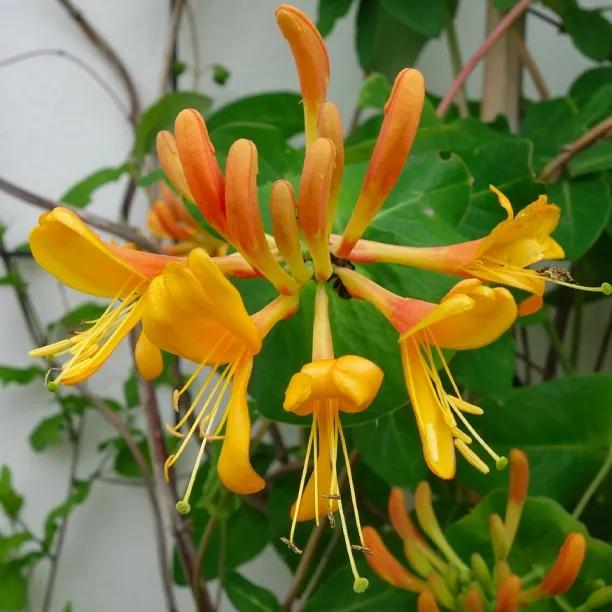
About Copper Beauty Honeysuckle Plants
- Variety: Copper Beauty — evergreen, copper-orange flowers, shade-tolerant
- Latin name: Lonicera henryi 'Copper Beauty'
- Type: Evergreen honeysuckle
- Flower: Copper-orange tubular flowers, followed by dark blue-black berries
- Scent: Lightly scented
- Climbing method: Twining stems
- Height: To 10m
- Flowering: June–July
- Hardiness: Fully hardy
- RHS AGM: No
- Sold as: P9 and 3L deep pots, grown from cuttings by us. Peat-free compost
- Plant outdoors: Year-round
- Delivered: March–November typically. Collection from Castle Cary also available
Copper Beauty – The Evergreen Honeysuckle That Handles Shade
Most honeysuckle is deciduous. You get the flowers, the scent, the summer romance — and then bare stems from November to April. Copper Beauty is different. A form of Lonicera henryi, it keeps its dark, glossy foliage through the year, which makes it a genuine screening plant as well as a flowering one. The leaves are handsome in their own right: pointed, leathery, dark green, looking more like a well-behaved evergreen climber than the tangle most people associate with honeysuckle.
The flowers arrive in June and July — copper-orange tubular blooms in clusters, followed by dark blue-black berries that birds seek out in autumn. The scent is lighter than the native honeysuckles, noticeable close up rather than carrying across the garden. The bronze tone of the young foliage adds an extra layer of colour in spring. At 10m, it covers a large wall, a long boundary fence, or a substantial pergola. It handles shade better than most flowering climbers, making it one of the few plants that can brighten a north-facing fence without losing its leaves in winter.
Screening and Structure
Where other honeysuckles are about flowers and fragrance, Copper Beauty earns its place on year-round foliage. Use it to screen an ugly fence, hide a shed, or create a green backdrop against which other plants can perform. For a mixed hedge effect, plant it with ivy (reliable evergreen ground layer) and a summer clematis threaded through for flower colour from July onwards. At its feet, shade-loving perennials like heucheras complement the dark foliage.
Why Ashridge?
We grow Copper Beauty from cuttings in peat-free compost using biological pest controls. Every plant is guaranteed. Delivered by next-day courier, with Which? Best Plant Supplier and Feefo Platinum awards behind us. Real people in Somerset if you need help. See all our honeysuckle or browse the full climbing range.
Frequently Asked Questions
Is Copper Beauty honeysuckle truly evergreen?
In all but the harshest winters. It may lose some foliage in a severe, prolonged freeze, but in normal UK conditions it holds its leaves year-round. This makes it one of the few honeysuckles that works as a permanent screen.
Will Copper Beauty grow in shade?
Better than most flowering climbers. It originates from woodland margins and handles north-facing walls and dappled shade comfortably. The flowers are fewer in deep shade, but the evergreen foliage — its main selling point — performs regardless of aspect.
How do I prune Copper Beauty?
Minimal pruning needed. After flowering, cut back anything that has outgrown its space and remove dead or congested stems to maintain airflow. The plant flowers on mature wood, so heavy annual pruning reduces next year's display. A renovation prune in late winter is possible if needed — cut back hard and accept one quiet year.
Is Copper Beauty deer-resistant?
The legacy PDP notes it is deer, rabbit and windproof — an unusually robust combination. The leathery evergreen leaves are less palatable to deer than soft deciduous growth, and the twining habit means wind damage is minimal because air passes through rather than catching a flat surface.