


Sold as:

from £10.95


Sold as:
from £19.99
 5 Star Service Rating




 Secure, One-Tap Checkout
 5 Star Feefo Rating
 Hand Picked, Delivered to Your Door!
 1 Year Bareroot Guarantee
 Platinum Trusted Service Award 2026
 Mail Order Plant Experts - Est. 1949
 1 Year Bulb Guarantee
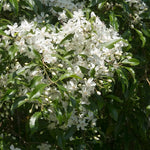
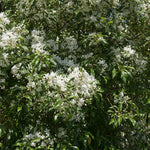

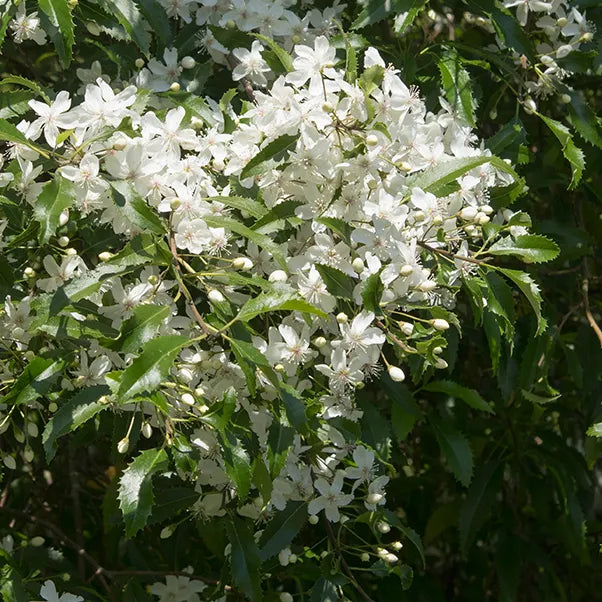
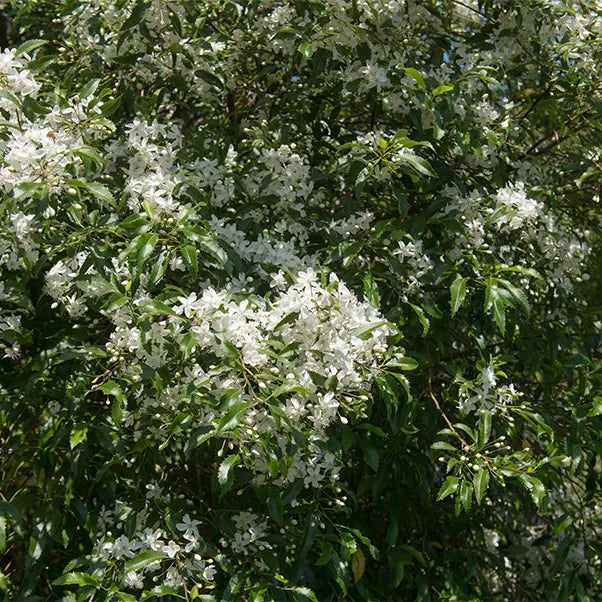




Hoheria sexstylosa 'Snow White' is the kind of plant that makes visitors ask what on earth it is. In June and July, the entire tree smothers itself in white five-petalled flowers that look remarkably like cherry blossom, except this tree keeps its leaves all winter. The flowers are fragrant, produced in such quantity that they almost hide the foliage at peak bloom, and the bees treat them as a midsummer festival. For the rest of the year, you've got a handsome evergreen column of glossy, sharply toothed leaves that earns its space without needing to do anything showy.
It comes from New Zealand, where it grows in lowland forest from the Waikato south to Wellington. The Māori name is houhere, which is where the genus name Hoheria comes from. 'Ribbonwood' and 'lacebark' are the English common names, both referring to the fibrous inner bark that the Māori used for making rope and cordage. The Latin name sexstylosa means 'six styles', which tells you something about botanists' priorities when naming things.
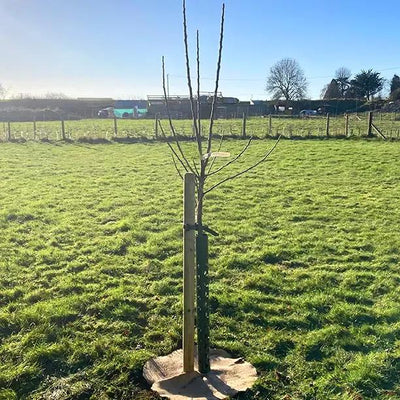
Snow White grows as an upright, pyramidal tree reaching about 4–5m in 20 years. Left alone it'll eventually make 5–8m, but it responds well to pruning and can be kept to 2–3m if you'd rather have a large shrub. It also makes an excellent evergreen hedge or screening plant — clip it and it thickens up nicely. The growth rate is fast by evergreen standards. A specimen planted in a Cornish garden in 1939 was over 7m tall and flowering prolifically by 1945. You won't wait long for results.
The pyramidal habit is naturally tidy, so it works in smaller gardens where a spreading tree would be a problem. Plant it as a specimen in a lawn, against a wall where you need year-round cover, or as an informal screen at the back of a border. The flowers appear in summer when most trees have finished their display, which makes it genuinely useful rather than just pretty.
Snow White handles temperatures down to about -10°C, which puts it on a par with many plants we consider perfectly hardy in southern and central England. The risk isn't really cold — it's cold wind. Plant it where it has shelter from bitter easterlies and northerlies, especially in its first couple of winters, and it'll be fine. A south-facing or west-facing wall is ideal. In more exposed or northern gardens, mulch the base thickly in late autumn with bark or gravel to protect the roots. Nurseries in West Sussex report established specimens sailing through winters well below -10°C without damage. The key word is 'established'. Give it a sheltered spot and a year or two to put its roots down.
An evergreen with white summer flowers pairs well with almost anything. Lavender planted at the base gives you purple and silver at ground level against the glossy green column. For more summer white at a different height, climbing plants on a nearby wall or fence extend the display. A group of dahlias in front provides colour from July onwards, taking over as the hoheria's flowers fade. In a coastal garden, where hoherias are naturally at home (the species is salt-tolerant), combine it with other New Zealand and southern hemisphere plants for a coherent planting scheme.
We grow our plants in peat-free compost using biological pest controls. Every tree is guaranteed, and if anything goes wrong the team in Castle Cary will help. We know from experience that hoheria aren't as widely grown as they deserve to be — most customers who buy one come back for another. Browse our full range of garden shrubs.
Yes. It keeps its leaves year-round, which makes it valuable for screening and winter structure. In a very cold winter it may drop a few leaves, but a well-sited plant will stay fully clothed. The glossy, deeply toothed foliage is handsome in its own right and provides a dark green backdrop for other plants in the border.
Yes, and it makes a very good one. It responds well to clipping, thickens up into a dense screen, and flowers on the growth it's allowed to keep. You can maintain it at any height from about 2m upwards. As a hedge it provides privacy, some wind protection, and a spectacular summer display of white flowers. Space plants about 60–90cm apart for a hedge.
Fast, for an evergreen. Expect 30–50cm of growth per year in a sheltered spot with reasonable soil. It'll reach about 4m in 10 years and 5m or more in 20. If that's too tall, prune it after flowering to keep it where you want it. The species is known for rapid establishment once the roots are settled.
Not if you're happy with the natural pyramidal shape. It's naturally tidy. If you want to control size or use it as a hedge, prune after flowering in late summer. Don't prune in winter or early spring because you'll cut off the developing flower buds. It can be pruned quite hard if needed and will regrow without complaint.
Both are cultivars of Hoheria sexstylosa, the New Zealand ribbonwood. Stardust holds the RHS Award of Garden Merit and has slightly smaller, darker leaves that make the white flowers stand out more dramatically. Snow White has a neater pyramidal habit and is widely reported as being slightly hardier. Both produce masses of white flowers in summer and both make excellent garden plants. The choice is largely personal.




 Sign In
 Saved items