



Sold as:

from £10.95

Sold as:
from £19.99
 5 Star Service Rating




 Secure, One-Tap Checkout
 5 Star Feefo Rating
 Hand Picked, Delivered to Your Door!1 Year Bareroot Guarantee
 Platinum Trusted Service Award 2026
 Mail Order Plant Experts - Est. 1949
 1 Year Bulb Guarantee
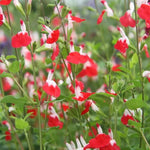
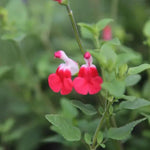
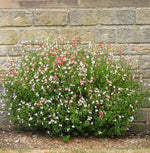







Hot Lips is a temperature sensitive salvia. When it is cool, its flowers are distinctly bicoloured with red lips and a white throat; as clear as a barber's pole. As the weather gets warmer (we hope) the red deepens and spreads until some flowers are almost entirely a darker, almost crimson, red. The flowering season is huge, so when autumn approaches, and the nights cool, guess what? Yup, the white creeps back. You get three different looks from one variety between spring and autumn. Actually, under a microscope, no two weeks see the same colouring. Hot Lips got an AGM in 2015, unsurprising given its ability to surprise for about 6 months of the year.
The plant itself is a neat, bushy subshrub reaching about 80cm. It is not a nemorosa type; it belongs to the shrubby salvias (Salvia × jamensis, a cross between S. microphylla and S. greggii) and behaves more like a small shrub than a herbaceous perennial. The stems are woody at the base and the foliage smells pleasant when bruised. It generally does not die in the ground in winter as Caradonna or East Friesland can; instead, don't cut it back until it breaks into growth in spring and you should get years of service.
Hot Lips is classed as H5 by the RHS, which means it will survive temperatures down to about minus 10°C. We haven't seen anything like that in Somerset for at least the last five or six years and with us it sails through winter without any protection as long as the ground is well-drained. Overwintering in wet soil kills more salvias than frost. Plant it in full sun, in ordinary to poor soil, and ideally in a south or west-facing position. Don't improve the soil as you will get lots of greenery and not enough flowers. Try Hot Lips (and other salvias) in a dry gravel garden, a raised bed or at the back of a rockery but if you have none of those then it should serve you well at the front of a sunny border. In colder or more exposed gardens (northern England, Scotland, high ground) for a good show of flowers, plant against a warm wall and mulch the base in late autumn with bark or gravel.
Hot Lips is as reliable and showy in a pot on the terrace as it is in a border. In the garden, plant it alongside Caradonna, whose upright violet spires make a strong vertical contrast against the looser, bushier habit of Hot Lips. Lavender is a natural companion; the two share the same appetite for sun and poor soil, and the silvery foliage of Hidcote or Munstead sets off the red-and-white flowers. For late-season colour that carries into autumn alongside Hot Lips, Rose Marvel adds a different texture with its dense herbaceous spikes in pink. A few dahlias behind, where the extra height is useful, will give you a show well into October.
We use peat-free compost and biological pest controls. The people who grow your plants are the people who pack your order and answer your questions if anything goes wrong (we are a small team). And every plant is guaranteed. See the full salvia collection.
Mid-spring, once you see new growth close to the base of the plant. Prune to just above the lowest new growth, but do not cut into bare wood below the new growth as the shrubby salvias don't put out new growth from old wood the way a nemorosa type does. Do not prune in autumn because the old stems help protect the crown from frost.
Temperature. In cool weather (below about 15°C), the flowers are bicolour: red with a white throat. As the mercury rises, the red pigment strengthens and the white area shrinks. By midsummer you generally see all-red flowers. Then, as nights begin to cool in autumn, the bicolour pattern returns. As they say, it's in the genes. The same plant can look entirely different in June and August.
Yes, it is in most of lowland England and Wales, tolerating temperatures down to minus 10°C. The real enemy is not frost but poor drainage and waterlogged soil in winter. Planted in well-drained ground, ideally in a warm spot, and your salvias will come through most winters without special care. In colder or more exposed planting sites, mulch the base in late autumn.
Yes, and it does well if you use a loam-based compost (none better than John Innes No. 2 or 3) with extra grit for drainage. Water through the hotter months of summer but let the compost dry between waterings. Feed lightly once a month with a liquid feed during the growing season. In winter, get the pot off the ground so it drians freely; a sheltered spot against a house wall helps.
From June until the first hard frost which is five months or so in a good year. Deadheading encourages new flushes, and probably lengthens the season a bit.


 Sign In
 Saved items