



Sold as:

from £10.95

Sold as:
from £19.99
 5 Star Service Rating




 Secure, One-Tap Checkout
 5 Star Feefo Rating
 Hand Picked, Delivered to Your Door!1 Year Bareroot Guarantee
 Platinum Trusted Service Award 2026
 Mail Order Plant Experts - Est. 1949
 1 Year Bulb Guarantee







Lutescens is the Whitebeam most people mean: a compact tree whose new leaves open silvery-grey, followed by creamy-white flowers in late spring and red berries in autumn. It reaches 8 to 12 metres, grows on chalk, takes town air and dry ground, and holds the RHS Award of Garden Merit.
Sorbus aria Lutescens is a hardy, native, medium-sized, deciduous Whitebeam tree that has a naturally upright and rounded canopy.
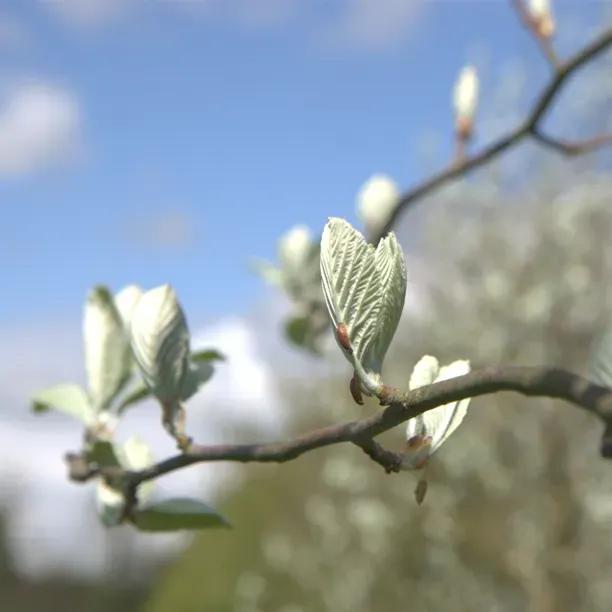
The young foliage has grey hairs: lovely in strong sunlight, shining like silver. These remain on the underside while the upper side matures through yellow (which distinguishes it from the species) to green by midsummer: sometimes the hairs stay on the leaf longer than normal, maintaining that lovely frosted appearance.
It produces panicles or flattened clusters of simple yellowy-white flowers in late spring, which become green berries that ripen into a shiny red by September and are much loved by birds.
It'll reach a height of about 8 to 12 metres.
Browse our other Sorbus varieties, our large trees, or our full range of trees.
Delivery season: Whitebeam trees are delivered bareroot from late autumn to early spring, November to April, and pot-grown in any month when in stock.
Choosing a size: Small trees are cheaper, easier to handle and more forgiving of less than ideal aftercare, so they're best for a big planting project. If instant impact is your priority, or if you are only buying a few plants for use in a place where it's convenient to water them well in their first year, then you may as well use bigger ones. All our bareroot trees are measured by their height in centimetres above the ground (the roots aren't measured).
Its timber is extremely hard and surprisingly light, it also has a lovely two-tone effect with reddish heartwood and white outer rings that look great when used in doors and table tops or when turned.
The cultivar name on its own, Lutescens, is probably a grammatical "re-Latinisation" of the English word lutescent, from the Latin luteus, yellow, in reference to the upper side of the leaves in Spring.
Standard trees are measured by their girth in centimetres 1 metre above ground level: their trunk's waist measurement. Unlike sapling trees and hedge plants, standards aren't measured by their height, which will vary quite a bit both between and within species.
So, a 6/8cm standard tree has a trunk with a circumference of 6-8cm and an 8/10 standard has a trunk 8-10cm around. This measurement makes no difference to the tree's final height.
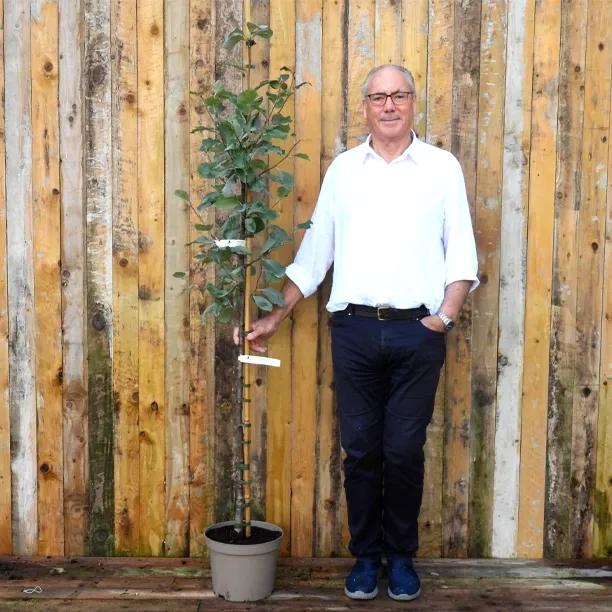
On average, standard trees are 2-3.5 metres tall when they arrive, but we cannot tell you precisely how tall your trees will be before we deliver them.
We grow three Whitebeams. Majestica is the other named variety, and the Common Whitebeam is the species itself. For an avenue on chalk, Whitebeam's usual companions are our Lime trees. See all our Rowans and Whitebeams, and dust bareroot roots with Rootgrow as you plant.
Ashridge has sold trees since 1949 and is a Which? Best Plant Supplier 2025. Your Lutescens Whitebeam comes bareroot, lifted while dormant, or pot-grown for planting in any month. Bareroot trees are guaranteed for 12 months, and so is a potted tree delivered leafless between November and March.
It reaches 8 to 12 metres tall and 4 to 8 metres wide, in 20 to 50 years: a compact tree of about 10 metres.
Yes. Whitebeams are at home on chalk, and Lutescens grows in any well-drained soil. It grows in chalk, clay, loam and sand, acid or alkaline.
Lutescens is a selected variety with a compact habit. The upper side of its young leaf passes through yellow on its way to green, which the species does not do. If you want every tree in an avenue to match, plant one named variety.
Yes. It is tolerant of atmospheric pollution and of dry conditions, and it takes an exposed site.
Bareroot trees cost less and are planted from November to April. Pot-grown trees cost more, and you can plant them in any month if you water them through their first summer.
Bareroot trees are delivered from November to April, while they are dormant. Pot-grown trees can be delivered and planted in any month when you find them in stock.




 Sign In
 Saved items