


Out of Stock
Sold as:

from £6.99

Sold as:
from £19.99
 5 Star Service Rating




 Secure, One-Tap Checkout
 5 Star Feefo Rating
 Hand Picked, Delivered to Your Door!
 1 Year Bareroot Guarantee
 Platinum Trusted Service Award 2026
 Mail Order Plant Experts - Est. 1949
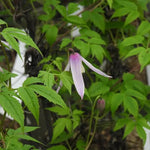
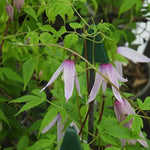
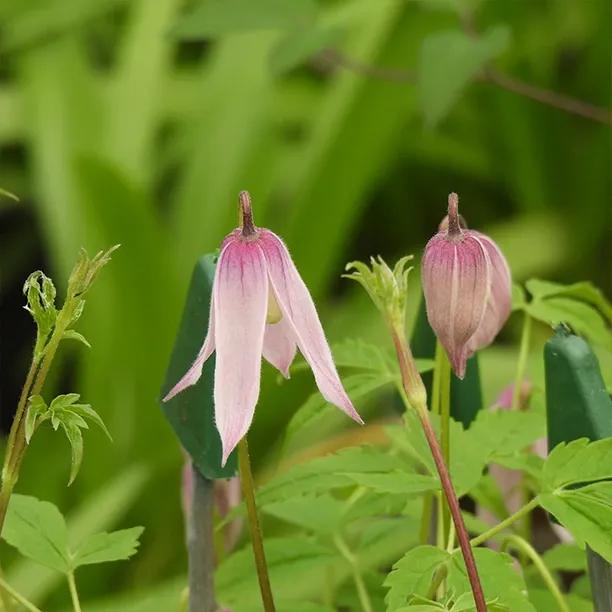
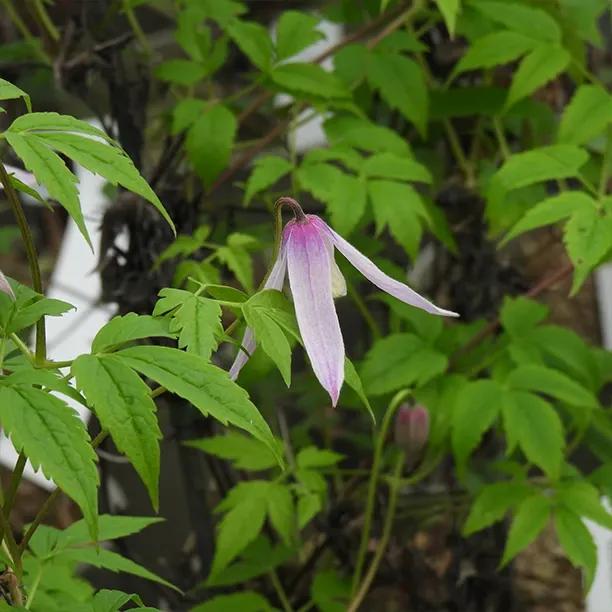
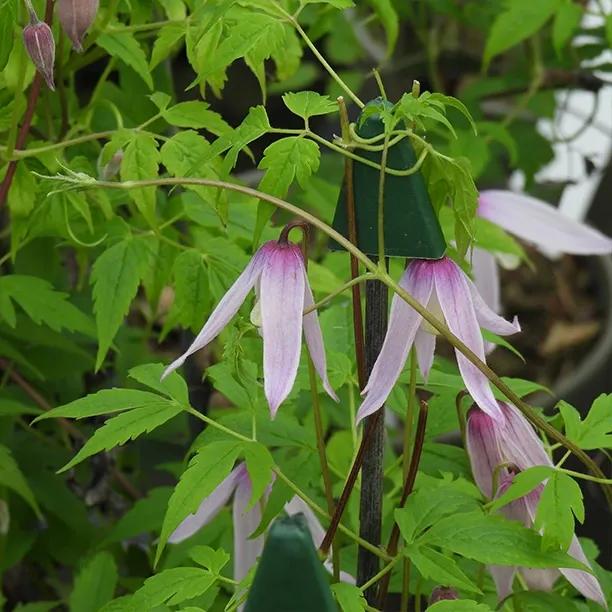




Markham's Pink is a macropetala clematis: nodding double bells in dusky rose-pink, each with a boss of golden anthers, appearing in April and May before most other clematis have even started. The flowers are smaller than the large-flowered hybrids (7–10cm) but produced in such numbers that a mature plant on a wall or fence is covered in them. They are followed by wispy silver seedheads that last through summer and into autumn, giving the plant a second season of quiet interest long after the flowers have gone.
At 3m it is compact enough for a small garden, an obelisk, or a fence panel. It is one of the hardiest clematis in the range; the atragene group evolved in mountain woodlands and they tolerate cold, wind, frost pockets, and poor soil without complaint. More usefully, they tolerate shade. We find Markham's Pink performs well in surprisingly deep shade, which makes it one of the few clematis well worth trying on a north-facing wall. If you have a cold, shaded boundary that defeats everything else, this is a plant to consider.
Ernest Markham was head gardener to William Robinson at Gravetye Manor in Sussex. He raised two clematis that are still widely grown nearly a century later. Clematis Ernest Markham, the vivid magenta-red Group 3 hybrid, is the more famous of the two; it was named in his honour after his death. Markham's Pink is the one he raised himself from a macropetala seedling in the late 1920s, listing it in his 1935 book simply as "C. macropetala var. markhamii" and noting that it had received the RHS Award of Merit that year. Two plants from the same gardener in the Ashridge range. One flowers in spring, the other from June to October. Grow both and you have Markham's legacy covering seven months of the year.
Markham's Pink flowers in April and May and has done its work by June, so it needs companions to fill the summer. A Group 3 clematis like Étoile Violette on the same wall takes over from July to September; the deep purple against Markham's wispy silver seedheads is a good combination. For a rose, plant a climbing rose (New Dawn or Madame Alfred Carrière, both shade-tolerant) on an adjacent wall. At the base, spring bulbs (narcissi, muscari) provide ground-level colour at the same time as the clematis flowers overhead. For another spring clematis of a different character, Apple Blossom is evergreen and scented but needs a sunnier wall.
Markham's Pink is slow and very tricky to strike from cuttings (and nearly as hard to source from other growers for the same reasons). It is always in short supply at the nursery. We persist because it is a good plant and there is nothing else quite like it. No wasted time though as every plant is guaranteed. See the full clematis range.
Group 1, it flowers on stems made the previous year, so prune only after flowering finishes in May or June, and only if the plant has outgrown its space. Never cut hard into old wood; the atragene clematis do not regenerate the way the large-flowered hybrids do. In most years, no pruning is needed at all.
At pot level. Do not bury the crown. This is the opposite of the deep-planting rule that applies to most clematis. Atragene types (alpinas and macropetalas) have a crown that rots if buried in damp soil. Set the top of the rootball level with the surrounding ground. For full instructions see our clematis growing guide.
Yes, and better than almost any other clematis. The atragene group thrives in shade and cool conditions. We find Markham's Pink flowers well even in deep shade. The colour holds; in fact, the flowers last longer out of direct sun. For more shade-tolerant climbers see our shade-tolerant climbers guide.
The main display is in April and May. A secondary flush can follow in late summer, but it is intermittent irrespective of position or care. Buy this clematis for its spring flowering; treat any repeat as a bonus rather than an expectation.
Yes. The atragene clematis (alpinas and macropetalas) are wilt-resistant. They are also slug-resistant, tolerant of poor soil, and among the hardiest clematis you can grow. If wilt has been a problem in your garden, this clematis is a safe choice.
Yes. At 3m it is compact enough for a large pot (45cm diameter minimum) with a small obelisk or trellis for support. Use a loam-based compost with good drainage, water regularly, and feed with a low-nitrogen fertiliser in spring. The plant is fully hardy in a pot and does not need winter protection. For full container advice see our clematis growing guide.


 Sign In
 Saved items