


Sold as:

from £10.95

Sold as:
from £19.99
 5 Star Service Rating




 Secure, One-Tap Checkout
 5 Star Feefo Rating
 Hand Picked, Delivered to Your Door!1 Year Bareroot Guarantee
 Platinum Trusted Service Award 2026
 Mail Order Plant Experts - Est. 1949
 1 Year Bulb Guarantee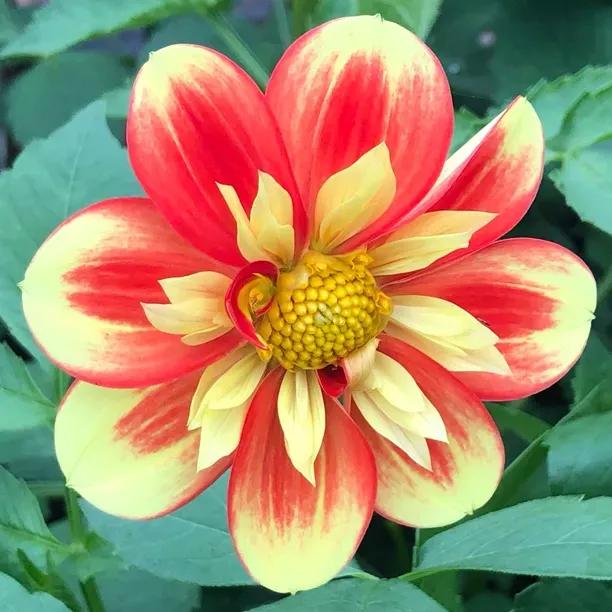




Some dahlias are sophisticated. Pooh is not trying to be sophisticated. It's trying to make you smile, and it's very good at it. The flowers have a single ring of broad red outer petals, a frill of smaller golden-yellow tubular petals (the "collar" that gives collarette dahlias their name), and a rich golden central button. The whole thing is open, bright and unapologetically cheerful.
It's also an RHS AGM holder, which is the horticultural establishment's way of confirming that something this fun is also properly good. The open flower form means bees and hoverflies can reach the central disc easily, making Pooh one of the better dahlias for pollinator gardens. The plant is compact at 90cm, flowers non-stop from July to November, and produces masses of blooms without needing much attention.
Pooh's colour scheme, we should note, also matches SuperTed's uniform and Paddington Bear when he gets home, takes off his jacket, but still has his hat on. Make of that what you will.
Hot colours with open, informal flowers. Plant Pooh alongside Bishop of York (golden yellow peony with dark Bishop foliage) for two pollinator-friendly dahlias in the same warm register but completely different forms. The deep red pompon Nescio picks up the red outer petals at a lower level with a tight, geometric form. For contrast, the burnt orange of David Howard (dark foliage, fully double) gives you warmth in a completely different mood. Helenium and Rudbeckia are natural late-summer companions. In a pot, Pooh with a soft Pennisetum grass is hard to beat.
Our dahlia tubers are Dutch first-class quality, imported direct and hand-graded by us. We reject undersized tubers so you get a clump with viable eyes, ready to grow. Delivered by next-day courier from March, covered by our plant guarantee, Which? Best Plant Supplier, and real people on the phone in Somerset. Browse the complete dahlia collection.
A dahlia with two rings of petals: an outer ring of full-sized petals and an inner ring (the "collar") of smaller, often different-coloured tubular petals surrounding the central disc. The centre is open and visible, which is why collarettes are good for pollinators. It's one of the more unusual dahlia forms. Our dahlia types guide explains all the classifications.
Excellent. The open centre means bees, hoverflies and other pollinators can access the nectar and pollen easily. Fully double dahlias (decorative, ball, pompon types) have petals covering the centre, which blocks pollinator access. If you're planting for wildlife as well as beauty, collarettes and single dahlias are the ones to choose. Bishop of Llandaff is another excellent pollinator choice.
Very well. At 90cm with a narrow 45cm spread and mid-sized flowers, it's compact and doesn't become top-heavy. Use a pot at least 30cm across, feed fortnightly from June, and plant with an ornamental grass for a natural, informal effect. Our dahlias in pots guide has the detail.
Bred by the Gitts family at Swan Island Dahlias in Oregon in 1998. You may see it listed as 'Pooh Swan Island' in some catalogues, to distinguish it from an older 'Pooh' dating back to 1951 that doesn't seem to be commercially available any more. The red-and-yellow colour scheme does have a certain Hundred Acre Wood quality.
Deadhead regularly, feed fortnightly with a liquid tomato fertiliser from June, and water in dry spells. That's it. Pooh is a vigorous, prolific variety that doesn't need much coaxing. The AGM confirms it performs well across a wide range of UK conditions. Full growing advice in our dahlia growing guide.


 Sign In
 Saved items