

Out of Stock
Sold as:

from £6.99

Sold as:
from £19.99
 5 Star Service Rating




 Secure, One-Tap Checkout
 5 Star Feefo Rating
 Hand Picked, Delivered to Your Door!
 1 Year Bareroot Guarantee
 Platinum Trusted Service Award 2026
 Mail Order Plant Experts - Est. 1949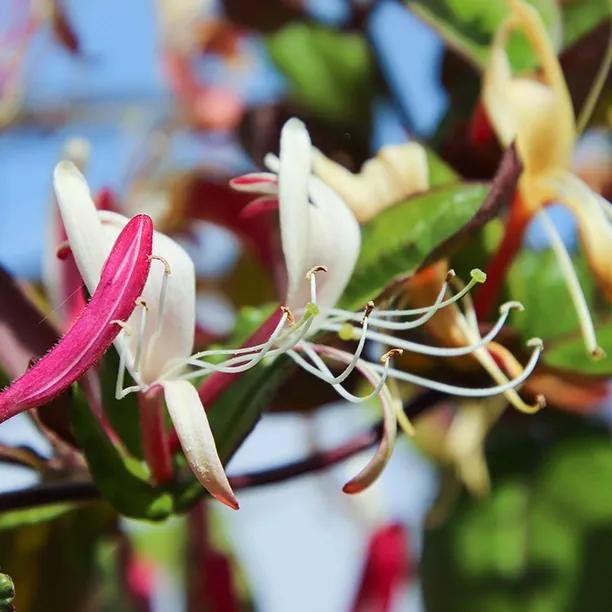




Princess Kate gives you two seasons of interest before the first flower opens. In spring, the new growth emerges with a creamy-white variegation that brightens a fence or pergola while the rest of the garden is still waking up. As the leaves mature, the variegation fades to plain green, but by then the flowers have arrived: white and pink trumpets, sweetly scented, from June into September. The scent is strongest in the evening — a few metres from an open window is all the persuasion this plant needs to justify its space.
It is vigorous, reaching 6–7m, and semi-evergreen in most of the UK. It twines enthusiastically through whatever support you give it, which makes it excellent for covering a large area quickly. An archway, a long run of fence, or a pergola over a seating area — anywhere you want both speed and beauty.
Evening-scented climbers earn their keep near the places where people sit after work. Combine Princess Kate with a jasmine for a one-two punch of fragrance from adjacent supports. For a quieter daytime scheme, train it alongside ivy for year-round coverage where the honeysuckle provides the summer flowers and the ivy fills in during winter. A late-flowering clematis like Étoile Violette threaded through gives a purple contrast to the white-and-pink flowers.
We propagate Princess Kate ourselves, in peat-free compost with biological controls. Guaranteed, delivered next-day by courier, and supported by a team who pack the plants and answer the phones — same people, same building in Somerset. Which? Best Plant Supplier. Browse all our honeysuckle or the full climbing range.
Semi-evergreen. In mild winters and sheltered positions, it holds its leaves. In colder areas, expect partial or full leaf drop. The stems are hardy and the plant regrows strongly in spring, which is when the variegated new growth makes its best appearance.
After flowering, cut back any stems that have outgrown their space and thin out congested growth to improve airflow. Honeysuckle flowers best on wood that is a year or two old, so avoid cutting back hard every year — you would be removing next season's flowering wood. A severe renovation prune is possible in late winter if the plant has become a tangled mess, but expect no flowers for a season afterwards.
The variegation is strongest on new growth in spring. As the leaves mature through summer, they gradually turn plain green. You get the best variegated effect in April and May. The flowers then take over as the main attraction from June.
Honeysuckle flowers are designed for long-tongued pollinators. The tubular shape suits moths particularly — the evening scent is specifically to attract them. Bees visit during the day. Berries in autumn feed birds. One of the better choices for a wildlife-friendly garden screen.


 Sign In
 Saved items