


Sold as:

from £6.99

Sold as:
from £19.99
 5 Star Service Rating




 Secure, One-Tap Checkout
 5 Star Feefo Rating
 Hand Picked, Delivered to Your Door!
 1 Year Bareroot Guarantee
 Platinum Trusted Service Award 2026
 Mail Order Plant Experts - Est. 1949
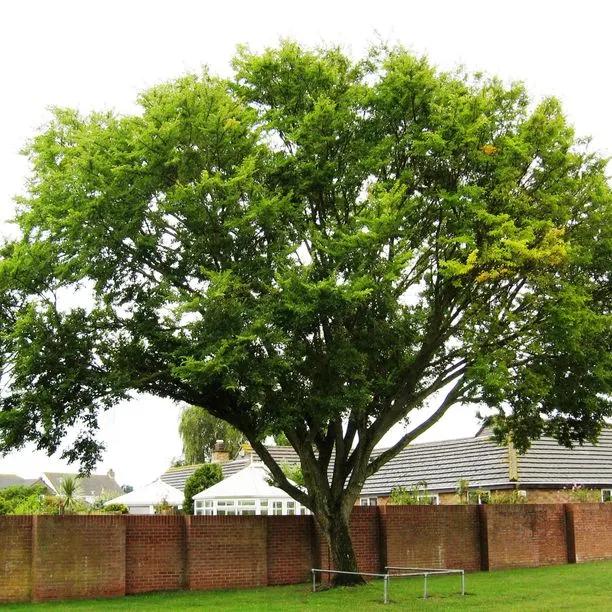




Sapporo Autumn Gold is a fast-growing hybrid Elm, bred for resistance to Dutch elm disease, with glossy leaves that are tinged red in spring and turn yellow in autumn. It makes a large, broadly conical tree, more than 12 metres tall in time, for any well-drained soil in sun or partial shade.
Sapporo Autumn Gold is a medium-sized, upright and spreading tree with an open canopy that doesn't cast very dense shade, making it a good choice for the average sized garden. The shiny leaves are narrow, serrated ovals which, true to their name, turn a warming yellow in autumn before they fall. The lemon and lime coloured spring foliage is attractive too, and sometimes carries a hint of pink. New bark is smooth and grey, turning sooty and grooved with age.
Sapporo Elms don't resemble the old European Elms, but they're a fine foliage tree in their own right. As far as the White-letter Hairstreak butterfly and White spotted pinion moth are concerned, they may as well be the same tree. Both species are just about surviving in this country; it's probably too late for native populations of the large tortoiseshell butterfly, which is also partial to Elm, but planting these trees gives them a chance of staging a comeback from captive specimens.
It's vigorous to about 15 metres.
Browse our large garden trees, or all of our trees.
Delivery season: Elm trees are delivered bareroot from late autumn to early spring, November to April.
Choosing a size: Small trees are cheaper, easier to handle and more forgiving of less than ideal aftercare, so they're best for a big planting project. If instant impact is your priority, or if you are only buying a few plants for use in a place where it's convenient to water them well in their first year, then you may as well use bigger ones. Our standard trees are measured by the girth of the trunk in centimetres, one metre above the ground, not by their height.
Favours light, alkaline soils, where it produces best yellow Autumn colour, but otherwise likes clay.
This tree was cultivated by Dr Eugene Smalley at Wisconsin University in the late 1950's, with seeds from the botanic gardens at Hokkaido university in Sapporo, Japan. It is a hybrid of Japanese Elm, Ulmus davidiana japonica, and the dwarf Siberian Elm, Ulmus pumila.
It has extremely high resistance to Dutch Elm Disease, not quite 100%, but close enough to be used as a benchmark for testing other cultivars against.
Standard trees are measured by their girth in centimetres 1 metre above ground level: their trunk's waist measurement. Unlike sapling trees and hedge plants, standards aren't measured by their height, which will vary quite a bit both between and within species.
So, a 6/8cm standard tree has a trunk with a circumference of 6-8cm and an 8/10 standard has a trunk 8-10cm around. This measurement makes no difference to the tree's final height.
On average, standard trees are 2-3.5 metres tall when they arrive, but we cannot tell you precisely how tall your trees will be before we deliver them.
We grow three disease-resistant Elms. The Golden Elm is the small one, at about 8 metres, and Wingham is the big one, at about 30. Sapporo Autumn Gold sits between them. See all our Elm trees. Dust bareroot roots with Rootgrow as you plant.
Ashridge has sold trees since 1949 and is a Which? Best Plant Supplier 2025. Your Sapporo Autumn Gold comes as a bareroot tree, lifted to order while dormant and guaranteed for 12 months. Plant it between November and April, and it will establish readily.
No Elm is sold as immune. The RHS describes Sapporo Autumn Gold as partially resistant. It was bred for resistance, as a hybrid between Japanese and Siberian Elms.
The RHS calls it fast-growing and gives it more than 12 metres tall and 8 wide, reached over 50 years or more. We find about 15 metres typical.
Any well-drained soil. The RHS lists clay, loam and sand, from acid to alkaline, in full sun or partial shade.
Not this one. Choose the Golden Elm, which the RHS gives about 8 metres tall and 4 wide, with a narrow, conical shape.
Rarely, according to the RHS. It is a tree you grow for its shape and its leaves.
Bareroot only, from November to April, while the trees are dormant. You can order at any time of year and your tree is lifted and sent once the season opens.






 Sign In
 Saved items