









 Sign In
 Saved items
 Secure, One-Tap Checkout
 5 Star Feefo Rating
 Hand Picked, Delivered to Your Door!
 1 Year Bareroot Guarantee
 Platinum Trusted Service Award 2026
 Mail Order Plant Experts - Est. 1949





Select form
Select a product

Single Plants
Select Size
About 'Snowman' White French Lavender Plants
- Variety: Snowman
- Species: Lavandula stoechas (French lavender / Butterfly lavender)
- Colour: White — pure white bracts ("ears") above pale grey-green buds
- Foliage: Evergreen, aromatic, grey-green with a slightly resinous scent
- Height: Around 45–60cm (18–24in)
- Spread: 40–50cm
- Flowering: May to September, often with a second flush in late summer if deadheaded
- Scent: Mild, resinous — more eucalyptus than sweet lavender. Not one for cooking
- Hardiness: Borderline hardy in most of the UK. Survives most winters in the south and west; needs a sheltered spot or pot culture north of the Midlands
- RHS AGM: No
- Introduced: Selected from Lavandula stoechas breeding lines; exact date uncertain
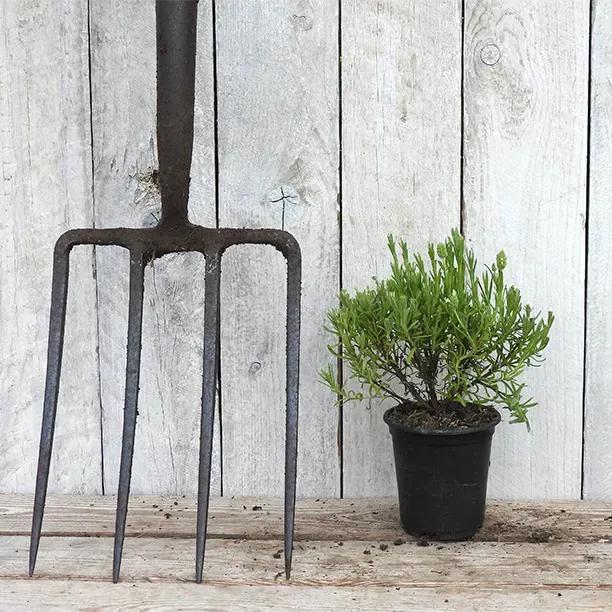
- Sold as: Pot-grown plants (P9 available depending on season)
- Plant outdoors: From late April onwards in sheltered, south-facing positions. May or June is safer. In exposed or northern gardens, keep it in a pot you can move under cover in winter
- Delivered: From April/May, weather dependent
Snowman — White Butterfly Lavender with Ears
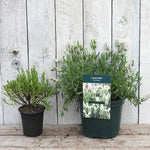
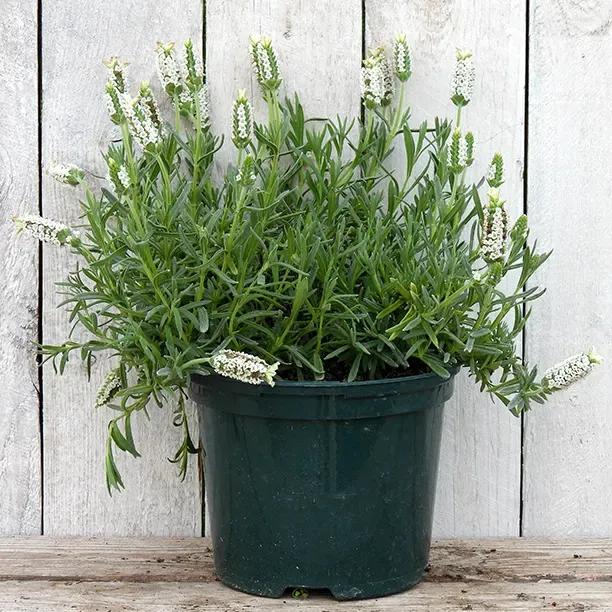
Most people think of lavender as purple. Snowman thinks differently. This is a white-flowered French lavender — the sub-species with the tall petal-like bracts on top of each flower head that give butterfly lavenders their common name. In Snowman's case, those bracts are a clean, bright white, sitting above a compact, pale-budded head on a neat, bushy plant. The effect is unlike anything else in the lavender family: less Mediterranean sun, more arctic English cottage garden in a cool palette. Although planted in a terracotta pot on a sunny terrace, it looks rather good. We would say that, of course.
Snowman flowers earlier than English lavenders, typically from May, and will keep going into September if you deadhead. The plant stays fairly compact at around 45–60cm, and the foliage is a grey-green that holds its colour through winter in most of the UK. The scent is the typical French lavender character: resinous, with a eucalyptus edge rather than the sweet, honeyed smell you get from Munstead or Hidcote. Honest assessment: it is not the lavender you buy for scent alone. You buy it because nothing else looks quite like it.
Will Snowman Survive Your Winter?
We need to be upfront about this. French lavenders are not as hardy as English or Dutch varieties. Snowman will sail through a normal winter in London, Bristol, or anywhere along the south coast. A hard frost — minus eight or below for several nights — can kill it, and prolonged wet cold is worse than dry cold. North of Birmingham, or in any exposed garden, we would strongly suggest growing Snowman in a pot that you can bring into an unheated greenhouse or porch from November to March. A sheltered south-facing wall can make the difference between a plant that thrives and one that turns to brown mush by February. If you want a white lavender that will stand up to anything a British winter throws at it, Edelweiss is a Dutch Lavandin and completely hardy, though it is a very different plant — taller, later flowering, and without those distinctive ears.
One thing in Snowman's favour: it looks best in pots, and pot culture actually suits French lavenders. The roots stay drier and warmer than they would in open ground, and you can move the plant to catch the best sun. A 30cm terracotta pot with gritty, free-draining compost is close to ideal.
Planting Companions
A line of Snowman (Snowmen?) in matching containers either side of a doorway is a simple, effective look. In the ground, plant it at the front of a sunny border alongside Papillon — the classic purple butterfly lavender — and you get a purple-and-white combination that flowers at the same time, with the same ear-shaped bracts giving the planting a visual coherence. Santolina and Artemisia 'Powis Castle' work well nearby, all silvery foliage and similar drainage requirements. Salvia nemorosa 'Caradonna' adds a vertical purple spike behind the rounded lavender shapes. By the way, in our experience, Snowman looks slightly lost in very large borders — it is better in containers, raised beds, or small front gardens where you can appreciate the detail of those white bracts close up.
Why Buy from Ashridge?
Your Snowman lavender is UK-grown and dispatched when conditions are right for planting — we will not send tender French lavenders into a late frost if we can help it. Plants travel by next-day courier; everyone comes with our guarantee, and our gardeners here in Somerset are always happy to talk you through planting, overwintering, or anything else. Browse our full lavender collection or see just the French butterfly lavenders. We are a Feefo Platinum Service Award winner, which means our customers rate us rather highly — and keep coming back.
Frequently Asked Questions
Our guide to growing lavender covers the full picture. These are the questions we hear most about Snowman.
What is the difference between English and French lavender?
English lavender (Lavandula angustifolia) is fully hardy, has a sweet scent, flowers in June and July, and is the one you use for cooking and drying. French lavender (Lavandula stoechas) is borderline hardy, has a resinous scent, flowers earlier and for longer, and has those distinctive petal-like bracts on top of each flower head. Snowman is a French type. The trade-off for the longer flowering season and the unusual flower shape is that you need to think a bit more carefully about winter protection.
Can I grow Snowman in a pot?
A pot is the best option for most of the UK. Use a container at least 25–30cm across with drainage holes, fill it with a gritty, free-draining compost (half John Innes No. 2, half horticultural grit works well), and stand it somewhere that gets at least six hours of sun. The advantage of a pot is that you can move it under cover in winter, which makes all the difference with French lavender.
Does lavender keep mosquitoes away?
Gardeners have been planting lavender near seating areas for years, and there is some evidence that the volatile oils do deter mosquitoes. French lavenders like Snowman have a stronger, more camphor-rich volatile oil than English varieties, so in theory they might be slightly more effective. In practice, a single pot of lavender is unlikely to create a mosquito-free zone, but it certainly will not hurt — and it looks better than a citronella candle.
Can I grow lavender from cuttings?
French lavenders root from semi-ripe cuttings taken in late summer, typically August or early September. Take 8–10cm non-flowering shoots, strip the lower leaves, dip in hormone rooting powder, and push them into a pot of gritty compost. Cover with a clear bag or put them in a propagator. They usually root within three to four weeks. Snowman is not the easiest lavender to propagate — English varieties tend to root more readily — but it is perfectly doable with a bit of patience and a warm windowsill.
Is lavender safe for cats and dogs?
Lavender is listed as mildly toxic to cats and dogs by the ASPCA — the essential oils can cause nausea if eaten in quantity. In practice, most pets ignore lavender plants entirely, and we have never had a customer report a problem. The resinous taste of French lavender is, if anything, less appealing to animals than the sweeter English types. Use common sense: if your cat likes to chew everything in the garden, keep the plant on a high shelf.