

Sold as:

from £10.95

Sold as:
from £19.99
 5 Star Service Rating




 Secure, One-Tap Checkout
 5 Star Feefo Rating
 Hand Picked, Delivered to Your Door!
 1 Year Bareroot Guarantee
 Platinum Trusted Service Award 2026
 Mail Order Plant Experts - Est. 1949
 1 Year Bulb Guarantee
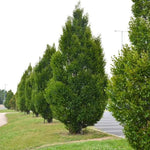







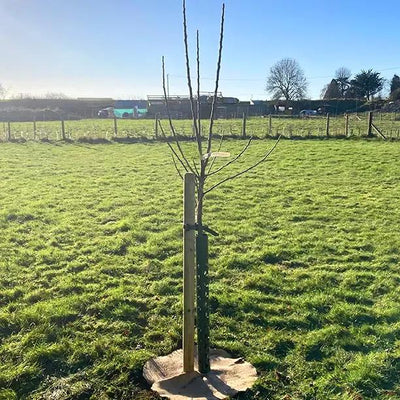
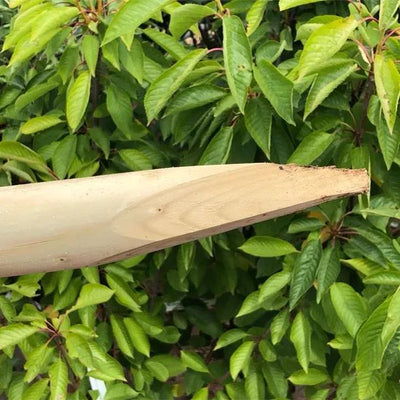
Fastigiata is the upright Hornbeam: narrow when young and filling out to a compact, egg-shaped crown, with ribbed bright green leaves that turn yellow in autumn. It grows on any soil in sun or partial shade, passes 12 metres in time, and has held the RHS Award of Garden Merit since 1993.
Fastigiate Hornbeam, nicknamed Flame due to its shape, is an upright, compact form of Common Hornbeam, ideal for roadside planting. It's a large tree with dense foliage, very narrow when young and broadening to egg-shaped when mature. It has big green catkins in Spring that develop into heart shaped, winged fruit whose seeds are popular with finches and tits.
Will grow to 20-30m.
Browse our other trees, or our younger hornbeam hedge plants.
Delivery season: Hornbeam trees are delivered bareroot from late autumn to early spring, November to April.
Choosing a size: Small trees are cheaper, easier to handle and more forgiving of less than ideal aftercare, so they're best for a big planting project. If instant impact is your priority, or if you are only buying a few plants for use in a place where it's convenient to water them well in their first year, then you may as well use bigger ones. Our standard trees are measured by the girth of the trunk in centimetres, one metre above the ground, not by their height.
Hornbeams are very versatile trees, only needing reasonably fertile soil. They love heavy clay, will tolerate shade and can be planted in the coldest regions and frost pockets.
The wood is very hard and can resist strong wind in exposed areas.
It's a superb screening tree that should need no pruning maintenance.
Hornbeam is the classic substitute for beech on wet or shady sites.
The old trend was to classify it as a subspecies, Carpinus betulus pyramidalis, but that's out of fashion now.
Standard trees are measured by their girth in centimetres 1 metre above ground level: their trunk's waist measurement. Unlike sapling trees and hedge plants, standards aren't measured by their height, which will vary quite a bit both between and within species.
So, a 6/8cm standard tree has a trunk with a circumference of 6-8cm and an 8/10 standard has a trunk 8-10cm around. This measurement makes no difference to the tree's final height.
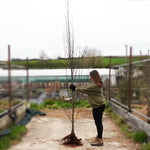
On average, standard trees are 2-3.5 metres tall when they arrive, but we cannot tell you precisely how tall your trees will be before we deliver them.
The Common Hornbeam linked above is the broad parkland tree to this one's column. For a line of trees along a boundary, browse our screening trees. For other natives, see our native trees, and if you are choosing between the two, compare our Beech trees. Dust bareroot roots with Rootgrow as you plant.
Ashridge has sold trees since 1949 and is a Which? Best Plant Supplier 2025. Your Hornbeam comes as a bareroot tree, lifted to order while dormant and guaranteed for 12 months. Plant it between November and April, and it will establish readily.
18 to 20 metres tall.
Not for ever. The crown is narrow when young, becoming compact and ovoid; allow for an egg-shaped tree more than 8 metres across at maturity.
Hornbeam where Beech fails: on wet, heavy or shaded ground. It grows in every soil type and every pH, in sun or partial shade.
No, it is deciduous. It is the clipped Hornbeam hedge that holds its brown leaves through winter, as a Beech hedge does.
Yes, since 1993. It is the upright form that holds the award, and not the Common Hornbeam.
Yes. It is rated H7, its hardiest band, and suits exposed or sheltered sites. We recommend it for frost pockets and windy ground.
Bareroot only, from November to April, while the trees are dormant. You can order at any time of year and your tree is lifted and sent once the season opens.




 Sign In
 Saved items