Sold as:

from £6.99



Sold as:
from £19.99
 5 Star Service Rating




 Secure, One-Tap Checkout
 5 Star Feefo Rating
 Hand Picked, Delivered to Your Door!
 1 Year Bareroot Guarantee
 Platinum Trusted Service Award 2026
 Mail Order Plant Experts - Est. 1949
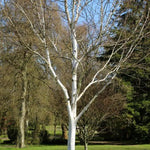

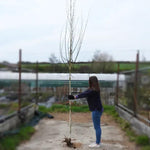
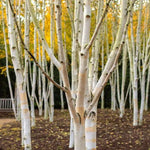
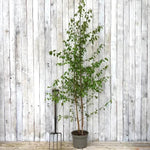







Himalayan Birch, Betula utilis subsp. jacquemontii, is a vigorous deciduous tree to 18m with brilliant white bark on the trunk and larger branches, yellow autumn leaves and long catkins in early spring. You can have it as a single stem or as a pot-grown multi-stem.
Himalayan birch, Betula utilis Jacquemontii, is an elegant, medium-sized tree with beautiful white bark. Unlike a native birch tree, the almost pure white bark stays smooth and bright when it's mature.
In spring, the tree makes long catkins that provide early season pollen for bees. The autumn leaf colour is a pale, warm yellow that contrasts nicely with the white bark.
They can reach a height of about 18 metres, with a very upright habit.
We also grow the even more ornamental Snow Queen.
Browse our varieties of birch tree or our full range of ornamental trees.
Delivery season: Birches are delivered bareroot during late autumn and winter, approximately November-April inclusive. Pot-grown trees are delivered all year, whenever they are in stock.
Choosing a size: Small trees are cheaper, easier to handle and more forgiving of less than ideal aftercare, so they're best for a big planting project. If instant impact is your priority, or if you are only buying a few plants for use in a place where it's convenient to water them well in their first year, then you may as well use bigger ones. All our bareroot trees are measured by their height in centimetres above the ground (the roots aren't measured).
It'll grow on most soils, chalk included (though it stays smaller on shallow chalk), and it's well suited to urban sites. It'll tolerate light shade, but full sun is best.
Apart from removing the usual dead, damaged or crossing branches, it's best not to prune birches.
Himalayan, or Kashmir, birch's native range is centred on Nepal and the first trees were introduced to Britain in the 1880's. They are named for the French naturalist Victor Jacquemont (1801-1832), a guest of the Sikh Maharajah Ranjit Singh (1780-1839), who explored the Kashmir region in 1831, and died of cholera on the way back to Mumbai.
Birch is a pioneer species: it is fast-growing, relatively short-lived, and thrives on sunny, poorly fertile sites.
Standard trees are measured by their girth in centimetres 1 metre above ground level: their trunk's waist measurement. Unlike sapling trees and hedge plants, standards aren't measured by their height, which will vary quite a bit both between and within species.
So, a 6/8cm standard tree has a trunk with a circumference of 6-8cm and an 8/10 standard has a trunk 8-10cm around. This measurement makes no difference to the tree's final height.
On average, standard trees are 2-3.5 metres tall when they arrive, but we cannot tell you precisely how tall your trees will be before we deliver them.
Bark beside bark is the trick with a white birch. A Tibetan Cherry brings shining coppery-brown to set against it, and a Paper Birch peels to pale orange where this one stays white. For a garden that cannot take 18 metres, Trinity College is the same subspecies selected to stop at 8m. Round the foot, dogwood stems carry the colour through winter, and there is more of this sort of thing among our trees for ornamental interest.
Your birch comes from Ashridge Nurseries, growing since 1949 and holder of the Feefo Platinum Trusted Service Award. It is one of six forms of Himalayan Birch we sell, bareroot and pot-grown. Bareroot trees are guaranteed for 12 months, and so are pot-grown trees delivered leafless between November and March.
The bark at the base. Himalayan birch stays brilliant white down the trunk; silver birch turns black and rugged at the foot. Silver birch is the native, with drooping twig tips.
A birch with several trunks rising from the ground instead of one, so you get more white bark at eye level. Ours is pot-grown in a 10 litre pot, 200 to 250cm tall.
Fast for its first twelve to fifteen years, then it slows. That early pace is why a birch is the tree that makes a new garden look established.
A small one, yes, in time: this is an 18m tree. Trinity College is the same white-barked birch selected to stop at about 8m, and the one to plant where space is tight.
Light shade does no harm, and the RHS lists Himalayan birch for sun or partial shade. Plant it in full sun if you can, because sun gives the whitest bark.
Birches bleed from cuts made in late winter and spring, when the sap is rising. Prune only in late summer or autumn, and only to remove damaged or crossing branches.




 Sign In
 Saved items